
As the global memory semiconductor landscape rapidly shifts toward AI accelerators and High Bandwidth Memory (HBM), a significant underlying structural realignment is unfolding within the mature, legacy DRAM sector. At the center of this shift is CXMT (ChangXin Memory Technologies), a prominent force in China’s domestic semiconductor strategy.
With global industry leaders—Samsung Electronics, SK Hynix, and Micron Technology—reallocating strategic capital toward HBM and advanced DDR5 lines, CXMT has moved steadily to fill the resulting supply void in legacy memory markets. This report examines CXMT’s operational trajectory, technology capabilities, SWOT position, and the potential for Korean and U.S. leaders to sustain their structural technological advantages, alongside key risk management considerations for investors.
1. Origins and Background of CXMT
CXMT was established in 2016 through a joint venture between the Hefei municipal government in Anhui Province, China, and state-backed investment capital. Supported by national policy initiatives aimed at increasing domestic semiconductor self-sufficiency, the firm received substantial financial allocations from national investment funds.
During its early development, CXMT laid its technological foundation by acquiring IP assets and technical talent associated with former memory manufacturer Qimonda. Subsequently, the company accelerated its process node maturity by onboarding experienced engineering talent from Taiwan and South Korea.
2. Technological Capabilities and Product Roadmap
- Process Node Progression: Having stabilized production yields on 18nm (1X) and 16nm/15nm-class (1Y, 1Z) nodes, the company is actively pursuing yield optimization for its 1a (14nm-class) process node.
- Core Product Portfolio: Mass production focuses primarily on DDR4 and LPDDR4X for mobile, PC, home appliance, and automotive applications.
- Expanded Offerings: Early-stage production of LPDDR5 and server-grade DDR5 is underway. Concurrently, CXMT is exploring domestic HBM3 prototyping leveraging Through-Silicon Via (TSV) technology in coordination with domestic tech enterprises like Huawei.
3. Global Market Share Trajectory
Expanding from a modest market footprint of 1–2% in previous years, CXMT’s share of the global DRAM market has increased alongside significant manufacturing capacity expansions.
- Global Market Presence: Ranks among the top global DRAM suppliers, holding an estimated market share near 8–10%.
- Domestic Market Penetration: Supported by domestic procurement policies, CXMT’s market share in Chinese mobile and legacy server memory segments continues to expand.
4. Comprehensive SWOT Framework
| Category | Details |
|---|---|
| Strengths |
• Near-unlimited subsidies and tax incentives from the Chinese government • Stable demand base within the massive Chinese domestic market (smartphones, home appliances, legacy servers) • Unrivaled price competitiveness compared to the Big 3 (aggressive low-price strategy) |
| Weaknesses |
• Limitations in sub-10nm sub-micron processes due to inability to import EUV lithography equipment • Technology and yield gaps in cutting-edge HBM and DDR5 sectors • Risks of potential international Intellectual Property (IP) infringement lawsuits |
| Opportunities |
• Capturing the supply gap in DDR4/LPDDR4 caused by the Big 3’s (Samsung/SK/Micron) total shift toward HBM and DDR5 • Growing push by domestic tech giants (Huawei, Xiaomi, etc.) to establish localized independent semiconductor supply chains |
| Threats |
• Tightening export controls on semiconductor equipment to China by the U.S. Department of Commerce (BIS) • Possibility of aggressive pricing countermeasures and sudden reactivation of legacy lines by Big 3 competitors |
5. Ecosystem Dynamics and Strategic Partnerships
1) Market Positioning vs. Global Leaders
- Legacy Segments: CXMT’s volume additions present a potential supply-side pricing variable once short-term legacy memory imbalances normalize.
- Advanced Segments: In premium categories like HBM4 and advanced DDR5, established global suppliers maintain a structural technology moat estimated at several years.
2) Domestic Supply Chain Integration
- Equipment & Software: Collaborating with domestic equipment manufacturers such as NAURA and AMEC to gradually lower reliance on foreign tool suppliers.
- System Integration: Aligning with domestic design and foundry partners (e.g., HiSilicon, SMIC) to foster an integrated domestic hardware infrastructure.
6. Technology Moat Assessment: Can Leading Firms Maintain Their Edge?
“As memory advancement shifts from simple dimensional scaling toward 3D stacking and Heterogeneous Integration, the technological moats of established market leaders appear well-positioned to endure.”
- Advanced DRAM Process Scaling: While multi-patterning allows DUV tools to extend lithography limits, the exponential rise in manufacturing steps introduces cost and yield complexities. Established producers leveraging multi-generation EUV experience maintain structural cost advantages at the sub-12nm node level.
- HBM Architecture Evolution: The transition to 6th-generation HBM (HBM4) marks a structural shift: the base die will be fabricated using advanced foundry nodes (4nm/3nm class). Access barriers to cutting-edge logic nodes create an architectural hurdle for isolated memory producers, favoring integrated foundry-memory ecosystems.
- Next-Generation Interfaces (CXL & PIM): Future memory demands extend beyond density to interface efficiency. Pioneer investments in Computer Express Link (CXL) and Processing-in-Memory (PIM) position market leaders to capture high-value enterprise server demand.
| Technology Segment | CXMT Limitations (China) | Samsung / SK Hynix Capabilities | Gap Outlook |
|---|---|---|---|
| Advanced DRAM (1c/1d nm) | Extreme reliance on DUV multi-patterning due to lack of EUV → Production costs surge & yield stagnates | Mass production of 1c nm based on EUV proficiency → Secures superior cost competitiveness & power efficiency | Gap Maintained (3–4 years) |
| HBM4 / Custom HBM | Inability to produce base dies in-house due to lack of advanced foundry processes (Limited to domestic legacy HBM) | Advanced foundry alliances (TSMC partnership or Samsung’s internal foundry) & adoption of hybrid bonding | Gap Widening ⬆ |
| CXL & PIM Memory | Focused on legacy memory due to lack of proprietary IP and advanced controller technology | Preempting global CXL 2.0/3.0 standards & leading the commercialization of Processing-in-Memory (PIM) | New Market Creation ⬆ |
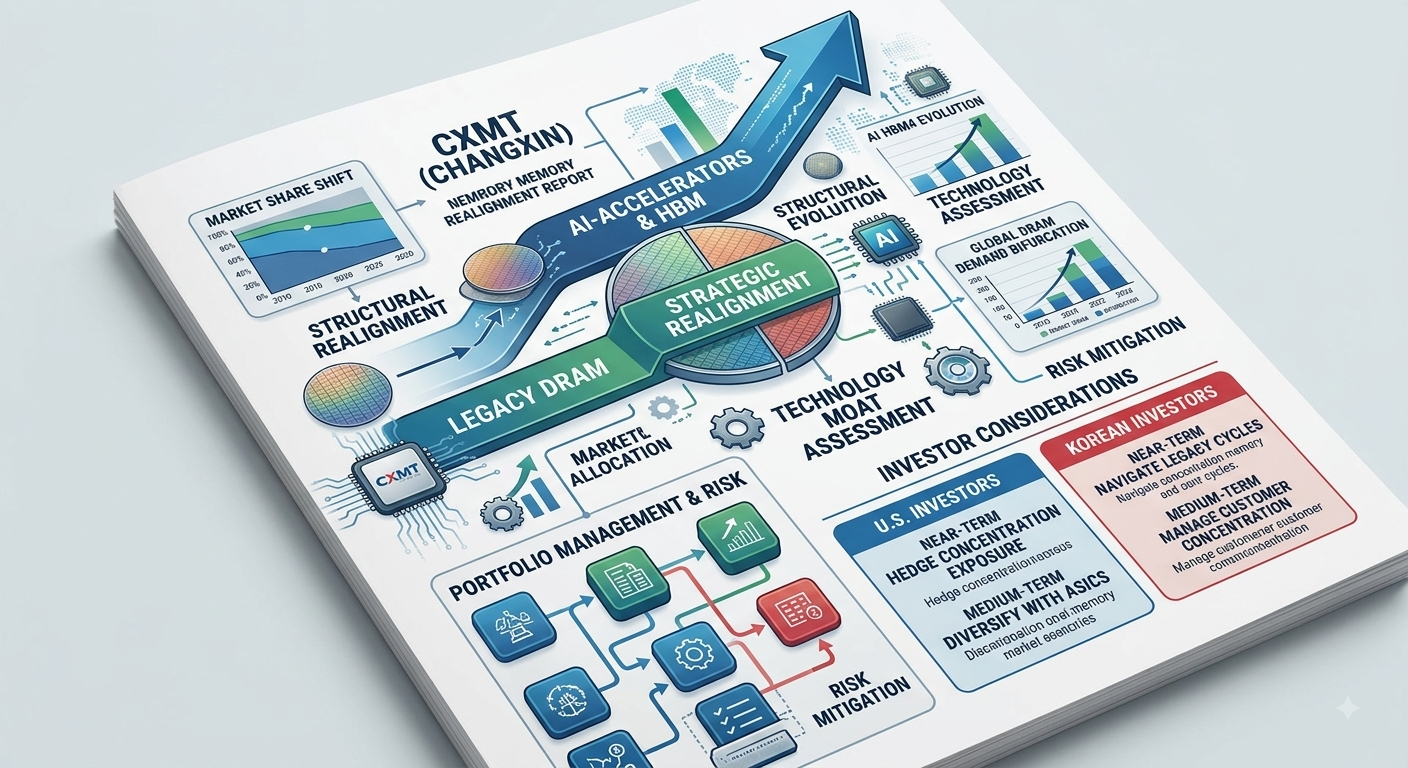
7. Portfolio Construction Considerations for Investors
7.1 US Investors: Managing Concentration Exposure in AI Hardware
- Near-Term Risk Management (1–1.5 Years):
- Evaluating Portfolio Concentration: High allocation to primary GPU and pure-play foundry leaders provides core exposure, but raises portfolio sensitivity to geopolitical developments. Incorporating non-hardware technology categories (e.g., enterprise AI software, cybersecurity) may help temper overall volatility.
- Assessing Equipment Demand Patterns: Semiconductor equipment sales driven by advance pull-ins ahead of potential regulatory shifts may normalize over time. Investors monitoring toolmakers with elevated regional exposure should evaluate long-term order visibility against potential policy adjustments.
- Medium-Term Outlook (1.5–3 Years):
- Custom ASIC Diversification: Hyperscale cloud providers developing in-house silicon present a nuanced market shift. Expanding research to fabless firms specializing in custom ASIC design (such as Broadcom or Marvell) offers a balanced approach to capturing evolving hardware architectures.
7.2 Korean Investors: Navigating Legacy Cycles and Customer Concentration
- Near-Term Risk Management (1–1.5 Years):
- Monitoring Commoditized DRAM Pricing: Temporary tightness in legacy DRAM markets may adjust as domestic Chinese capacity ramps up. Portfolios heavily tilted toward suppliers focused exclusively on legacy process nodes should remain mindful of potential margin compression.
- Customer Diversification Metrics: While close integration with primary GPU vendors offers near-term earnings clarity, monitoring expansion into broader customer bases (such as alternative accelerator vendors and cloud hyperscalers) provides insight into long-term demand stability.
- Medium-Term Outlook (1.5–3 Years):
- Turnkey Execution Oversight: Integrated manufacturing models covering memory, foundry, and packaging offer compelling structural advantages, provided advanced node yields remain competitive. Staggered positioning based on yield milestones can help mitigate execution risks.
- Supply Chain Geographic Rebalancing: Suppliers actively diversifying their revenue profiles toward North American and European markets present reduced sensitivity to potential trade restrictions compared to legacy-dependent peers.
Conclusion: Key Takeaways
- Recognizing Structural Market Bifurcation: The semiconductor market is increasingly splitting into two distinct realms: commoditized legacy supply subject to expanding capacity from emerging players, and high-margin AI memory governed by complex packaging and advanced lithography.
- Focusing on Technology Moats: Investors navigating the long-term AI infrastructure expansion should focus on structural moats—such as HBM4 foundry integration, advanced hybrid bonding, and CXL standard leadership—rather than relying on temporary supply-demand imbalances in legacy components.
※ This post is provided strictly for informational purposes and does not constitute a recommendation or solicitation to buy or sell any specific financial instruments or securities. The analysis and opinions expressed herein are based on information available at the time of writing, but no guarantee is made regarding their accuracy, completeness, or timeliness. All investment decisions and risk exposures are solely the responsibility of the individual investor.
※ Some images and technical descriptions in this post were created in collaboration with Google Gemini AI, and were finalized after direct creation, review, revision, and editing by the author.