
Recent market sentiment surrounding Coupang (NYSE: CPNG) has swung wildly between extreme optimism and intense fear. While investors celebrated quarters of solid operating profits, news of a massive 600 billion KRW (approximately $410 million) regulatory penalty and a sudden shift into a net loss triggered classic emotional reactions—FOMO (Fear Of Missing Out) and FOOP (Fear Of Other People’s success or impending collapse).
However, looking at Coupang through the lens of Warren Buffett—who has navigated economic bubbles and market crashes for decades—the true value of a company does not lie in short-term noise or erratic stock charts.
Here is a comprehensive 2026 value investing analysis of Coupang’s fundamentals, its Korean core business, Taiwan expansion, regulatory hurdles, consumer sentiment, and long-term moat.
1. Reason for Being: Viewing the Market as a Business Owner
Most retail traders view stock certificates as pieces of paper to flip for a quick profit tomorrow. In contrast, Warren Buffett evaluates a stock as fractional ownership in a real-world enterprise.
Instead of reacting to daily headlines, a value investor asks: “If I bought this entire company and the stock market closed for ten years, would Korean and Taiwanese consumers still rely on Rocket Delivery every day to generate consistent cash flow?”
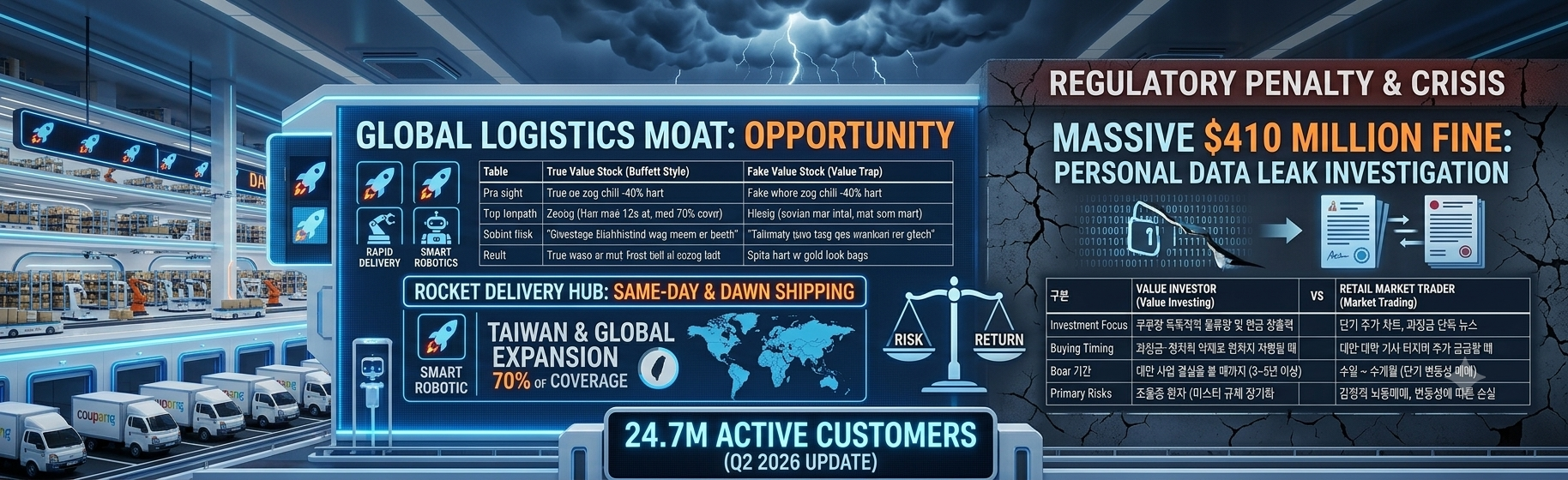
In Q2 2026, Coupang generated $8.9 billion (approx. 12.2 trillion KRW) in revenue, representing an 8% year-over-year growth, while active customers rebounded to 24.7 million. While market prices fluctuate due to one-time administrative costs, intrinsic business value eventually asserts itself over time.
2. Word Anatomy: The 3 Pillars of Coupang’s Value Thesis
① Intrinsic Value & Margin of Safety
In June 2026, Coupang absorbed a one-time administrative fine of roughly $410 million (approx. 624.7 billion KRW) regarding personal data protection regulations, leading to a Q2 net operating loss of $556 million. However, excluding non-recurring items, core product commerce spend per active customer grew 16% year-over-year. When short-term fear depresses the share price well below the company’s long-term earning power, a “margin of safety” is established.
② Compounding Engine & High Return on Equity (ROE)
Buffett prefers businesses that reinvest retained earnings at high rates of return. Coupang takes cash generated from its mature Korean operations and reinvests it into Taiwan (approx. $1.07 billion or 1.465 trillion KRW). Opening its 4th fulfillment center in Taoyuan helped push Rocket Delivery coverage to 70% in major Taiwanese cities, building a powerful second growth engine.
③ Cash Reserves & Patience
Developing Offerings (including Taiwan logistics) run an annual planned operating loss of $950 million to $1 billion. This is not structural burn; it is intentional capital expenditure (CapEx) to capture market dominance. Investors must maintain patience until these investments mature.
3. Investment Analogies: The Baseball Batter vs. The Farmer
- Coupang as “Baseball Without Called Strikes”: In investing, you don’t get called out for watching pitches pass by. You can ignore endless headlines about tax audits, antitrust reviews, or quarterly dips. You simply wait for the “fat pitch”—when panic depresses the stock price to an undeniably cheap level—and swing.
- Coupang as “Farming Through a Drought”: Value investing is like farming. You don’t dig up seeds every morning to see if they are growing. You endure temporary droughts (regulatory fines) and give the seeds planted in Taiwan time, sunshine, and compound interest to yield a harvest.
4. Practical Real-World Comparisons
- Coca-Cola’s Cash Flow vs. Coupang’s WOW Membership: Just as Coca-Cola provides steady dividend cash flow, Coupang possesses an unbeatable recurring revenue engine through its WOW membership ecosystem. Bundling food delivery (Coupang Eats), streaming (Coupang Play), and overnight shipping makes the service indispensable to Korean consumers.
- 1987 Market Crash Opportunism vs. 2026 Regulatory Fears: Value investors look for moments when great businesses suffer temporary, fixable wounds. Regulatory fines and tax adjustments create the exact type of temporary hysteria that allowed legendary investors to acquire world-class franchises at bargain prices.
5. Key Warning: Avoiding the “Value Trap” Illusion
Falling stock prices do not automatically create a margin of safety. If underlying fundamentals deteriorate, a cheap stock is simply a trap.
| Category | True Value Stock (Buffett Style) | Fake Value Stock (Value Trap) | Remarks |
|---|---|---|---|
| Stock Status | Down 40% from peak due to temporary negative news | Down 40% from peak due to deteriorating earnings | Superficial decline is identical |
| Intrinsic Value | Robust (Korea revenue holds at 12T KRW, Taiwan 70% coverage) | Impaired (Mass customer churn, revenue slashed) | Valuation analysis required |
| Consumer Sentiment | “Concerned about data leaks, but can’t quit due to fast delivery” | “Plenty of alternatives, deleting the app immediately” | Lock-in effect status |
| Outcome | Breaks previous high once negative issues clear & Taiwan turns profitable | Further decline and permanent loss of capital | Risk of ‘Value Trap’ |
6. Side-by-Side Comparison: Value Investor vs. Momentum Trader
| Category | Buffett-Style Value Investor (Value Investing) | Retail Market Trader (Market Trading) |
|---|---|---|
| Investment Focus | Coupang’s monopolistic logistics network & cash flow generation | Short-term stock charts, isolated regulatory fine headlines |
| Buying Timing | When significantly undervalued due to fines & political headwinds | When buying during stock surges triggered by Taiwan success news |
| Holding Horizon | Until Taiwan expansion bears fruit (3–5+ years) | Days to months (Short-term volatility trading) |
| Market Perspective | Capitalizing on ‘Mr. Market’s’ depressive mood swings | Panic selling driven by fear over single news headlines |
| Primary Risks | Failure in Taiwan expansion, prolonged domestic regulations | Emotional impulsive trading, capital loss due to market volatility |
7. Recent Financial Results: Korea & Taiwan (Q2 2026 Update)
- Q2 2026 Earnings Breakdown: Revenue reached $8.9 billion (up 8% YoY). Net operating loss stood at $556 million due to reserving ~$410 million for Korean regulatory fines. Active customers rose to 24.7 million, proving core demand remains fully intact.
- Taiwan Expansion Milestones: The Taoyuan 4th Smart Fulfillment Center expanded coverage to 70% of major cities. Over 10,000 Korean small businesses utilize Coupang Taiwan as an export channel, generating 30–100% annual growth in cross-border sales. Fortune 500 ranking jumped 10 spots to #132 in 2026.
- Outlook Summary: Despite one-time administrative expenses in Korea, active customer growth and Taiwanese market capture are accelerating. Reaching profitability in Taiwan (expected around 2027–2028) remains the key inflection point for enterprise valuation.
8. Practical Guide for Retail Investors
- Capitalize on “Mr. Market’s” Mood Swings: When short-term traders dump shares over regulatory headlines, evaluate whether the underlying moat is damaged. If active users remain loyal, treat extreme fear as a buying opportunity.
- Consider Passive Indexing: If analyzing single-stock regulatory risks and international expansion CapEx is too complex, low-cost S&P 500 index funds allow you to capture compound market growth effortlessly.
- Maintain Cash Reserves: Keep 10–20% of your portfolio in cash or short-term treasuries so you have liquidity when high-quality franchises experience sudden price drops.
Conclusion: Key Takeaways
- Core Moat Remains Intact: Despite a $410M regulatory penalty pushing Q2 2026 into an operational loss, customer metrics (24.7M active users) and revenue ($8.9B) continue to expand.
- Taiwan Is the Growth Engine: CapEx spend in Taiwan mirrors Coupang’s early Korean logistics buildup, setting the stage for long-term compound growth once fulfillment automation matures.
- Patience Over Panic: Value investing requires distinguishing between temporary administrative fines and permanent business decay. Long-term valuation hinges on Taiwan’s breakeven timeline and sustained user lock-in.
⚠️ Investment Disclaimer The stock analysis and related materials provided on this blog are intended solely as supplementary reference for investment evaluation. This content does not, under any circumstances, constitute a recommendation or solicitation to buy or sell any security. All final investment decisions, as well as any resulting profits or losses, rest entirely with the individual investor. This blog does not guarantee the accuracy or completeness of the information provided and assumes no legal liability for any investment outcomes.
※ Images and specific descriptive content in this post were created in collaboration with Google Gemini AI, with all core ideas, reviews, revisions, and final edits completed by the author.