
While financial textbooks present Net Present Value (NPV) and Internal Rate of Return (IRR) as precise tools for decision-making, the reality of the business world is far more complex. Theoretical models often struggle to account for the unpredictable variables that define real-world projects. In this article, we examine six practical challenges in capital budgeting, contrasting theoretical approaches with the pragmatic strategies required for actual success.
1. The Real-World Obstacles to Investment Evaluation
Investment decisions are rarely as clean as a spreadsheet formula. Managers must account for external factors that can distort financial data.
- Income Tax: Just as your “take-home pay” differs from your gross salary due to taxes, a project’s true value is determined by its After-tax Cash Flow.
- Unequal Lives: Comparing a project that lasts 10 years to one that lasts 3 years is like comparing a steady salary to a high-paying short-term gig; you must normalize the period for a fair assessment.
- Lease vs. Buy: This is a classic “rent versus mortgage” dilemma. The choice involves balancing the benefits of full ownership against the risk reduction and liquidity provided by leasing.
- Uncertainty: Think of an umbrella vendor trying to predict rainfall. Without knowing the exact weather, they must plan inventory levels based on probability scenarios.
- Price Levels (Inflation): If your bank interest rate is 5% but inflation is 6%, you are effectively losing purchasing power. Future cash flows must be adjusted to reflect real inflation.
- Qualitative Factors: Even if the numbers look perfect, you cannot ignore “soft” factors like brand reputation or corporate ethics—similar to avoiding a great-looking used car with a history of accidents.
2. Theoretical Solutions vs. Practical Management
| Challenge | Theoretical Approach | Practical Reality & Management Strategy |
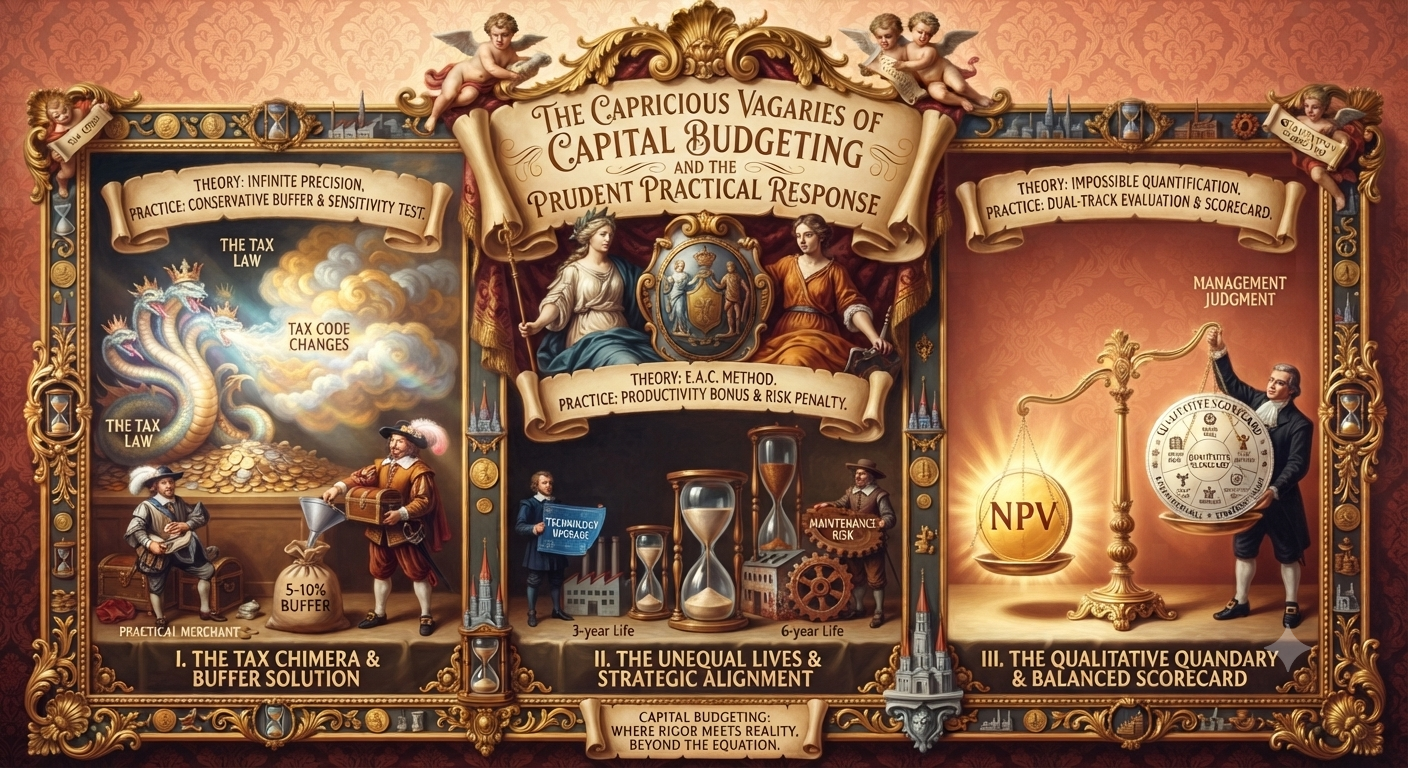
| Income Tax | Calculate the “Tax Shield” from depreciation and model after-tax cash flows. | Tax laws change constantly. Use conservative basic models and subtract 5–10% as a “buffer” to account for regulatory risk. |
| Unequal Lives | Use the Equivalent Annual Cost (EAC) method to normalize project durations. | Technology changes rapidly; assume that a 3-year project will be replaced by superior technology rather than an identical machine. |
| Lease vs. Buy | Use the Net Advantage to Leasing (NAL) formula to minimize costs. | Compare NAL, but prioritize “Asset-light” strategies if market conditions are volatile, even if buying is slightly cheaper. |
| Uncertainty | Use Risk-Adjusted Discount Rates (RADR) and probability weighting. | Humans cannot predict exact odds. Conduct stress tests and sensitivity analyses to ensure survival in a worst-case scenario. |
| Price Levels | Use the Fisher Effect to match nominal flows with nominal discount rates. | Product prices don’t always track inflation. Focus on specific raw material cost trends relevant to your industry. |
| Qualitative Factors | Attempt to quantify “intangibles” into a dollar value. | Maintain a separation between quantitative NPV reports and qualitative Balanced Scorecards. |
3. CEO Insights: Moving Beyond the Formula
Theoretical formulas should serve as the starting point, not the final destination. A high-quality financial report is not one that is mathematically flawless, but one that demonstrates a rigorous analysis of the “real-world” risks that equations often fail to capture.
Do not become so obsessed with the precision of the numbers that you lose sight of overall corporate liquidity and long-term strategy. The best leaders use theoretical formulas to define the “floor” for acceptable risk while using pragmatic, strategic judgment to open the “ceiling” for growth.
Strategic Framework for Decision-Making:
- Use NPV as a Baseline: Use quantitative metrics to filter out projects that fail to meet the company’s minimum return hurdles.
- Apply Strategic Overlays: Once a project passes the “math test,” apply a qualitative scorecard. Consider how the project impacts brand loyalty, technical superiority, and ESG commitments.
- Stress Test Everything: Always ask, “What happens if this forecast is wrong?” If a project cannot withstand a 10% deviation in revenue, it is likely too fragile for an uncertain market.
Conclusion: Key Takeaways
- Numbers are Just the Beginning: Financial models provide a baseline, but seasoned executives supplement these with deep qualitative analysis.
- Buffer for Volatility: Because tax laws and market conditions are fluid, always apply a conservative margin of error to your cash flow projections.
- Prioritize Strategy over Precision: A mathematically superior project that damages your brand reputation is a bad investment. Use a Balanced Scorecard to align finances with corporate vision.
- Flexibility is Value: In an uncertain market, the ability to pivot—such as leasing instead of buying, or staging investments—is often more valuable than a high, fixed NPV.
*This post was created in collaboration with Google Gemini AI. The author independently created, reviewed, and edited the content to ensure professional quality.