
In the not-so-distant past, software development was akin to a medieval fortress with high, formidable walls. It was a secluded realm accessible only to a select guild of experts who spoke complex mathematical dialects. For decades, the barrier to entry was immense: creating even a basic functional result required painstaking mastery of syntax, writing tens of thousands of lines of code, and enduring sleepless nights spent debugging a single misplaced semicolon.
Thankfully, that era is rapidly fading. We are witnessing the dawn of a new age, powered by No-Code and Low-Code platforms. Complex, rigid grammar is being replaced by intuitive drag-and-drop interfaces and visual guides that allow almost anyone to translate imagination into reality instantly. The industry is shifting from the solitary labor of a master craftsman meticulously carving and laying individual bricks to a modern era of “digital architecture,” focusing on designing and deploying massive systems efficiently through pre-built modules.
1. The Paradigm Shift: From Mastering Syntax to Strategic Structural Design
If traditional developers of the past were “faithful scribes” adaptive at transcribing strict grammatical rules—the computer’s syntax—modern No-Code and Low-Code users are “strategic planners” designing the essential flows of a business.
- No-Code: This approach allows users to build functional applications or websites visually, using drag-and-drop components, without writing a single line of traditional code. Instead of spending months learning a programming “language,” users focus on mastering the “tool” to rapidly instantiate business ideas.
- Low-Code: This methodology utilizes visual platforms to automate complex, repetitive tasks, handing the heavy lifting to the tool. It applies minimal, targeted manual coding only for core business logic or specialized functionality that requires precise customization.
The epicenter of development is shifting from the technical hurdle of “How to implement it” to the essential business intent of “What to create.”
2. Relatable Metaphors for the Modern Era
To truly grasp this shift, let’s look at how No-Code/Low-Code compares to traditional development using analogies relevant to modern North American daily life.
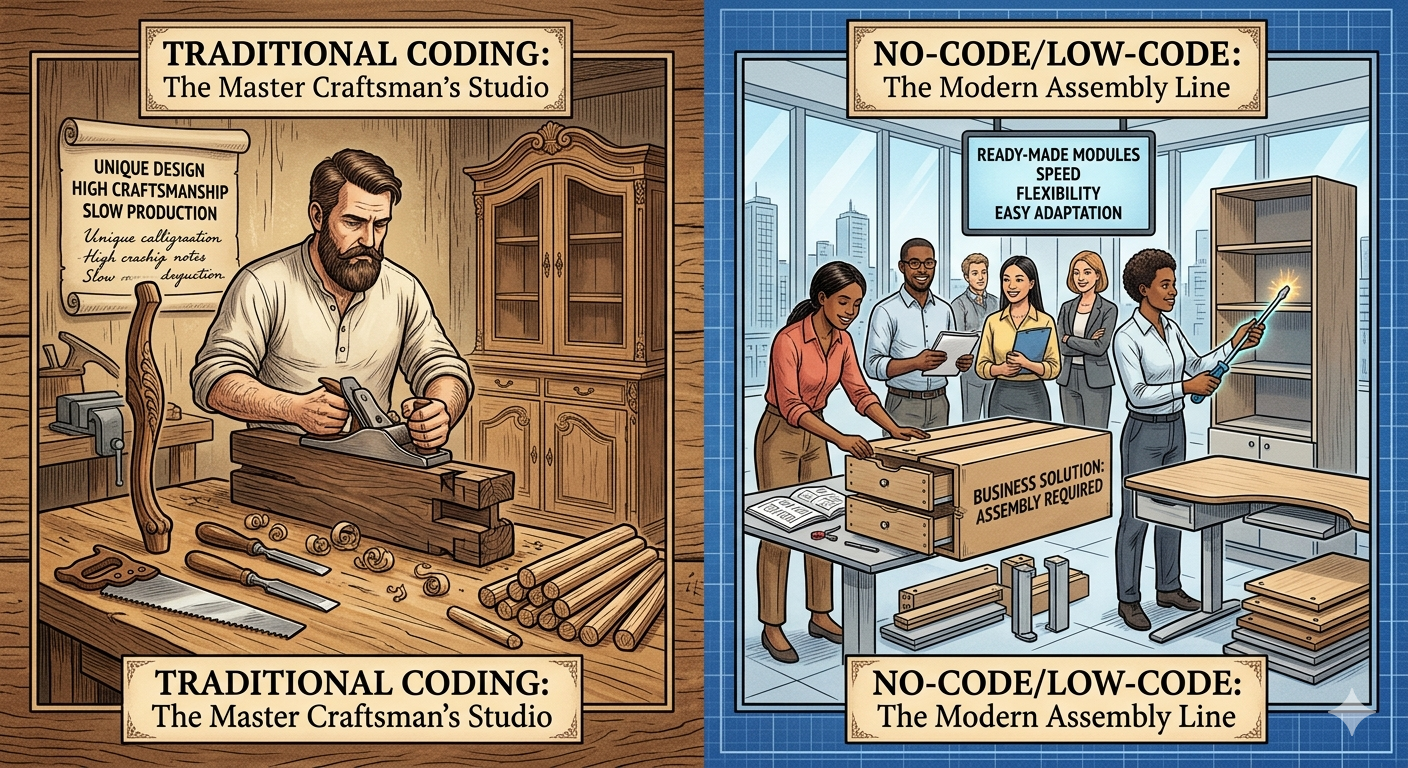
1) Traditional Coding = ‘Custom Handmade Furniture’
- The Approach: You chop down the tree, season the wood, trim it, sculpt every joint, and manually craft every nail to create a specific piece of furniture from scratch.
- The Characteristics: This process produces a highly sophisticated, bespoke masterpiece tailored exactly to specialized needs. However, it requires exceptionally long production times and a very high level of specialized mastery.
2) No-Code/Low-Code = ‘Assembling IKEA Furniture’
- The Approach: You select high-quality, pre-manufactured modules (drawers, legs, tabletops) that fit your general needs and assemble them according to your specific taste. If necessary, in a Low-Code scenario, you might manually replace a standard generic screw with a more heavy-duty one for added strength.
- The Characteristics: Non-experts can rapidly achieve stylish, functional results. This enables businesses to respond immediately to changing market environments without waiting for a master craftsman.
3. How No-Code and Low-Code are Revolutionizing the Digital Landscape
Recent explosive advancements in Artificial Intelligence (AI) and cloud technology have made these visual tools exponentially more powerful.
- Visual Abstraction: Users no longer need to understand complex database normalization or server architecture. A few intuitive mouse clicks can now connect complex data flows visually.
- AI Integration: Many No-Code tools now feature AI assistants. Simply prompting, “Create a member registration form,” causes the No-Code tool to instantly generate the appropriate layout, data fields, and underlying database structure. This is essentially integrating the core ethos of “Vibe Coding”—where intent drives creation—directly into No-Code platforms.
- Maximizing Productivity: This empowers domains experts, planners, and entrepreneurs in startups and enterprises facing shortages of professional developers to immediately launch and test ideas in the market via Minimum Viable Products (MVPs).
4. Successful Adoption: An Architect’s Mindset
While the tools have become easier to use, this does not mean the resulting product is trivial. Shaper tools demand higher skill levels from the handler.
1) Pitfalls to Avoid
- Scalability Limits: Since No-Code operates within predefined visual frameworks, you may hit a structural wall when attempting to implement highly specific, unparalleled, or massively scalable functionalities.
- Security and Governance: Because almost anyone can create applications, it can lead to unmanaged, unverified software within an organization, a significant risk known as “Shadow IT.” Utilizing unverified tools without IT oversight carries inherent security and compliance risks.
2) Mastering the Art of Utilization
- Process Concreteization: Before grabbing the digital tool, draw the service workflow (Flow) on paper first. The clearer the underlying business logic, the more powerful the No-Code tool becomes.
- Integration Capability: Modern agility requires the ability to connect various best-in-class No-Code tools (such as utilizing Zapier to connect Airtable with Slack) rather than obsessing over a single, all-encompassing tool.
3) The Human Role: “Tools are Just Assistance; Humans Make Decisions”
- Digital Literacy: Even without writing code, it is essential to understand how data flows, how databases interconnect, and how systems integrate.
- Problem-Solver Spirit: Define yourself not merely as a “user” of software, but as a “solution architect.” AI and No-Code tools are faithful assistants that help bring your vision to life, but you must own the vision.
5. At a Glance: Side-by-Side Comparison
6. The Evolution of Coding: Differentiation from ‘Vibe Coding’
No-Code and Low-Code have successfully abstracted complex computer code into ‘visual blocks’ (modules). However, humans still had to manually design the logical flow, determining that “Block A must connect to Block B.”
Vibe Coding represents the next evolutionary step. With the advent of powerful AI “interpreters” (such as Gemini, Antigravity, etc.), we are moving to a stage where AI automatically handles even the logical connections. Therefore, it is accurate to understand that Vibe Coding is a flower that bloomed upon the foundation of ‘abstraction’ paved by No-Code/Low-Code.
- No-Code/Low-Code: You must choose from the “menu” provided by the tool. It is difficult to go beyond the fixed framework.
- Vibe Coding: Even for dishes not on the menu, if you describe your “feeling” (the vibe) well, the AI creates a new recipe and cooks it. Antigravity captures the overall context of the code while Gemini generates the specific lines of code.
Conclusion: Key Takeaways
The rise of No-Code and Low-Code platforms represents a profound shift toward the democratization of software creation. By removing the technical barriers of manual coding, these tools empower line-of-business experts, planners, and entrepreneurs in North America to become “digital architects.” The value of a modern professional is shifting from their ability to write syntax to their ability to design effective business logic and structural flows. Furthermore, No-Code/Low-Code paved the way for the emerging era of Vibe Coding, acting as the necessary layer of abstraction that allows AI to effectively translate human intent into functional software. As tools become sharper through AI integration, the irreplaceble human role is that of the strategic decision-maker.
※ Images and some descriptions in this posting were produced in collaboration with Google Gemini AI, and the author personally created, reviewed, revised, and edited the content for final completion.