
In the past, computer memory was like a simple desk drawer: you opened it to store information and opened it again to take it out. However, in the era of Artificial Intelligence (AI), memory is evolving into a high-speed material supply system, akin to one that allows thousands of chefs to cook simultaneously in a massive kitchen.
For AI to perform complex calculations effortlessly, a powerful brain—the Graphics Processing Unit (GPU)—is crucial. Yet, it is equally essential to have High Bandwidth Memory (HBM) to deliver data to that brain at incredibly high speeds. Think of it this way: no matter how powerful a supercar’s engine is, it cannot run if fuel is not supplied in a timely manner. Today, I will explain the difference between the DRAM we use daily and HBM, the protagonist leading the AI era, in a way that even an elementary school student can understand!
1. The Speed Revolution: Widening the Data Road
What we commonly call “memory” is a temporary workspace where a computer places the materials it needs to do its job. As of 2026, the amount of data AI needs to study at once has become enormous. To handle this, memory technology has transformed into a completely new form.
Why isn’t conventional DRAM enough anymore? Standard DRAM is like a regular local road with a limited number of lanes for sending and receiving data. In contrast, HBM is like a high-speed elevated highway with thousands of lanes, created by stacking many DRAM chips vertically, like a high-rise apartment complex.
To use a sports analogy, standard DRAM is like a practice partner who throws you one soccer ball at a time. HBM, on the other hand, is like a fantastic assistant who sprays thousands of balls at the same time, allowing the AI forward to score goals without a moment’s rest.
2. Understanding through Everyday Analogies
1) Unpacking the Terms: DRAM vs. HBM
- DRAM (Dynamic Random Access Memory):
- Dynamic: This means it needs a constant supply of electricity to keep moving so the data doesn’t disappear.
- Random Access: This means it can immediately find desired information no matter where it is located.
- Memory: A device that remembers information.
- Overall Meaning: It is the fast and smart “basic memory device” most commonly used in our computers and smartphones.
- HBM (High Bandwidth Memory):
- High: Meaning very high and numerous.
- Bandwidth: Refers to the “width of the road” through which data passes.
- Memory: A device that remembers information.
- Overall Meaning: It is a “ultra-high-speed data dedicated highway memory” that enormously widens the data pathway by stacking multiple DRAMs vertically.
2) DRAM = ‘A Wide, One-Story Single-Family Home’
- The Approach: It is built wide on the ground, so you move horizontally to find things.
- The Characteristics: It is easy to make and stable, but the door (pathway) is too narrow for many people to enter at once. It is perfect for our daily laptops and smartphones.
3) HBM = ‘A State-of-the-Art High-Rise Apartment’
- The Approach: One-story houses are stacked high up, and thousands of elevators (pathways) are installed in every house.
- The Characteristics: It can hold an enormous amount of data in a small area, and above all, the speed at which data comes and goes is overwhelmingly fast. It is essential for the huge servers that train AI.
3. Why is HBM So Fast?
The secret to HBM becoming an essential item in the AI era lies in “stacking” and “drilling holes” technologies.
- Vertical Stacking Technology: In the past, memory chips were laid out horizontally. However, HBM stacks them upward, like an apartment building. As a result, the distance for exchanging information has become very short.
- TSV (Through-Silicon Via): Thousands of microscopic holes were drilled through the stacked memory chips to connect them vertically. While conventional DRAM communicated through a single narrow “corridor,” HBM installs numerous “dedicated elevators” on each floor to carry an enormous amount of data all at once.
4. Why is HBM the Talk of the Town Right Now?
As Artificial Intelligence (AI) gets smarter, it needs to consume more data, faster.
- Solving the Bottleneck: No matter how fast the smart brain (GPU) is, if the memory gives data slowly, the computer hesitates. HBM solves this “hesitation phenomenon.”
- Power Efficiency: Because data doesn’t need to be sent far and is delivered directly vertically, HBM can do more work while using less electricity. This is crucial for massive data centers where power costs and heat management are major concerns.
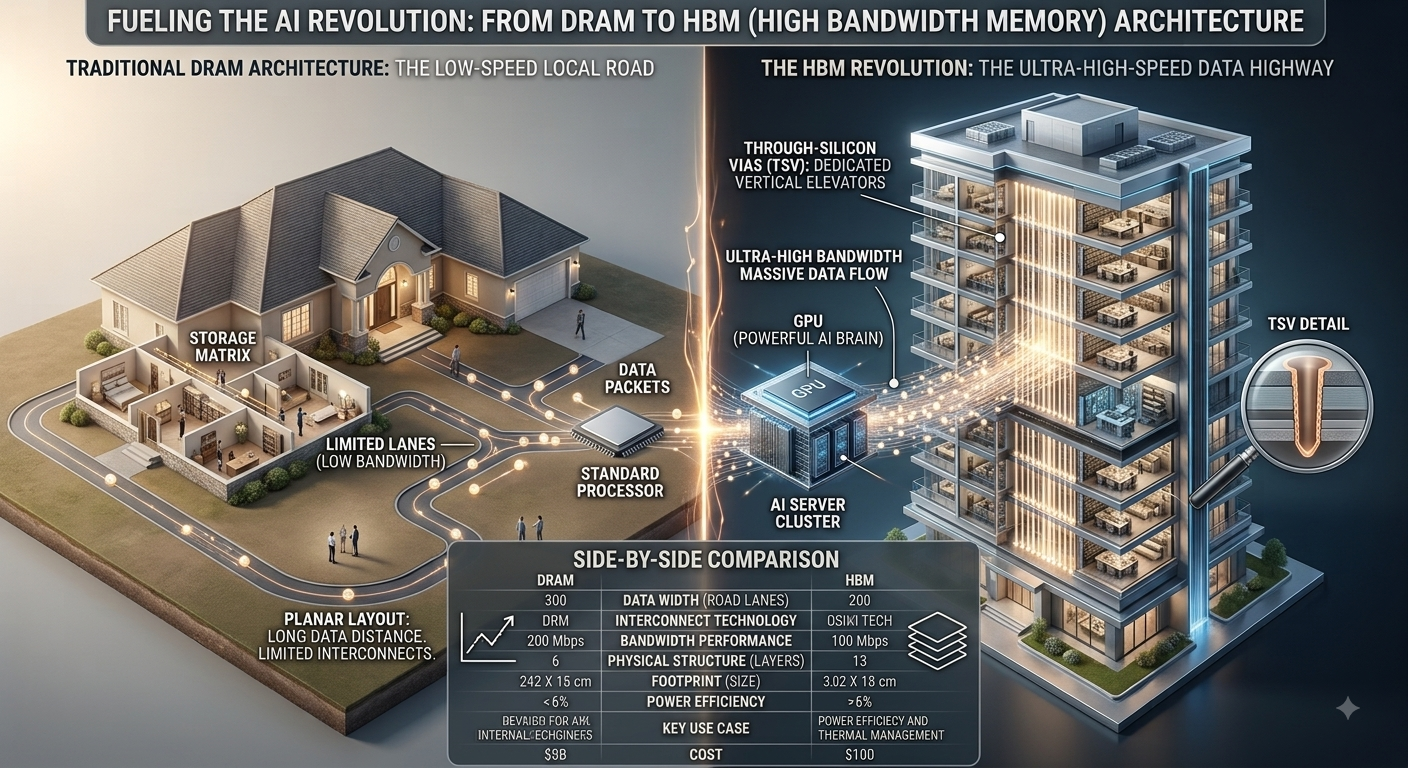
5. At a Glance! Side-by-Side Comparison
| Category | DRAM (Standard Memory) | HBM (High Bandwidth Memory) |
| Core Structure | Horizontal, side-by-side planar structure | Vertically stacked structure |
| Analogy | ‘1-lane road’ for data traffic | ’16-lane highway’ for data traffic |
| Key Advantages | Low cost and highly versatile | Overwhelmingly fast data transfer speed |
| Applications | Smartphones, Standard PCs, Laptops | AI Servers, Supercomputers, Graphics Cards |
6. The ‘Semiconductor Giants’ Shaping the AI Landscape (+ TSMC’s Special Role)
Let’s look at the companies that make this incredible technology a reality. It’s crucial for North American investors and tech enthusiasts to distinguish between the companies that “manufacture the memory” and the company that “connects and assembles” the final system.
1) Memory Manufacturers (The Ingredient Producers)
Currently, South Korean companies dominate this specific market!
- SK hynix: Considered the current leader in the HBM market. They have made significant waves by being the first to supply advanced HBM models to NVIDIA, the global leader in AI computing.
- Samsung Electronics: The number one player in the overall memory market. Samsung is utilizing its overwhelming production capacity and technology to lead the race for next-generation HBM solutions.
- Micron: America’s flagship memory manufacturer. Based in Idaho, Micron has recently introduced very high-performance HBM models and is aggressively chasing its Korean rivals.
2) TSMC (Special Appearance: The Master Assembler)
“Isn’t Taiwan’s TSMC also a semiconductor company?” Yes, absolutely. However, TSMC plays a distinct and crucial role as the final ‘integrator’ rather than a memory manufacturer.
- Their Role: TSMC doesn’t make memory. Instead, they act as the foundry that integrates the smart brains (GPUs) designed by companies like NVIDIA with the high-performance memory (HBM) produced in Korea or America. They fuse them together into a single, cohesive unit—the “final AI chip package”—using advanced packaging technologies (like CoWoS).
- Analogy: If Samsung and SK hynix are producing the finest A5 wagyu beef (HBM), TSMC is the world’s top Michelin-starred chef (Foundry) who takes that beef and transforms it into the perfect, final steak dinner (the complete AI semiconductor solution). You can’t have the final, cohesive AI accelerator without TSMC’s advanced integration.
Conclusion: Key Takeaways
As Artificial Intelligence becomes more integrated into our economy and daily lives, understanding the underlying hardware becomes essential. The old desk drawer of computer memory is gone, replaced by HBM, the ultra-fast fuel system essential for AI’s powerful engines. Standard DRAM remains vital for our everyday devices, but for the heavy lifting of AI training and inference, HBM is irreplaceable. As the AI revolution continues, keep an eye on these critical semiconductor players—SK hynix, Samsung, Micron, and TSMC—as they hold the keys to the compute power defining our digital future.
※ Images and some descriptions in this posting were produced in collaboration with Google Gemini AI, and the author personally created, reviewed, revised, and edited the content for final completion.