
Standard investing relies on asset appreciation to generate returns: when share prices go up, investors profit. Inverse Exchange-Traded Funds (ETFs), however, offer a structural alternative. They allow market participants to generate positive returns when stock indices decline, serving as both downside protection and tactical trading instruments.
When holding long equity positions, investors can utilize inverse ETFs as financial insurance to hedge against sharp portfolio drawdowns without selling underlying assets. Alternatively, active traders use these instruments to capture short-term momentum during confirmed bear markets or market corrections. However, improper use of these products—particularly leveraged inverse funds—can lead to rapid capital erosion even when overall market trends align with investor expectations.
What Does “Inverse” Really Mean?
To understand these instruments, two core concepts must be examined:
- Inverse Relationship: These funds move inversely relative to their underlying benchmark. If an index drops, the fund value increases.
- Daily Return Reset: Inverse ETFs do not track long-term cumulative index performance. Instead, they are engineered to replicate −1×, −2×, or −3× the single-day percentage change of their target benchmark.
Combining these elements, an inverse ETF is an engineered investment vehicle designed to deliver the exact opposite percentage return of an index on a daily rebalanced basis.
Visualizing the Mechanics: Standard Vehicle vs. Reverse-Only Machine
To grasp how inverse funds function, consider a comparison between traditional and inverse investment structures.
A standard 1× index fund operates like a standard automobile moving forward. When the highway ascends (a bull market), the vehicle advances smoothly. When the road flattens or dips, progress slows or reverses slightly.
An inverse ETF operates like a vehicle modified specifically to run in reverse. When the road descends rapidly downhill (a market crash), it gains speed effectively in the opposite direction. However, if the road shifts upward into a long incline (a sustained bull market), forcing the machine to move forward damages its transmission, resulting in rapid mechanical breakdown—or in financial terms, severe capital loss.
Common Examples of Inverse ETFs
- Standard 1x Inverse Funds: Engineered to deliver −1× the daily performance of broad market benchmarks (such as major domestic stock indices). If the benchmark falls by 1.5% in a single session, a standard inverse fund rises by approximately +1.5%.
- 2x Leveraged Inverse Funds: Designed to replicate −2× the daily move of an index or futures contract. A 1.5% daily decline in the target index yields an approximate +3.0% gain for the fund.
- ProShares UltraPro Short QQQ (SQQQ): A widely traded US-listed inverse ETF tracking −3× the daily performance of the Nasdaq-100 Index. If the Nasdaq-100 drops by 2.0% on a given day, SQQQ increases by roughly +6.0%.
The Critical Risk: Volatility Drag and Negative Compounding
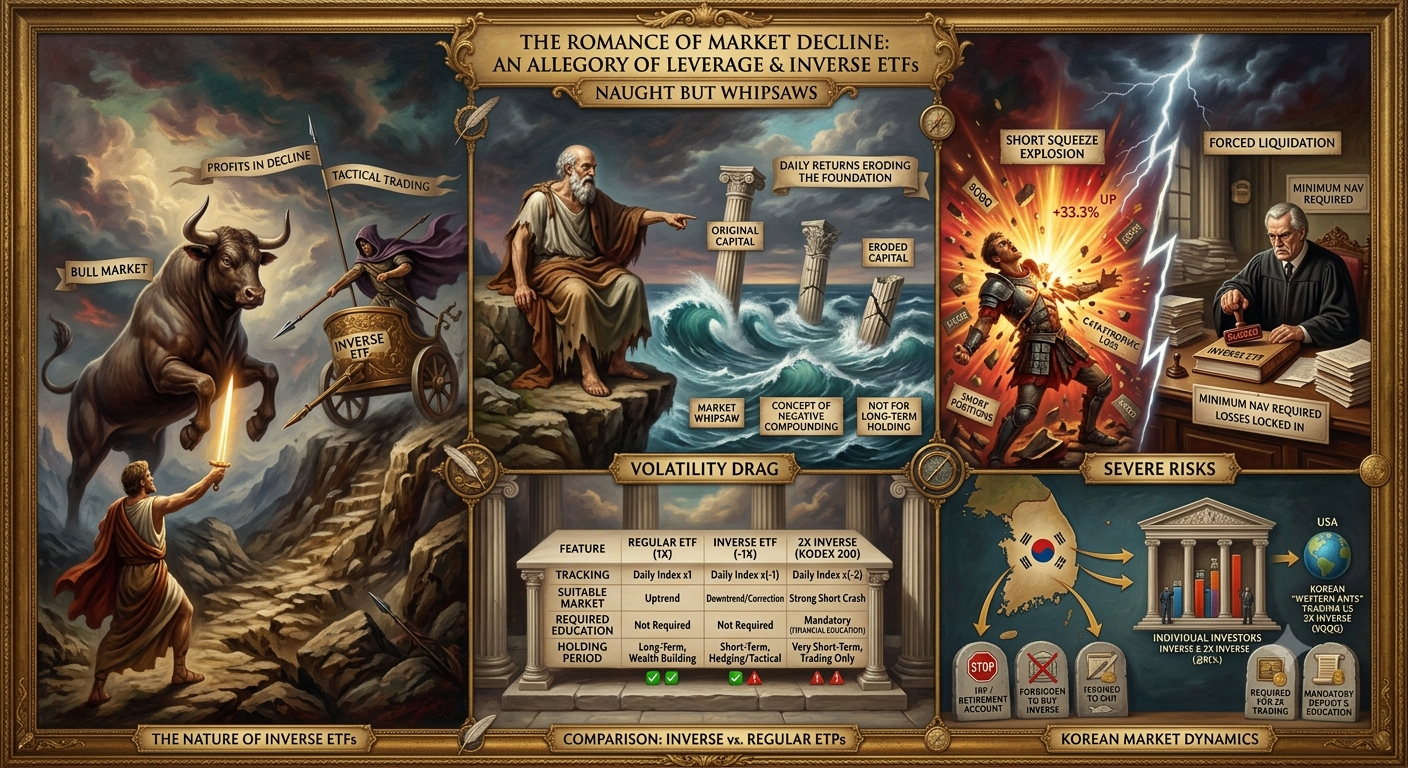
A widespread misconception among retail traders is assuming that if a benchmark drops by 10% overall across a fluctuating period, an inverse ETF will automatically deliver a matching positive return of +10%, +20%, or +30%.
This assumption is mathematically incorrect. Due to daily rebalancing, choppy markets induce compounding erosion, known as volatility drag.
A Practical Mathematical Illustration
Consider a starting principal of $10,000 over two trading sessions. The benchmark index first rises by 20%, then falls by 25% on the second day.
- Index Path: Starts at 100 points → rises to 120 points (+20%) → falls to 90 points (−25%). The benchmark reflects a net loss of −10%.
Below is an HTML breakdown showing how daily resetting affects performance across different inverse leverage ratios under identical market conditions:
Takeaway on Structural Decay
Even though the underlying benchmark dropped by −10% overall, an investor holding a 2× or 3× inverse fund experienced losses of −10% and −30% respectively due to daily rebalancing during high volatility. In sideways or range-bound markets, holding inverse ETFs long-term progressively erodes principal balance.
Severe Risks: Short Squeezes and Forced Liquidation
Trading inverse vehicles entails specific structural hazards that go beyond standard market risk:
1. Rapid Capital Destruction during Sudden Rallies
Stock market indices historically exhibit a long-term upward trajectory driven by corporate earnings growth and economic expansion. Betting against this natural upward bias exposes traders to asymmetric risk.
For instance, if a benchmark index surges by 33.3% in a single trading session, a −3× inverse ETF faces catastrophic losses:
Daily Return=+33.3%×(−3)=−99.9%
This effectively wipe out the account principal in a single market shock.
2. Forced Liquidation and Closure Mechanisms
When persistent bull markets drive an inverse fund’s Net Asset Value (NAV) near zero, fund sponsors may no longer be able to maintain derivative swap contracts efficiently.
If NAV falls below regulatory thresholds, the fund sponsor executes a forced liquidation. Shareholders receive the remaining cash value at settlement, permanently locking in losses. Even if the broader market crashes shortly after liquidation, affected investors cannot participate in any subsequent recovery.
Comparison: Standard ETFs vs. Inverse ETFs
| eature | Standard ETFs | Inverse ETFs (“Bear ETFs”) |
| Primary Direction | Moves in the same direction as the benchmark index. | Moves opposite to the benchmark index. |
| Mechanics | Holds underlying physical assets (stocks, bonds, commodities). | Uses financial derivatives (futures contracts, swaps) to achieve inverse exposure. |
| Target Holding Period | Long-term (months to decades). | Short-term (typically intra-day or a few days). |
| Key Risk Factor | Market downturns and sector volatility. | Volatility decay, path dependency, and daily reset mismatch over time. |
| Expense Ratios | Generally low (often 0.03%–0.35%). | Higher (typically 0.75%–1.00%+) due to derivative management costs. |
| Best Used For | Passive wealth building, asset allocation, dollar-cost averaging. | Tactical portfolio hedging, short-term tactical trades during market declines. |
Unique Market Behavior: The Global Retail Craze for Downside Bets
Retail trading behaviors around inverse funds vary noticeably across global markets, driven by regional market dynamics and regulatory frameworks.
1. Range-Bound Trading Mindset
In markets that historically experience multi-year range-bound consolidations (often referred to as “box-bound markets”), retail investors frequently build systematic habits. When benchmark indices approach upper resistance levels, retail capital heavily flows into 2× inverse products anticipating a predictable pullback. However, when an index decisively breaks out to new highs, these concentrated retail positions suffer severe losses.
2. Retail Appetite for High-Leverage Global Products
Because domestic regulators in several countries restrict local listings to −2× leverage caps, aggressive retail investors frequently route capital into US-listed products. During periods of global macroeconomic stress, retail volumes spike in 3x daily inverse funds like SQQQ or single-stock inverse vehicles (such as single-stock inverse ETFs tracking volatile tech names) to maximize downside potential.
3. Investor Safeguards and Regulatory Rules
Regulatory frameworks increasingly incorporate investor protections for derivative-linked products:
- Prerequisite Qualification: Trading 2× inverse products often requires completing mandatory online financial education courses and maintaining minimum cash equity balances.
- Retirement Account Exclusions: Tax-advantaged retirement accounts (such as IRAs, 401(k) equivalents, or individual pension plans) generally prohibit purchasing inverse or leveraged derivative products by law to protect long-term retirement savings.
Why Inverse ETFs Remain Essential Financial Tools
Despite their risks, inverse products remain active and widely offered due to structural market demands:
- Efficient Short-Term Hedging: Institutional fund managers use inverse ETFs to protect portfolio value during expected market downturns without triggering capital gains taxes or incurring transaction costs associated with liquidating underlying core stock holdings.
- Accessible Short Exposure for Retail Traders: Direct short selling requires margin accounts, stock borrow fees, and unlimited loss liability. Inverse ETFs democratize short exposure, allowing retail accounts to hedge market downside inside standard brokerage accounts with losses capped at the initial investment amount.
- Product Liquidity and Issuer Fees: Financial institutions issue inverse products because volatile markets generate substantial trading volume, yielding consistent fee revenue from fund expense ratios.
Actionable Strategy: When to Use Inverse ETFs
Recommended Scenarios
- Short-Term Portfolio Risk Management: Holding inverse funds temporarily to hedge existing stock holdings against short-term earnings volatility or macroeconomic events.
- Tactical Trend Trading: Entering short positions for several days or weeks during confirmed multi-week downside technical breakdowns.
Unsuitable Scenarios
- Buy-and-Hold Investing: Keeping inverse funds long-term expecting an inevitable future crash. Compounding decay and long-term market upward drift will erode account capital.
- Dollar-Cost Averaging Down: Buying additional shares of an inverse ETF as the underlying market continues to rise (“averaging down”) leads to compounding losses that are difficult to recover from.
Conclusion: Key Takeaways
Inverse ETFs are effective short-term tactical instruments designed for risk mitigation and downside speculation. However, their structural dependency on daily rebalancing creates significant volatility drag during sideways market environments.
To manage inverse investments responsibly:
- Limit usage to short-term holding periods to prevent volatility drag from eroding capital.
- Rely on inverse funds primarily for hedging long equity exposure rather than long-term speculative holdings.
- Avoid dollar-cost averaging into losing inverse positions during sustained market rallies.
AI Disclosure: This content was developed with research support and technical collaboration from Google AI tools, translated and structured for North American investor context.