
The artificial intelligence sector has experienced unprecedented capital expansion over the past few years. However, institutional investors and market analysts have increasingly raised red flags regarding a specific accounting practice: circular financing (also known as round-tripping or vendor financing).
Circular financing occurs when capital injected into an entity flows directly back to the original investor to purchase its products or services, artificially inflating top-line revenue figures. In the context of the current AI boom, critics allege that semiconductor giant NVIDIA invests heavily in emerging AI startups, which then turn around and use those funds to purchase NVIDIA’s graphics processing units (GPUs) and enterprise server infrastructure.
The Mechanics of Circular Financing in the AI Sector
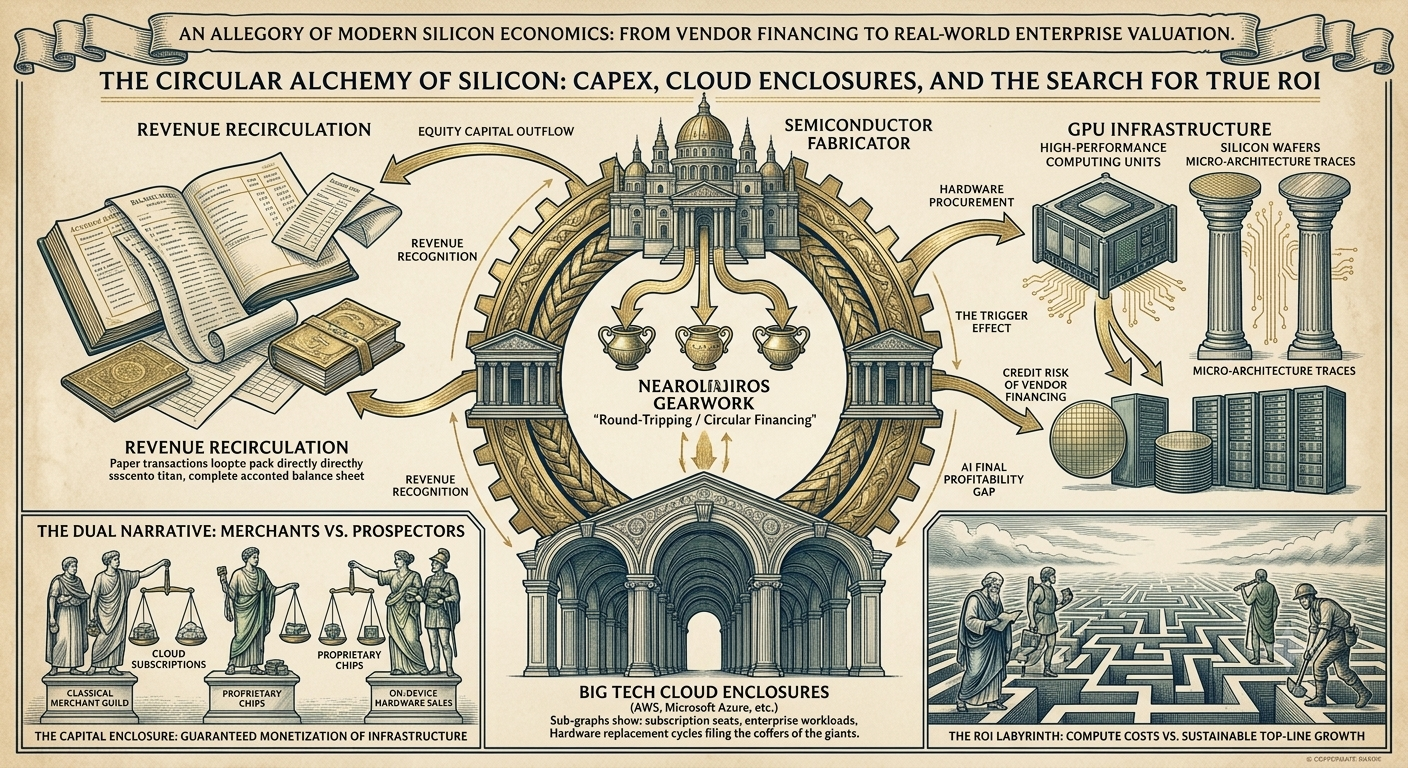
To understand how this feedback loop functions, consider the four distinct stages of the mechanism:
- Equity Investment: NVIDIA allocates substantial venture capital to early-stage or scaling AI companies requiring compute capacity.
- Product Procurement: The recipient startups deploy these funds to buy high-margin hardware directly from NVIDIA.
- Revenue Recognition: Although NVIDIA supplied the underlying capital, the transaction is booked on financial statements as pure semiconductor sales revenue.
- Valuation Expansion: Enhanced top-line revenue and operating margins drive up share prices, expanding equity value and unlocking further capital to fund subsequent investments.
Why Financial Analysts Express Concern
Wall Street analysts highlight two primary systemic risks created by this arrangement:
- Demand Optical Illusions: The reported demand for high-end AI chips may not stem entirely from organic, end-user market adoption, but rather from vendor-backed liquidity.
- Asset Bubble Inflation: Revenue numbers become inflated before the underlying commercial utility and profitability of generative AI are fully verified, increasing the risk of a market-wide correction.
NVIDIA’s Defense vs. Wall Street Skepticism
NVIDIA Chief Executive Officer Jensen Huang has publicly pushed back against circular financing claims, emphasizing that NVIDIA’s capital represents only a modest fraction of the total financing raised by AI startups. According to corporate leadership, these enterprises purchase GPUs voluntarily because the hardware creates authentic business value, not because of structural revenue engineering.
Despite this defense, market strategists and macro economists—including prominent short-sellers—have raised four major counterarguments.
1. Capital Injections Serve as Catalytic Triggers
Even if NVIDIA’s investment comprises only 10% to 20% of a startup’s funding round, that initial institutional endorsement acts as a critical signal. An equity stake or credit guarantee from the dominant chipmaker reassures institutional venture capital funds and commercial lenders. Consequently, a small capital commit from the vendor unleashes hundreds of millions in secondary external debt and equity, generating synthetic demand that would not otherwise exist.
2. Credit Risk Transfer and Vendor Financing Liabilities
Beyond direct equity investments, vendor financing arrangement—such as issuing loan guarantees for private data center operators—transfers structural credit risk onto the chipmaker’s balance sheet. If enterprise AI services fail to achieve sustainable monetization, these credit guarantees and accounts receivable convert directly into balance sheet write-downs. Skeptics question why a chip manufacturer would need to underwrite customer debt if organic market demand truly outstrips supply.
3. Disconnect Between Infrastructure Spending and End-User ROI
A major divergence remains between hyperscaler capital expenditure and the actual commercial revenues generated by enterprise AI services. While technology giants invest hundreds of billions annually in GPU clusters, consumer and enterprise subscription revenues lag significantly behind. This gap suggests that current chip purchases may be driven more by corporate fear of missing out (FOMO) and recirculated investment dollars than by genuine end-user willingness to pay.
4. Valuation Inflation Across Public and Private Markets
When an established semiconductor manufacturer values private startups at elevated multiples, those startups leverage those paper valuations to secure larger credit facilities. They then allocate that credit toward additional hardware purchases. Historical parallels are frequently drawn to the dot-com bubble, when telecommunications equipment providers financed their own customers to inflate revenue growth, ultimately leading to severe industry write-downs.
Big Tech Earnings: Proving the Monetization Case
Earnings announcements from major technology firms—specifically Microsoft, Amazon, and Apple—offered clear quantitative data addressing whether massive AI infrastructure investments are translating into tangible enterprise earnings.
Breakdown of Quarterly Performance in July 2026 quarterly earnings announcements
- Amazon: High capital efficiency was driven by enterprise adoption of Amazon Web Services (AWS) and proprietary silicon (Trainium and Inferentia). By offering cost-effective alternatives to standard GPUs, AWS expanded operating margins while maintaining triple-digit growth in its dedicated AI business unit.
- Microsoft: Software-based monetization showed strong traction. Commercial B2B integrations, led by Microsoft 365 Copilot, secured a durable recurring revenue stream, demonstrating that enterprise buyers are willing to pay for direct productivity extensions.
- Apple: Rather than selling enterprise cloud infrastructure, Apple capitalized on an on-device hardware upgrade cycle. Integrating intelligence features directly into iOS and macOS accelerated hardware replacements across consumer and professional segments.
Persistent Risks Outside the Hyperscale Ecosystem
While hyperscalers demonstrate clear top-line expansion, broader market concerns regarding circular financing and return on investment (ROI) remain unresolved, particularly for mid-market enterprises and early-stage software providers.
PLATFORM PROVIDERS
(Hyperscalers / Hardware)- Capture upfront capital
- Expanding operating margins
- Strong balance sheet cushion
APPLICATION DEVELOPERS
(Startups / Mid-Market)- Face high inference costs
- Unproven long-term margins
- Productivity vs. Revenue
Unresolved Structural Challenges
- Capital-Backed Consumption: A significant portion of cloud platform utilization continues to be funded by venture capital injections into startups rather than organic operating cash flow. Until these early-stage firms achieve self-sustaining profitability from end consumers, round-tripping vulnerabilities remain active.
- High Inference Overhead for Software Developers: Unlike traditional software-as-a-service (SaaS) models—where marginal distribution costs approach zero—generative AI features incur compute costs on every user query. These ongoing API and token expenditures compress gross margins for downstream application developers.
- Internal Productivity vs. Top-Line Growth: Middle-market enterprises report measurable internal efficiency gains in areas like code generation and workflow automation. However, translating these productivity improvements into direct top-line revenue expansion or pricing power remains challenging, making ongoing subscription costs harder to justify.
Conclusion: Key Takeaways
- Circular Financing Dynamics: While equity-for-hardware transactions help fund the initial buildout of AI infrastructure, they risk creating synthetic demand indicators if end-user monetization stalls.
- Hyperscaler Monetization: Tier-1 technology companies (Amazon, Microsoft, Apple) have validated their infrastructure spending with measurable revenue growth across cloud services, enterprise SaaS, and hardware upgrades.
- The Downstream ROI Gap: Smaller enterprises and software developers face high compute costs and uncertain pricing power, shifting the market focus from infrastructure buildout to long-term operational profitability.
AI Disclosure: This post was written, reviewed, and edited by the author in collaboration with Google Gemini AI. All featured images, and visual materials were generated using Google Gemini AI to enhance technical clarity, readability, and overall visual presentation.