
In Part 1, we introduced the basic principles of leveraged investing. In Part 2, we dive deeper into how retail investors should analyze these high-octane products in real-world scenarios.
Leveraged Exchange-Traded Funds (ETFs) act as both an accelerator and a shortcut in the financial markets. Designed to multiply index returns by two or three times—such as generating a $2\%$ or $3\%$ gain when the benchmark index rises by $1\%$—these products have surged in popularity among investors seeking rapid capital appreciation.
When market direction appears clear, leveraged products satisfy the desire for fast growth without waiting years for standard market compounding. However, diving into leveraged funds without understanding their underlying financial mechanics can lead to severe capital depletion.
What Does “Leverage” Really Mean?
To understand these products, we must break down two core concepts:
- Leverage: Derived from the physical lever used to lift heavy objects with minimal force, financial leverage uses debt, derivatives, or borrowed capital to amplify potential returns.
- Daily Return Tracking: This is the most crucial mechanical distinction. Leveraged ETFs do not track cumulative long-term returns; they strictly track the single-day return of the underlying index multiplied by $2\times$ or $3\times$.
Putting these together, a leveraged ETF is a fund structured through financial engineering to mimic two or three times the movement of an index on a day-to-day basis.
Analogy: Standard Sedan vs. Tuned Supercar
Imagine a standard $1\times$ index ETF as a reliable factory-built sedan. When you press the gas pedal, it accelerates predictably; when you step on the brakes, it comes to a controlled stop.
A leveraged ETF is like a modified, high-horsepower supercar. Tap the accelerator, and you burst forward at triple the speed. On a long, straight, dry highway (a clear, sustained bull market), you reach your destination faster than anyone else. However, on a winding, icy, or unpredictable road (a sideways or volatile market), a single sharp turn or sudden loss of control can flip the vehicle, resulting in a total loss.
Common Leveraged Product Examples
- ProShares UltraPro QQQ (TQQQ): One of the most popular US-listed leveraged funds, designed to track $3\times$ the daily return of the Nasdaq-100 Index. If the Nasdaq-100 rises by $2\%$ in a single trading session, TQQQ jumps roughly $6\%$.
- 2x Leveraged Index ETFs: Products engineered to deliver $2\times$ daily index performance (such as domestic $2\times$ broad-market tracker funds in various regional exchanges). A $1.5\%$ daily increase in the underlying benchmark results in an approximate $3.0\%$ gain for the fund.
The Critical Warning: Understanding “Volatility Drag”
A common misconception among retail investors is believing that if an index moves up and down over a period and ends up back at its starting point, their leveraged investment will also break even.
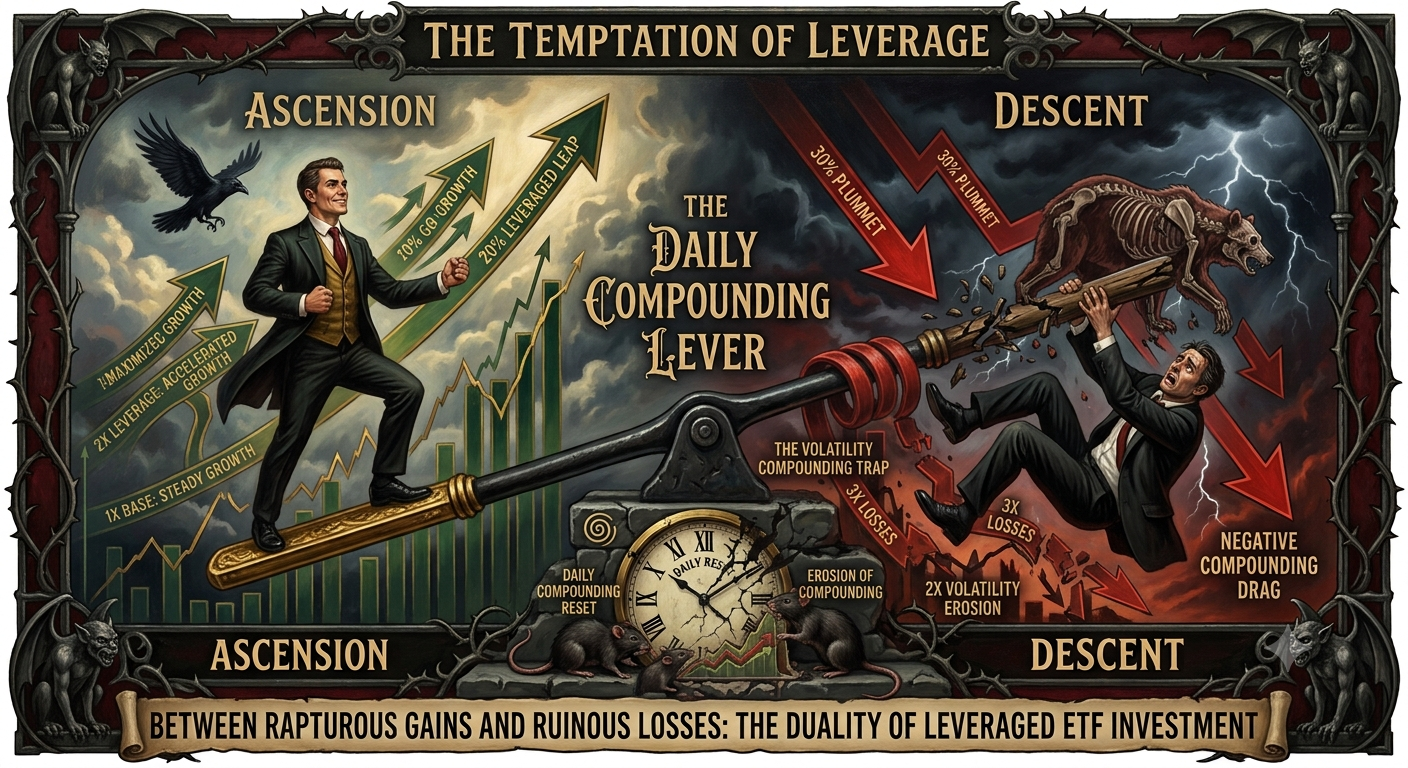
This is mathematically incorrect. Due to daily resetting, your capital will actually shrink. This phenomenon is known as volatility drag (or compounding decay).
How Daily Compounding Erodes Your Capital
Consider a starting principal of $10,000 over two trading days. The underlying index gains $10\%$ on Day 1 and loses $10\%$ on Day 2. The index starts at 100 points, moves to 110 points, and ends at 99 points—a net benchmark loss of $-1\%$.
Below is an HTML-rendered breakdown demonstrating how different leverage ratios perform under this exact scenario:
Key Takeaway on Volatility Drag
Notice that while the underlying index lost only $1\%$, a $3\times$ leveraged product lost $9\%$—far worse than simply multiplying the index drop by three. When markets move sideways or exhibit high daily volatility without a clear direction, daily rebalancing continually reduces your base principal. This mathematical decay is the main reason leveraged ETFs are unsuitable for long-term buy-and-hold strategies.
Comparison: Standard 1x ETFs vs. Leveraged ETFs
| Feature | Standard 1x ETFs | Leveraged ETFs (2x, 3x) |
| Primary Goal | Track index performance 1:1 over long horizons. | Multiply daily index performance by 2x or 3x. |
| Asset Structure | Holds actual underlying securities directly (stocks, bonds). | Uses total return swaps, index futures, and options contracts. |
| Reset Frequency | Natural continuous compounding. | Daily reset at market close. |
| Holding Horizon | Months, years, or decades. | Intra-day to a few days (tactical trades). |
| Volatility Drag | None (moves directly with index value). | High (daily compounding erodes value in choppy markets). |
| Expense Ratios | Very low (typically 0.03% – 0.20%). | Higher (typically 0.90% – 1.05%+). |
| Primary Risk | Broader market risk / economic downturns. | Rapid capital destruction, path dependency, severe drawdowns. |
Global Regulatory & Market Environments
Regulators worldwide treat leveraged exchange-traded products with caution to protect retail accounts from sudden capital losses:
- Account Restrictions: In many jurisdictions—such as Korea’s strict retail trading rules—leveraged products are legally banned within tax-advantaged retirement accounts (such as IRPs or DC pensions) due to their speculative nature.
- Capital & Educational Mandates: European and Asian markets often require retail investors to complete mandatory educational courses or hold minimum cash deposits before unlocking leveraged trading permissions.
- Leverage Limits: Local market authorities frequently cap domestic funds at $2\times$ leverage, driving aggressive traders to seek US-listed $3\times$ funds like TQQQ or SOXL for higher exposure.
Why Leveraged Products Continue to Flourish
Despite clear warnings, leveraged products remain prominent in global markets for several core reasons:
1. The Power of Sustained Bull Trends
While volatility drag destroys capital during sideways markets, compounding works powerfully in favor of investors during strong, persistent uptrends. When an index rises consecutively over multiple days, daily resetting generates exponential returns, allowing a $3\times$ ETF to outperform simple math.
2. Capital Efficiency for Portfolio Managers
Institutional investors use leveraged funds as tactical tools to optimize capital. Rather than committing $10,000 to track an index, a trader can deploy $3,333 into a $3\times$ leveraged fund to achieve equivalent market exposure, keeping the remaining $6,667 in cash or low-risk fixed income.
3. Financial Institution Revenue
Sponsoring firms earn significantly higher management fees on derivative-based leveraged products (around $0.95\%$) compared to passive broad-market ETFs (often below $0.05\%$). Combined with high trading volume, these products generate consistent fee income for fund managers.
Practical Actionable Guide: When to Trade and When to Avoid
Who Should Consider Leveraged ETFs?
- Short-Term Trend Traders: Experienced investors who trade strong technical breakouts over days or weeks.
- Tactical Hedgers: Investors looking to gain quick, concentrated market exposure during clear market turnarounds without reallocating their entire core portfolio.
Who Should Avoid Leveraged ETFs?
- “Set-It-and-Forget-It” Investors: Anyone building long-term wealth through passive monthly contributions.
- Retirement Account Builders: Investors focused on wealth preservation across long market cycles.
- Passive Watchers: Traders who do not monitor their portfolios daily to react quickly to intraday reversals.
Conclusion: Key Takeaways (Part 2 Summary)
In this second part of our deep dive, we highlighted that leveraged ETFs offer a powerful mechanism to amplify short-term returns, but they operate on mathematical rules that penalize long-term holders during volatile market cycles.
To trade leveraged funds successfully:
- Treat them exclusively as short-term tactical instruments, not core investment holdings.
- Monitor daily market conditions to protect capital against sudden trend changes.
- Factor in the hidden erosion of daily rebalancing before holding positions through sideways markets.
Understanding these mechanics ensures you use financial leverage as a controlled tool rather than an unexpected liability.
AI Disclosure: This content was developed with research support and technical collaboration from Google AI tools, translated and structured for North American investor context.