
In our previous session, we explored bond redemption and refinancing strategies aimed at optimizing a corporation’s cost of capital. While bonds represent visible, “confirmed debts” on the balance sheet, today we shift our focus to the liabilities hidden behind the formal ledger—uncertain, potential obligations that can erupt at any moment, threatening a company’s cash reserves and financial stability.
Corporate management inevitably encounters unexpected ambushes. A manufacturing firm may face a massive product recall due to a quality defect, or a tech company might be slapped with a multimillion-dollar patent infringement lawsuit by a competitor. While no actual cash has left the building in these scenarios, the critical question remains: Must we record these potential obligations as debts on this year’s balance sheet, or can we legitimately omit them?
Today, we will provide a clear, concise guide to the core concepts and accounting treatments for Provisions and Contingent Liabilities, the two critical classifications that dictate the health and integrity of a corporation’s financial statements.
1. Demystifying Accounting Terminology: Definitions and Practical Analogies
Before diving into strategic financial management, it is crucial to understand how specific English terms differ between everyday usage and the precise world of accounting (IFRS/GAAP). Mastering these distinctions is half the battle won.
A Closer Look: Everyday vs. Accounting Meanings
- Provision:
- Everyday Usage: Preparation, supplying, or a stockpile of necessities (e.g., “provisions for the winter”).
- Accounting Usage: A specific type of liability. It represents a potential future expenditure where the timing or amount is uncertain, but the obligation itself is highly probable, requiring the company to recognize a cost immediately and record a debt on the balance sheet.
- Contingent:
- Everyday Usage: Subject to chance, conditional, or accidental.
- Accounting Usage: Conditional. It implies that a liability is not yet confirmed and its final existence depends entirely on the outcome of a future event (e.g., a final court ruling).
- Liability:
- Everyday Usage: Legal or moral responsibility or obligation.
- Accounting Usage: A debt. Specifically, a present economic obligation of a company arising from past events, which will require the transfer of assets (like cash) to an outside party in the future.
Key Accounting Definitions
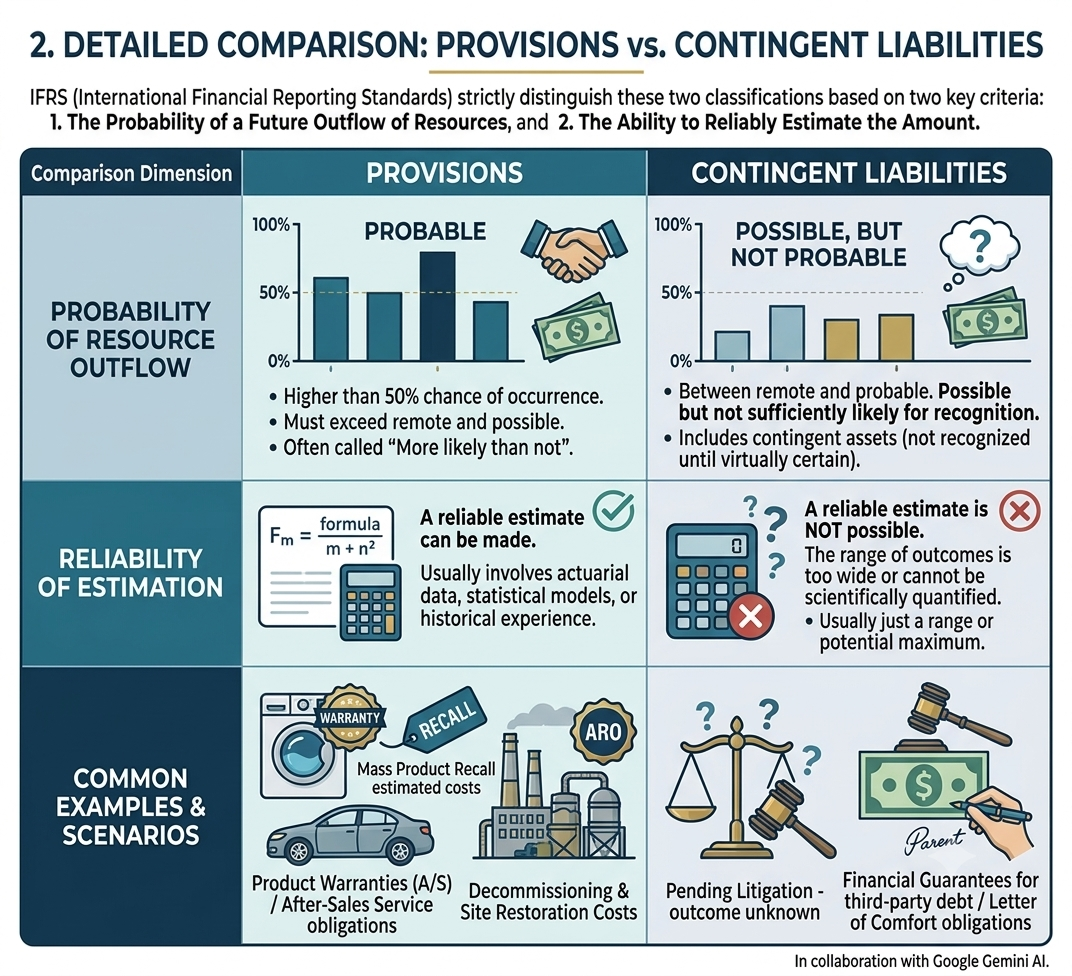
- Provision: A liability of uncertain timing or amount, but one where a future outflow of resources is probable (more likely than not) and the amount can be reliably estimated. These are formally recorded in the main financial statements.
- Contingent Liability: A potential obligation whose existence is uncertain, OR a present obligation where an outflow of resources is not probable or cannot be reliably estimated. These are not recorded in the main financial statements but must be disclosed in the footnotes.
- Present Obligation: A legal or constructive obligation that exists today as a result of a past event.
- Outflow of Resources: The transfer of corporate assets (primarily cash) to satisfy an obligation.
The “Medical Check-Up” Analogy
Think of financial statement risk assessment as a comprehensive physical.
- Provisions are “diagnosed cavities needing dental work.” After the check-up, your dentist says, “You have significant cavities that must be treated soon. The cost will be approximately $1,000.” While you haven’t booked the exact appointment date and the final cost might vary slightly, it is highly probable you will spend about $1,000 soon. Therefore, you mentally record this $1,000 as a debt in your personal ledger (Provision).
- Contingent Liabilities are “awaiting further specialist results.” The doctor notes, “There’s a small shadow on your lung scan. Let’s monitor it for six months and decide then if treatment is needed.” You don’t know yet if you are sick, whether treatment will be required, or how much it might cost. You cannot record this as a definite debt today, but since there is a known risk, you make a note about it on a sticky pad in your ledger for future reference (Disclosure in Footnotes).
2. Head-to-Head Comparison: Provisions vs. Contingent Liabilities
Accounting standards (IFRS) strictly distinguish between these two classifications based on two criteria: the probability of a future outflow of resources and the ability to reliably estimate the amount.
3. Practical Real-World Cases in Corporate Management
Case 1: Manufacturer’s Product Warranty Provision
Scenario: Consumer Electronics Company A sells washing machines with a “1-year parts and labor warranty.” Historically, statistical data shows that 3% of all units sold require warranty service.Accounting Treatment: Even before a single repair request arrives, Company A calculates the anticipated repair costs based on past data at the time of sale. This estimated amount is immediately recognized as a expense on the income statement and simultaneously recorded as a “Product Warranty Provision” on the balance sheet. (This adheres to the Matching Principle of revenue and expense).
Case 2: Decommissioning and Site Restoration Costs
Scenario: Construction Firm B leases land for 10 years to build a temporary office and warehouse complex, agreeing to restore the land to its original condition at the end of the lease.Accounting Treatment: It is estimated that dismantling the complex and restoring the land in 10 years will cost $5 million. Although the actual cash outflow will happen a decade from now, Firm B must calculate the present value of this expected cost today and recognize it immediately as a “Decommissioning Provision” (or Asset Retirement Obligation).
Case 3: Pending Patent Litigation
Scenario: Tech Firm C is sued for patent infringement by a competitor, and the lawsuit is currently in the first round of litigation. Corporate legal counsel assesses the probability of losing and paying damages at roughly 50-50 (not yet probable).Accounting Treatment: The outcome is uncertain, and the final damage amount is unknowable before a ruling. In this case, Firm C does not record a liability in the main financial statements. Instead, it provides a detailed note in the footnotes describing the nature of the lawsuit and its potential impact (Contingent Liability). If, in a subsequent round of litigation, a loss becomes probable and damages can be reasonably estimated, the obligation must be converted to a Provision and recognized on the balance sheet.
4. Strategic Financial Implications for Corporate Leadership
I. Provisions are NOT Legitimate “Income Smoothers”
A significant temptation exists for corporate management or financial officers to manipulate Provisions (e.g., bad debt provisions, warranty reserves) to manage earnings. They might intentionally over-accrue reserves during exceptionally profitable years to lower current net income and “bank” the income to be released during poor performing years. This is considered an aggressive accounting practice and a major target during statutory audits. Furthermore, tax authorities may disallow these excess reserves, leading to substantial penalties for underpayment of taxes. Calculations must always be based on objective, statistical data.
II. M&A and Investment: Verify Hidden Footnotes Double and Triple Time
When conducting due diligence for a potential acquisition, never trust a 피인수기업’s clean-looking balance sheet without scrutinized analysis. The footnotes are where the true financial dangers lurk. Multimillion-dollar pending lawsuits or parent guarantees hidden in the notes (Contingent Liabilities) can transform into massive, actual debts (confirmed liabilities) the moment the acquisition agreement is signed. In M&A valuations, legal and financial experts must diligently quantify the likelihood and potential magnitude of these contingent obligations before finalizing any deal price.
III. Proactively Manage “Constructive Obligations” Risk
Corporate liabilities do not arise solely from signed legal contracts. Accounting standards also recognize “Constructive Obligations.” If a company has created a valid expectation in outside parties that it will accept certain responsibilities—for instance, by publicly stating “we will provide a full refund if any defect occurs”—even if not legally bound by contract, a liability exists. Management must be keenly aware that marketing statements, official corporate announcements, or past established patterns of behavior can compel the corporation to accrue expensive Provisions, thereby increasing the debt ratio.
Conclusion: Key Takeaways
The transition between fiscal years highlights the need for precise management of hidden liabilities.
- Provisions Maintain Integrity: They are recognized as liabilities in the main financial statements because a future outflow of resources is highly probable and reliably estimable, adhering to faithful representation.
- Contingent Liabilities demand Disclosure: They are disclosed in the footnotes due to their inherent uncertainty. Changes in facts and circumstances can transform them into Provisions or confirmed debts over time.
- Proactive Management is Vital: For M&A valuations, investment analysis, or internal risk management, executive leadership must prioritize the early identification, quantification, and control of these volatile, hidden obligations, rather than relying solely on the main balance sheet sheets.
AI Disclosure: This article was created, translated, and structured in collaboration with Google Gemini AI technology. The underlying concepts, structural edits, and final technical reviews were conducted directly by the author.