
The fundamental accounting equation—Assets = Liabilities + Equity—and double-entry bookkeeping serve as the structural backbone of financial reporting. Together, they form an economic framework that absorbs 100% of a firm’s operational transactions. However, when a demanding fiscal year draws to a close, corporate financial books cannot simply roll forward indefinitely. Accounting ledgers require a systematic reset process to clean the temporal slate and establish a clean starting baseline for the next reporting period.
Navigating the transition between fiscal years while maintaining balance sheet equilibrium requires a precise understanding of closing entries, post-closing trial balances, and reversing entries. Below is a comprehensive guide to how these accounting mechanisms interact, along with the operational insights behind their implementation in modern business environments.
1. The Full Mechanics of the Accounting Cycle
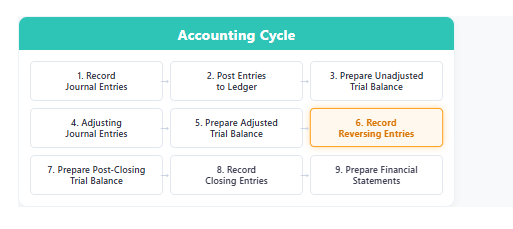
Accounting operates through an interconnected, cyclical sequence known as the accounting cycle. Moving systematically from year-end adjusting journal entries to closing procedures and opening reversing entries, this annual cycle safeguards reporting integrity and preserves corporate financial health.
2. Closing Entries, Reversing Entries, and Financial Statements
The core mechanics of fiscal year-end transition represent a chain reaction designed to systematically reset temporary ledgers while preserving balance sheet continuity.
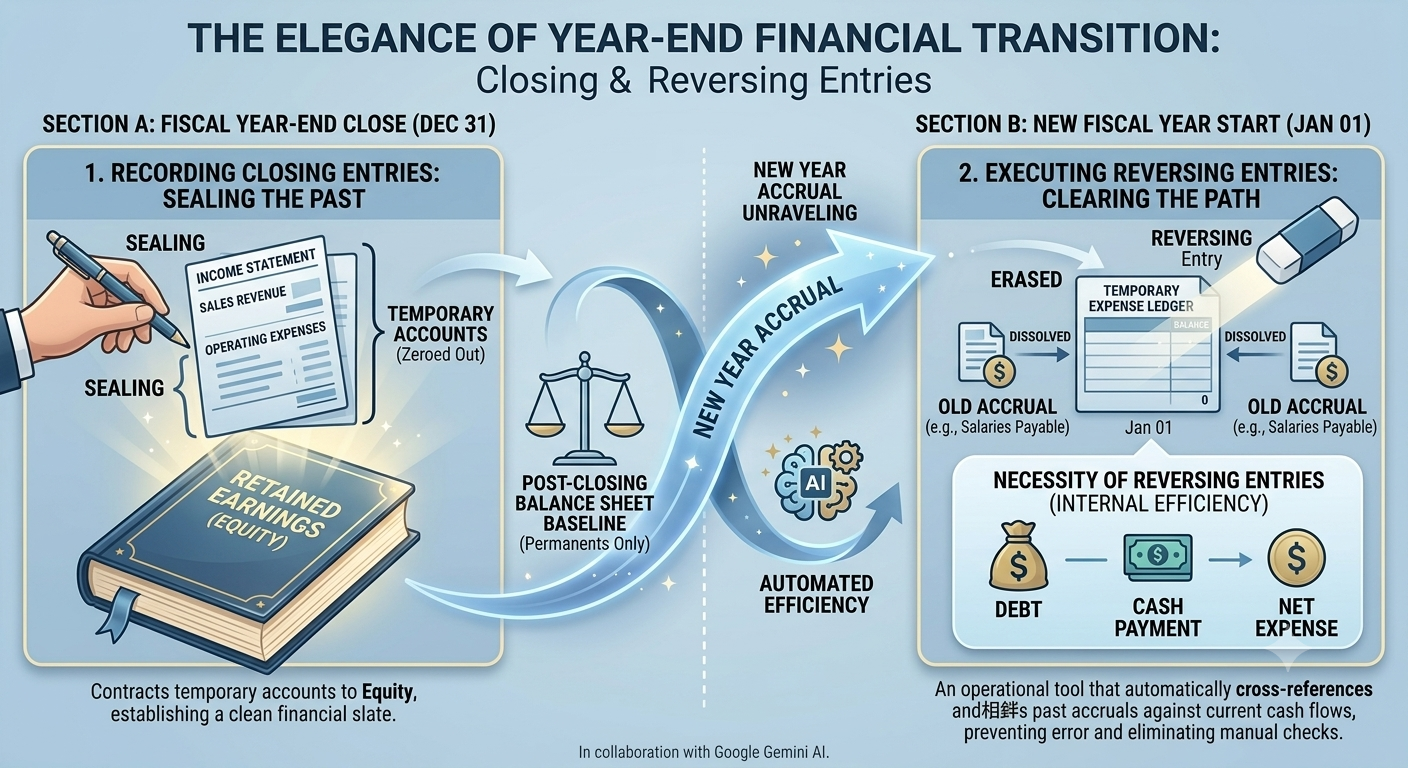
① Closing Entries: Sealing the Time Frame into Equity
Revenue and expense accounts are classified as temporary accounts because they exist solely to measure operating performance across a specific reporting period. At the start of a new fiscal year, these temporary accounts must be zeroed out.
- Procedure: Closing entries credit temporary expense accounts and debit temporary revenue accounts to reduce their balances to zero. The net differential—representing net income or net loss—is transferred directly into retained earnings, an essential permanent equity account.
- Outcome: The expanded accounting equation contracts back to its fundamental baseline: $\text{Assets} = \text{Liabilities} + \text{Equity}$.
② Post-Closing Financial Statements: Establishing the Base Line
Once closing entries are posted, temporary income statement accounts drop to zero. Only permanent accounts—assets, liabilities, and retained earnings—remain on the general ledger.
- Procedure: The accounting department prepares a post-closing trial balance to verify that debit and credit balances remain equal across permanent accounts.
- Outcome: This trial balance forms the definitive opening balance sheet on January 1, establishing the company’s financial foundation for the upcoming year.
③ Reversing Entries: Unraveling Accruals on Day One
On the first day of the new fiscal period (January 1), accounting teams can choose to reverse specific period-end adjusting entries recorded on December 31, such as accrued expenses or accrued revenues.
- Operational Example: Suppose a company records an adjusting entry on December 31 for $10,000 in accrued payroll owed to employees:$$\text{Debit: Salaries Expense } \$10,000 \quad / \quad \text{Credit: Salaries Payable } \$10,000$$On January 1, an automated reversing entry is executed:$$\text{Debit: Salaries Payable } \$10,000 \quad / \quad \text{Credit: Salaries Expense } \$10,000$$
- Practical Benefit: When the actual monthly payroll payment of $30,000 is processed later in January, accounting staff do not need to cross-reference previous year balance sheet accruals. They simply record the full payment as a standard operating item:$$\text{Debit: Salaries Expense } \$30,000 \quad / \quad \text{Credit: Cash } \$30,000$$Because the reversing entry placed a $10,000 credit into the salaries expense ledger on January 1, the net current-year payroll expense automatically reflects the correct figure of $20,000.
3. Practical Implementation: Software and Enterprise Resource Planning (ERP) Systems
While accountants historically tracked year-end adjustments manually, enterprise accounting software automates these processes.
- Responsible Parties: Corporate controllers, accounting managers, and financial system administrators oversee closing workflows.
- Enterprise-Level Platforms (SAP, Oracle ERP Cloud): Large corporations utilize advanced ERP software and Robotic Process Automation (RPA). When entering December 31 accruals, staff select flags such as
[Reversing Entry: Yes]and[Reversing Date: Jan 01]. At midnight on New Year’s Day, the system automatically posts the reversing entries. - Mid-Market Platforms (QuickBooks Online, Sage, NetSuite): Mid-sized businesses leverage built-in journal batch replication modules. Built-in automation allows staff to clone, invert, and post year-end accrual batches with minimal manual intervention.
- Small Business Outsourcing: Small enterprises relying on external CPA firms benefit from similar software workflows managed directly by their external advisors during year-end tax compliance preparation.
4. Operational Hazards of Omitting Reversing Entries
Reversing entries are not required under Generally Accepted Accounting Principles (GAAP) or International Financial Reporting Standards (IFRS) for external reporting. However, omitting them from internal record-keeping systems creates substantial operational risks.
Overstatement of Expenses and Revenue (Double-Counting)
Without reversing entries, staff processing cash disbursements in January might record the payment as a fresh operating expense without clearing the December liability. This causes double-counting of expenses, artificially deflating net income and introducing corporate tax compliance risks.
Operational Bottlenecks and Manual Reconciliation Errors
In high-volume enterprise environments, requiring staff to cross-check every vendor invoice against prior-year balance sheet accruals creates severe processing delays and increases human error.
Financial Statement Distortion
Unreversed accruals leave stale assets or liabilities on the balance sheet. Management relying on these inflated figures risks misjudging available working capital and corporate liquidity.
5. External Disclosure vs. Internal Accounting Management
Understanding the distinction between statutory financial reporting (external) and managerial ledger administration (internal) clarifies why reversing entries exist.
Statutory closing entries are legally mandated to provide clean, auditable financial snapshots to external stakeholders, including equity investors, lending institutions, and regulatory authorities. Conversely, reversing entries are an internal operational tool used to prevent transactional errors and streamline daily bookkeeping.
Conclusion: Key Takeaways
The transition between fiscal years highlights the elegance and balance of double-entry accounting.
- Closing Entries Maintain System Integrity: By zeroing out temporary revenue and expense accounts, closing entries aggregate operating results into retained earnings and preserve balance sheet equilibrium.
- Reversing Entries Drive Operational Efficiency: Reversing entries eliminate manual reconciliation, protect against double-counting errors, and simplify current-period cash entries.
- Automation Protects Financial Quality: Leveraging modern ERP capabilities to automate year-end closing entries safeguards financial data, ensures GAAP compliance, and provides executive leadership with accurate reporting for strategic decision-making.
AI Disclosure: This article was created, translated, and structured in collaboration with Google Gemini AI technology. The underlying concepts, structural edits, and final technical reviews were conducted directly by the author.