
n both corporate finance and accounting, few concepts hold as much critical importance as the Effective Interest Method. This sophisticated methodology serves as the standard for reflecting the Time Value of Money (TVM), rationally adjusting the carrying amount of financial assets and liabilities, and recognizing the true, substantive interest income or expense across different reporting periods. Far more than a simple bookkeeping technique, it is the foundational principle for tracking the ‘real value’ of capital—whether it’s funds a company has raised or capital it has deployed for investment. This comprehensive guide will dissect the method, starting with a bond amortization schedule and exploring its diverse applications in modern finance.
1. Deep Dive: A Bond Amortization Schedule (Discounted Issuance)
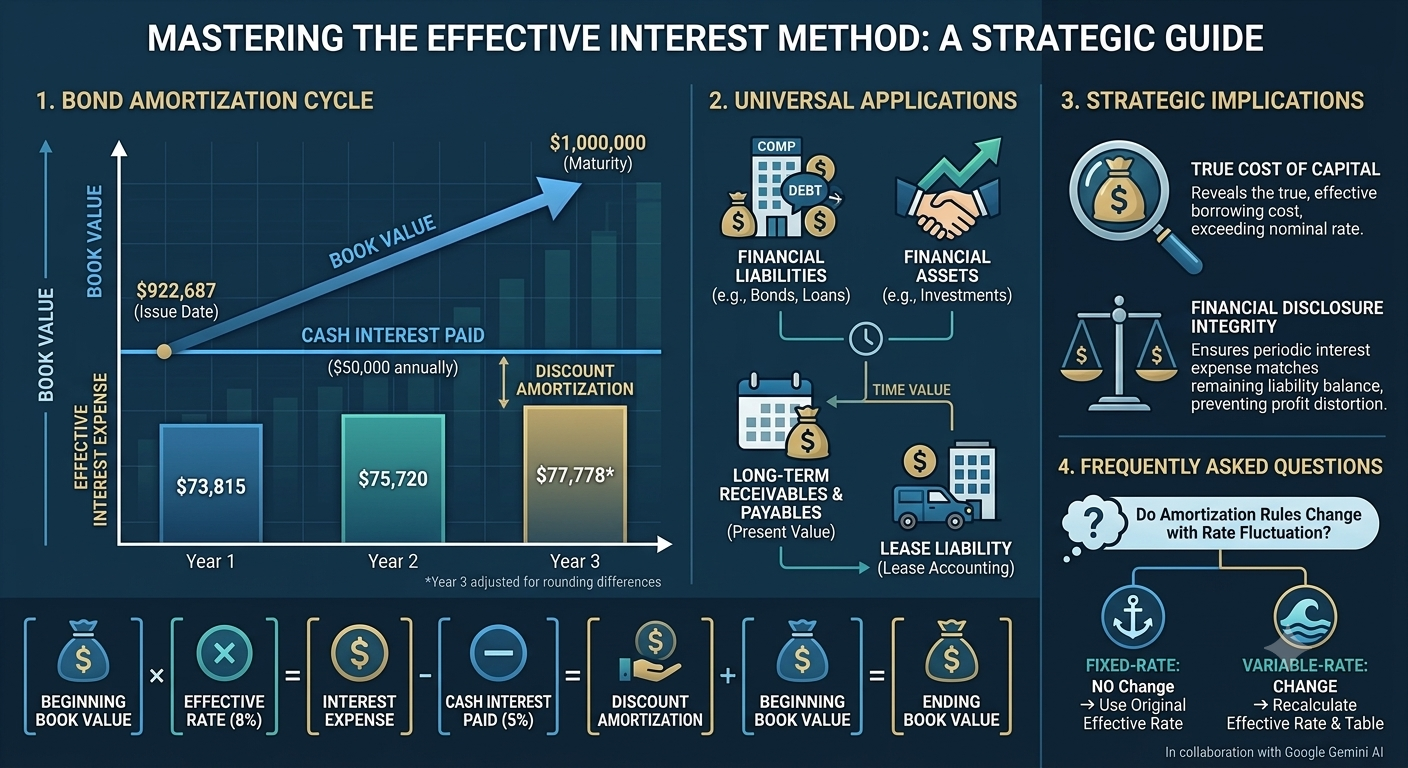
To understand the core mechanics of the Effective Interest Method, we have prepared a practical example based on a corporation issuing a bond at a discount. The following inputs are used for our illustration:
- Face Value (Par): ₩1,000,000
- Stated Rate (Coupon Rate): 5% Annual (Cash payment of ₩50,000 per year)
- Effective Rate (Market Rate): 8% Annual
- Maturity: 3 Years
- Present Value at Issuance (Opening Carrying Amount): ₩922,687 (Discounted)
The following amortization schedule illustrates how both the real interest expense and the bond’s carrying value evolve over the three-year period under the Effective Interest Method. You can seamlessly integrate this polished table into your blog by creating a ‘Custom HTML’ block and pasting the following code.
| Year | Beginning Carrying Amount (A) |
Effective Interest (B = A × 8%) |
Cash Interest (C = Par × 5%) |
Discount Amortization (D = B – C) |
Ending Carrying Amount (E = A + D) |
|---|---|---|---|---|---|
| Issue Date | – | – | – | – | $922,687 |
| Year 1 | $922,687 | $73,815 | $50,000 | $23,815 | $946,502 |
| Year 2 | $946,502 | $75,720 | $50,000 | $25,720 | $972,222 |
| Year 3 | $972,222 | $77,778* | $50,000 | $27,778 | $1,000,000 |
* Note: The Year 3 effective interest reflects a minor rounding adjustment to ensure the final ending carrying amount precisely equals the $1,000,000 par value at maturity.
Key Amortization Insight: Observe that in Year 1, the corporation pays only ₩50,000 in actual cash interest. However, because investors demand a real market yield of 8% (the effective rate), the true interest expense that the company must recognize on its income statement is ₩73,815. This ‘unpaid’ cash difference (₩23,815) is instead added back to the bond’s liability, increasing the carrying value. As this process repeats, the carrying value builds up to exactly ₩1,000,000—the par value required for redemption at the end of Year 3.
2. Comprehensive Scope: How the Effective Interest Method is Applied
Across all major financial reporting standards (K-IFRS and modern GAAP), the Effective Interest Method is the absolute standard for any transaction or instrument involving long-term payments or significant differences between the face and issued value. Key application cases include:
Corporate Financial Liabilities (Long-term Debt)
This is the classic example. When a company issues corporate bonds and incurs transaction costs (like underwriting fees), these costs are deducted from the initial proceeds. This lowers the net funds received and creates a new, substantive effective interest rate, which is then used to rationally allocate the increased real cost over the life of the debt.
Financial Assets Measured at Amortized Cost
The principle applies symmetrically. When a company purchases government or corporate bonds intending to hold them to maturity to generate stable income, these investments are classified under ‘Financial Assets at Amortized Cost’. The effective rate is calculated on day one and used to recognize a stable, economically faithful interest income over the investment’s term.
Present Value Measurements of Long-Term Receivables and Payables
Consider a long-term contract where payment is deferred or collected over several years (e.g., a long-term note receivable). The nominal value may be large, but the present value at the transaction date is significantly less. Financial standards require the asset or payable to be recorded at its present value on day one. The difference (the implicit discount) is then amortized into interest income or expense over the maturity period using the Effective Interest Method, faithfully reflecting the economic reality of the transaction.
3. Expansion: Beyond Bonds to “Every” Financial Transaction
Many mistakenly relegate the Effective Interest Method to a formula for calculating the ‘amortization of discount on bonds payable’. In practice, however, it is a truly versatile standard used for measuring the real value of any financial asset or liability that incorporates the time value of money.
This is because the method is the sole mechanism that authentically reflects the Economic Substance of a financial agreement.
The ‘Stated Interest Rate’ printed on the front page of a contract is merely a formal figure for determining the fixed periodic cash flow. The real value of money at the transaction’s inception is governed by the Market Interest Rate (Effective Interest Rate)—the rate that implicitly captures current market demand for yield, credit risk, and inflation expectations.
Therefore, modern accounting principles demand that assets and liabilities be measured monthly or annually using this effective rate, rather than formally focusing on the observed movement of cash.
Beyond corporate bonds, the philosophy of the Effective Interest Method is seamlessly woven into every financial transaction around us:
Bank Loans and Deposits
The method serves as the basis for calculating the bank’s actual realized yield (effective rate) or the depositor’s real return. It incorporates factors like early repayment penalties, introductory teaser rates, and additional account opening fees that alter the substantive yield beyond the nominal quoted figure.
Lease Accounting
Under both modern GAAP and IFRS lease standards, the method is used directly for allocating interest expense on the lease liability for the lessee and for calculating the realization of lease income for the lessor.
Complex Financial Instruments (Hybrid Debt)
When evaluating hybrid instruments—such as Convertible Bonds (CB) or Bonds with Warrants (BW), which contain embedded options to convert into stock—the method is crucial. The normal effective rate for a straight-debt instrument is used to determine the value of the bond portion, allowing the equity option portion to be valued as the residual component.
4. Addressing Common Reader Questions: “What Happens When Interest Rates Fluctuate?”
A frequent question we receive from both blog readers and finance professionals is whether the amortization schedule must be fundamentally revised when market benchmark rates change or if the contractual stated rate is variable.
The answer depends entirely on whether the original contract is for a fixed or variable instrument:
For Fixed-Rate Instruments (Change in Market Rate Only)
In modern North American GAAP and K-IFRS, if we have issued ‘fixed-rate’ debt, the effective interest rate calculated at the time of issuance remains the same until the bond matures—regardless of how much market benchmark rates may rise or fall. When utilizing the Amortized Cost (AC) methodology, any change in the fair market value of the fixed bond caused by market rate fluctuations is explicitly ignored in our financial statements. In other words, you do not intermediate-level revise the amortization schedule.
For Variable-Rate Instruments or Cash Flow Adjustments
If the instrument was explicitly structured with a ‘variable rate’ tied directly to a market index (e.g., SOFR, prime, or a local index), or if the contract itself is structurally altered to change future cash flows, the situation changes. Financial standards dictate that you must either recalculate a new effective interest rate based on the revised future cash flows or reset the entire carrying amount and calculate a fresh amortization schedule. This is required because the external financial environment now has a substantive, observable effect on the contract’s actual future cash flow stream.
5. Practical Considerations and Internal Controls
When applying the Effective Interest Method, professional-grade precision is critical. Failure to account for the following practical risks can introduce significant reporting errors:
Accuracy of the Initial Effective Rate Calculation
The effective rate is the discount rate that precisely equates the present value of all future cash flows (principal + interest) to the initial carrying amount. If corporate accounting teams omit ‘transaction costs’—such as legal fees or underwriting expenses—or input the future cash flow schedule incorrectly on day one, the entire effective rate calculation will be distorted. This leads to recursive accounting errors on the balance sheet and income statement for years until maturity.
Management of Rounding and Final Plug-in Differences
As you observe in our amortization schedule, multiplying a multi-decimal interest rate by a number with varying decimal places inevitably generates 원 (or small dollar cent) rounding differences. Deciding how to handle these differences (plug-in strategy) on an ongoing basis can lead to a material gap of up to several hundred dollars by maturity. Operationally, the optimal strategy is typically to plug the entire final year difference, ensuring the ending carrying amount matches the principal or face value with absolute precision.
6. Strategic Implications for Corporate Managers
For corporate executive leadership (C-Suite), the Effective Interest Method is far more than a technical accounting requirement. It serves as a vital strategic tool for accurate profit management and capital cost analysis.
Grasping the Substantive True Cost of Capital
Focusing only on the formal nominal stated rate can make a company’s interest burden seem artificially low. Management must view the effective rate—which incorporates factors like underwriting discounts, transaction costs, and issuance premiums—to determine the actual percent cost the company is paying every year to procure that capital. This is a crucial metric for making sound investment decisions or allocating corporate capital across different strategic opportunities.
Preventing Period-End Profit Distortion
Unlike the ‘straight-line’ method used primarily in legacy reporting, which amortizes the discount or premium in equal annual amounts, the Effective Interest Method recognizes interest expense based rationally on the unpaid balance of the liability. As the carrying amount increases, the interest expense logically increases as well. This faithful representation prevents the distortion of net income in any single accounting year or quarter, allowing leadership to present shareholders with reliable, predictable, and faith-preserving financial statements.
Conclusion: Key Takeaways
The Effective Interest Method is the essential mechanism for applying the core principles of Time Value of Money and economic substance across modern corporate finance.
- Reflecting Substantive Economic Reality: Far more than a formal calculation, it rationalizes periodic interest expense or income by adjusting the carrying value to match the real market rate at inception.
- A Standard for “Every” Transaction: The principle extends universally beyond bonds to leasing, bank loans, receivables, and all hybrid instruments involving deferred cash flows.
- Driving High-Caliber Strategic Decisions: Corporate managers leverage the effective rate to grasp a company’s absolute true cost of capital and provide the capital market with transparent, faithfully prepared financial statements.
Understanding this principle unlocks the fundamental key to modern financial and accounting theory: the unassailable rule of Time Value of Money and Real Yield Preservation.
AI Disclosure: This guide was prepared and translated through a unique collaborative process involving Google Gemini AI technology, under the direct creative and strategic oversight of a senior professional financial author.