
If traditional business management was simply about selling products and dropping leftover cash into a metal safe, modern corporate leadership is about meticulously maintaining a transparent report card and drawing a roadmap for the future.
Every entrepreneur and investor faces a choice: Will you pilot a ship lost in a fog of scattered paper receipts, or will you command your business with the ultimate navigation chart known as accounting? In today’s dynamic economic environment, the single most critical capability for both individuals and corporations is the ability to read and track financial flows with absolute precision.
1. Understanding Accounting Through Everyday Analogies
At its core, corporate accounting is not fundamentally different from keeping a personal allowance log or balancing a household budget. It is the structured process of recording where every dollar comes from, where it goes, and what remains in your account—all strictly adhering to standardized rules so that external stakeholders can clearly evaluate your financial health.
Etymology and Core Concepts
To truly understand financial management, it helps to break down the foundational terminology into clear, accessible definitions.
- Bookkeeping: The literal practice of keeping and maintaining financial record books. It represents the meticulous craftsmanship of recording daily transactions chronologically according to set rules without deviation.
- Accounting: Derived from the Latin root ad (toward) and computare (to count or calculate), accounting means more than just summing up numbers. It carries a deeper functional meaning: to count and synthesize financial data specifically to explain and report status to someone else.
- Account: Represents a designated, specific location within a ledger or computer system reserved for tracking particular assets, liabilities, or equities. In practical usage, to “account for” something means to explain or tell its story. The numbers recorded inside these ledger accounts work together to reveal the living story of a enterprise’s operational health.
- The Unified Definition: Accounting is the comprehensive management process of using the raw data faithfully collected through bookkeeping to transparently demonstrate a company’s financial condition to shareholders, lenders, and the public.
A Company’s Overall Report Card and Black Box
Think of corporate accounting as both an enterprise’s standardized report card and its operational flight recorder.
- Methodology: It logs every single transaction, invoice, and receipt generated through daily operations, summarizing them into comprehensive financial statements at the end of every fiscal period.
- Characteristics: It reveals whether a firm is operating profitably or burdened by excessive debt, directly establishing corporate credibility and lowering capital acquisition costs.
2. Industry Comparison: Conservative vs. High-Tech Frameworks
Different economic sectors apply financial tracking principles tailored to their unique balance sheets.
- Traditional Finance and Manufacturing: Legacy industrial giants dealing with billions in tangible inventory and physical plant machinery rely heavily on conservative valuations. Every item must be audited to the exact dollar to reflect depreciated physical assets accurately.
- Technology and Big Tech Enterprises: For software giants and modern platforms, invisible assets form the cornerstone of the balance sheet. Intellectual property, proprietary artificial intelligence algorithms, and research and development (R&D) expensing represent the primary focus of their financial disclosures.
3. Clear Concept Breakdown: Bookkeeping vs. Accounting
Many people use these terms interchangeably, but they represent two distinct functions—much like the relationship between an athlete executing plays and a head coach designing long-term game strategy. While bookkeeping is the mechanical skill of logging transactional numbers, accounting is the broader discipline of analyzing those records to guide strategic direction.
| Comparison Category | Bookkeeping | Accounting |
| In Simple Terms | The mechanical act of entering financial numbers into ledger books based on receipts. | The analytical act of interpreting, summarizing, and explaining financial ledger data. |
| Primary Role | Record every daily transaction without omission, strictly following established ledger rules. | Synthesize ledger entries into formal financial statements (report cards) to evaluate performance. |
| Who Performs It? | Data entry clerks, bookkeepers, or automated transaction processing software. | Certified Public Accountants (CPAs), Chief Financial Officers (CFOs), and financial analysts. |
| Core Objective | Ensure zero computational errors and maintain absolute transactional record accuracy. | Empower leadership to make intelligent, forward-looking strategic business decisions. |
| Operational Timing | Continuous and ongoing; performed immediately as daily transactions and receipts occur. | Concentrated periodically at quarter-end reviews and fiscal year-end closing periods. |
| Everyday Analogy | Cleaning your home daily and recording every minor purchase in a personal daily spending log. | Reviewing monthly spending trends to reallocate budgets and build long-term investment plans. |
| Future in the AI Era | Highly transactional tasks that can be nearly 100% automated by modern software and AI. | High-value strategic advisory work requiring human reasoning to interpret complex AI outputs. |
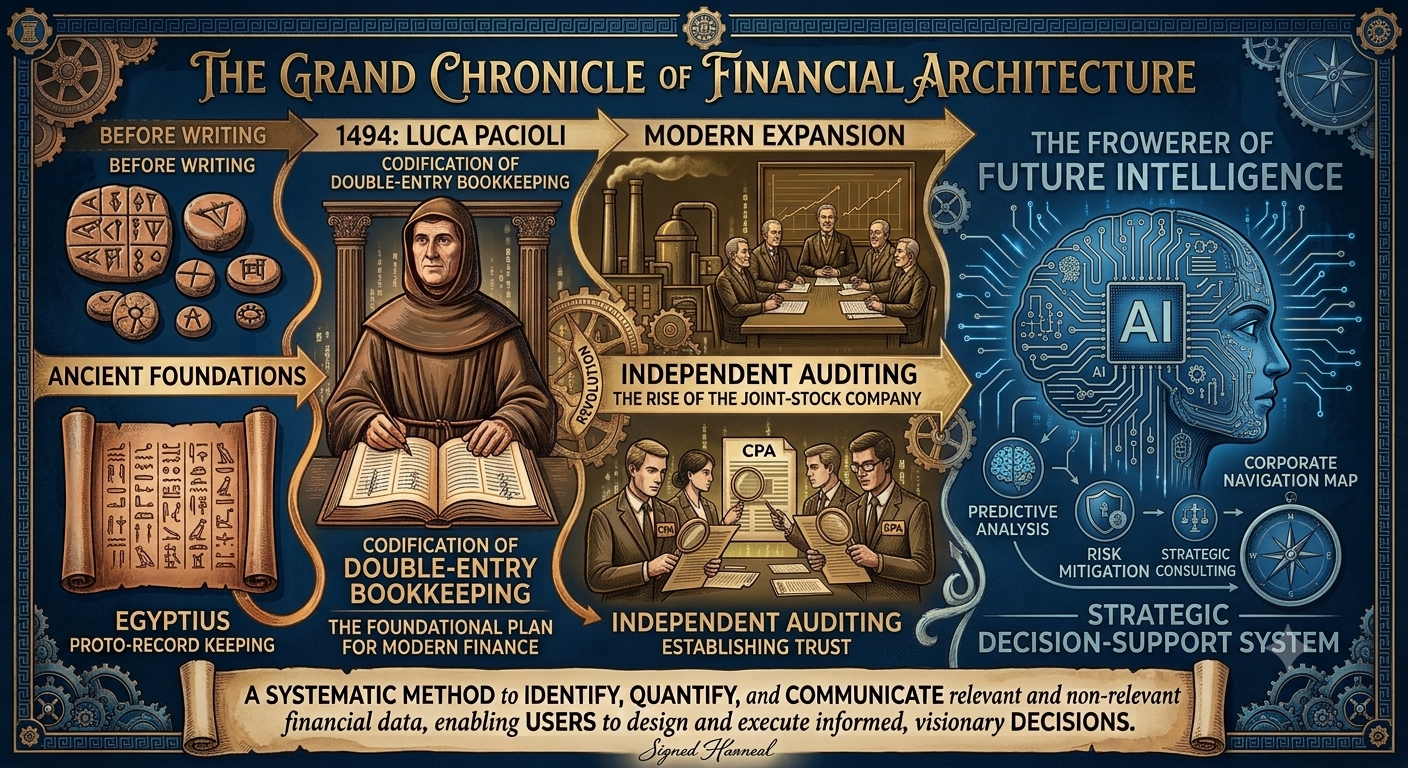
4. The Evolution of Financial Tracking: From Ancient Clay Tokens to AI
Financial record-keeping has continuously evolved alongside global economic progress.
1. Ancient Eras
- Clay tokens in Mesopotamia & Papyrus logs in Egypt.
- 1494: Luca Pacioli codifies Double-Entry Bookkeeping.
2. Modern Industrial Era
- Industrial Revolution creates massive joint-stock firms.
- Emergence of independent CPAs and standard Auditing.
3. The Artificial Intelligence Frontier
- Automated ledger entries via machine learning.
- Transition from data entry to strategic risk management.
Ancient Foundations
Before written language fully developed, Mesopotamians used small clay tokens inside sealed envelopes to track livestock counts, while ancient Egyptians tracked pyramid construction materials on papyrus sheets. A major breakthrough occurred in 1494 when Italian mathematician Luca Pacioli published the formalization of double-entry bookkeeping. By recording equal debits and credits on opposite sides of a ledger, Pacioli created an elegant self-balancing mechanism that prevented human error and established modern financial recording.
Industrial Revolution and the Modern Corporation
During the 18th and 19th centuries, the Industrial Revolution gave rise to massive manufacturing plants and publicly traded joint-stock corporations. When thousands of armchair investors pooled their capital into factory ventures, a critical question arose: How can investors verify that management is deploying their money responsibly? To establish public trust, the accounting profession institutionalized independent Certified Public Accountants (CPAs) and standardized external financial audits.
The Artificial Intelligence Frontier
Today, machine learning algorithms and software bots handle repetitive data entries and receipt scanning instantly. Modern financial professionals are no longer required to spend endless hours manually balancing ledger columns; instead, they serve as strategic consultants who utilize AI-generated diagnostics to mitigate operational risks, optimize tax structures, and guide capital deployment.
5. Pros and Cons Matrix of Structured Financial Systems
Implementing a rigorous financial tracking framework offers immense institutional value, though it comes with distinct administrative considerations.
| Strategic Focus Area | Advantages of Formal Financial Systems | Disadvantages & Operational Challenges |
| Management Decision-Making | Delivers concrete numerical data to make calculated business growth moves. | Relies on historical data, which cannot predict black swan events or future shocks perfectly. |
| External Market Credibility | Offers complete transparency, helping secure bank loans and venture investment. | Compliance with complex reporting standards requires significant capital and legal costs. |
| AI Integration Efficiency | Completely automates manual invoice processing, data extraction, and ledger posting. | Introduces systemic vulnerabilities regarding data breaches, security hacks, or algorithmic errors. |
| Performance Evaluation | Fairly measures departmental profit margins and individual unit cost efficiencies. | Focuses heavily on balance metrics, often obscuring unquantifiable employee creativity and effort. |
| Corporate Asset Control | Prevents asset leakage, fraud, and embezzlement through rigorous audit trails. | struggles to capture intangible digital assets (e.g., brand value, custom data) accurately. |
6. Standardized Rules: Generally Accepted Accounting Principles (GAAP)
For financial statements to serve as a reliable universal framework, everyone must play by the exact same rules. This standardized framework is known as Generally Accepted Accounting Principles (GAAP).
Uniform Financial Reporting Standards
Why Standardized Principles Matter
If every business used custom formulas to measure revenue or expense recognition, investors would have no objective way to evaluate competing firms. Standardized reporting frameworks prevent market chaos by ensuring consistency, comparability, and transparency across financial disclosures.
Core Framework Variations
Globally active enterprises and publicly listed firms generally adhere to International Financial Reporting Standards (IFRS) to maintain seamless capital access across international borders. Private mid-market businesses frequently utilize domestic GAAP frameworks designed to streamline administrative overhead while preserving rigorous reporting integrity.
Institutional Significance
Uniform financial rules act as a structural firewall preventing management from manipulating earnings figures artificially, preserving system-wide trust across capital markets.
7. The Modern Definition of Accounting
Modern professional standards define accounting as:
“The systematic process of identifying, measuring, and communicating relevant financial and non-financial information regarding an entity’s economic activities, enabling investors, executives, creditors, and regulatory agencies to make informed judgments and strategic decisions.”
While historical methods focused predominantly on backward-looking record retention, contemporary accounting functions as an agile, strategic decision-support system designed to forecast enterprise value and optimize resources.
8. The Three Key Pillars of Modern Business Accounting
3 Pillars of Modern Accounting
1. Language of Business
Standardized stakeholder communication
2. Compass for Decisions
Forward-looking strategic resource plan
3. Accountability & Transparency
Efficient capital allocation
Pillar 1: The Universal Language of Business
Enterprises must communicate continuously with diverse external parties, including retail shareholders, commercial banks, tax authorities, and internal teams. Accounting translates complex operational transactions into standardized financial statements that stakeholders anywhere in the world can instantly interpret.
Pillar 2: The Compass for Strategic Decision-Making
Financial metrics serve as both a rear-view mirror analyzing historical performance and a telescope scouting future growth pathways.
- For Chief Executive Officers: Cost accounting illuminates unit economics, product line margins, and budget allocations vital for long-term survival.
- For External Investors: Standardized ratios evaluate profitability, debt liquidity, and risk metrics, determining where investment capital can earn the highest risk-adjusted returns.
Pillar 3: Ensuring Efficient Capital Allocation and Social Accountability
Transparent financial disclosure is the bedrock of market economies. When enterprises publish audited balance sheets, capital naturally flows toward efficient, innovative businesses while avoiding mismanaged entities. This system minimizes market friction and builds broader social trust.
9. Emerging Trends and Modern Priorities
AI and Digital Transformation
Robotic Process Automation (RPA) and artificial intelligence now handle routine transactional postings, data ingestion, and reconciliations automatically. Consequently, modern financial leadership has pivoted from mechanical transactional processing toward strategic risk advisory, predictive modeling, and business consulting.
Environmental, Social, and Governance (ESG) Accounting
A modern company’s true value extends beyond tangible cash reserves. Non-financial metrics—such as corporate carbon footprints, supply-chain ethics, and board diversity—increasingly dictate enterprise valuation. Modern financial reporting is expanding rapidly to incorporate sustainability audits alongside balance sheet figures.
Conclusion: Key Takeaways
Numbers themselves never lie, but how executive leadership interprets those numbers determines an enterprise’s ultimate trajectory. In an era accelerated by artificial intelligence, cultivating the strategic vision to read beyond ledger figures is what separates market leaders from obsolete organizations.
- Accounting is a Strategic Roadmap: Far from an administrative burden designed to restrict spending, precise financial reporting serves as a clear mirror reflecting past operational efficiency and a guided navigation chart for future investments.
- Bookkeeping Builds the Foundation, Accounting Drives Strategy: Bookkeeping guarantees data accuracy at the transaction level, while accounting transforms that raw data into actionable insights for corporate leadership.
- Trust Drives Valuation: Transparent reporting according to established GAAP or IFRS guidelines builds institutional market trust—and enduring corporate valuation is built directly on trust.
AI Disclosure: This article was created, translated, and structured in collaboration with Google Gemini AI technology. The underlying concepts, structural edits, and final technical reviews were conducted directly by the author.