
n previous discussions, we explored the five-step revenue recognition model and the nuances of variable consideration in modern accounting. Today, we delve into long-term contracts—the cornerstone of project-based industries where these accounting principles face their ultimate test.
You may have seen headlines about a company winning a multi-billion-dollar project, causing its stock price to surge, only to see the same firm face sudden earnings shocks or liquidity crises a few years later. Why does this happen? What exactly is a long-term contract, how does it shape corporate management, and how is this massive revenue recorded on the balance sheet? Let us break down this essential topic into three key dimensions.
1. What Are Long-Term Contracts and Why Do They Exist?
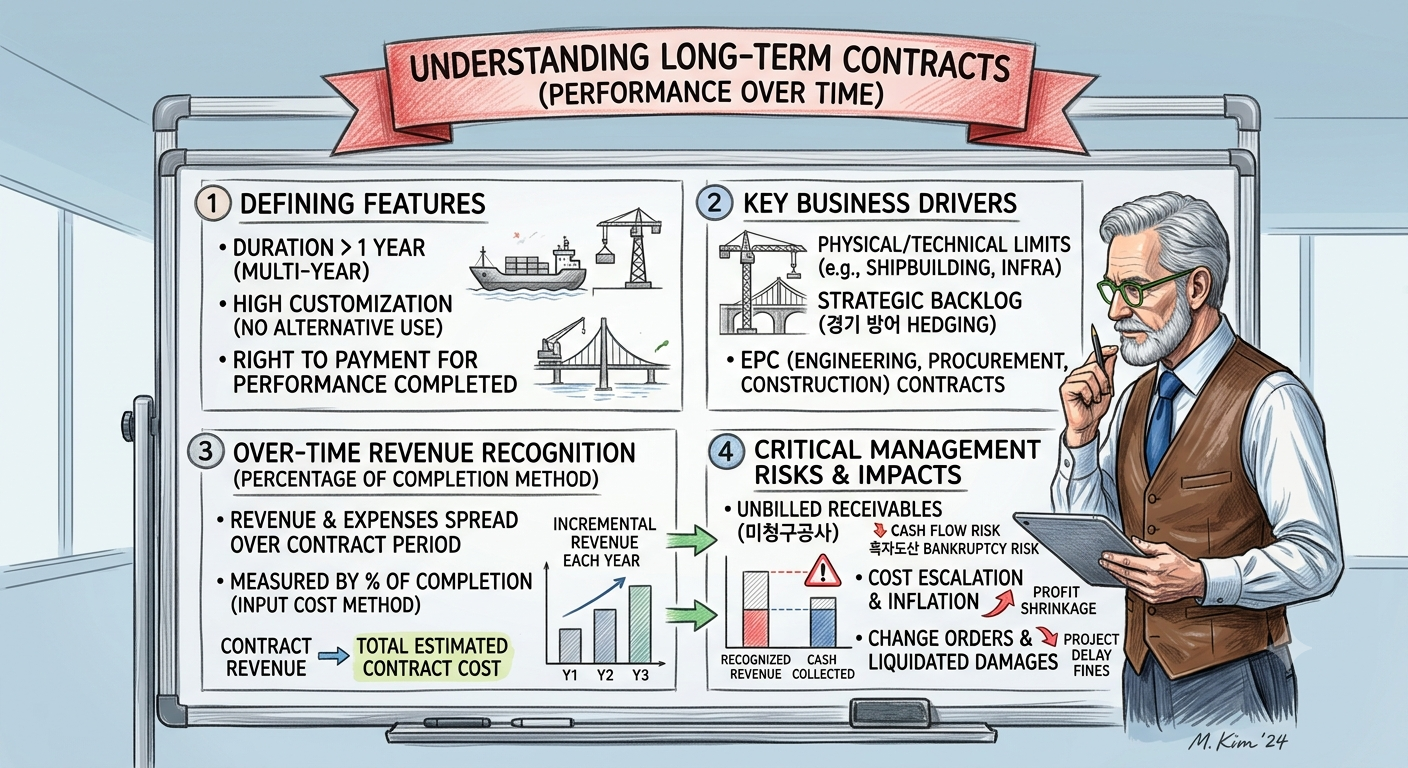
Unlike routine, single-point transactions, long-term contracts span from initial signing to final delivery over an extended period—typically exceeding one year and often stretching across several years. Beyond mere duration, these contracts arise from distinct business drivers:
- Physical and Technological Constraints: Constructing commercial vessels, offshore platforms, aerospace assets, or large infrastructure (such as bridges, power plants, and urban developments) inherently requires years of design, engineering, and testing.
- High Customization (No Alternative Use): Enterprise-level Systems Integration (SI) projects and defense assets (like fighter jets or submarines) are tailored to specific client specifications. If a contract is canceled mid-way, the asset cannot easily be resold to another buyer.
- Strategic Economic Hedging: Securing a multi-million or multi-billion-dollar backlog provides a stable foundation, ensuring operational continuity and consistent cash flow even during economic downturns.
2. Accounting for Revenue: Point-in-Time vs. Over-Time Recognition
How a company recognizes revenue from long-term contracts drastically alters its financial statements under International Financial Reporting Standards (IFRS).
① Point-in-Time Recognition (Exceptional Case)
Under this approach, revenue and expenses are recognized all at once when the project is fully completed and control of the asset is transferred to the client.
- The Drawback: If a shipbuilder takes three years to construct a vessel, recognizing zero revenue in Years 1 and 2, followed by a massive lump sum in Year 3, severely distorts financial reporting. The business appears unprofitable for two years before suddenly showing inflated performance in the final year.
② Over-Time Recognition (Standard Practice)
Under this preferred approach, revenue is recognized incrementally over the contract period as the client obtains control or as the firm establishes an enforceable right to payment for work completed.
- Measuring Progress (Input Method): In practice, completion is typically calculated using the ratio of cumulative costs incurred to date against total estimated project costs:
Example: Consider a contract valued at $30 million with total estimated costs of $20 million. If actual costs incurred in Year 1 reach $5 million, the progress rate is 25% ($5 million/$20 million). Consequently, the firm records $7.5 million in revenue (25% of $30 million) and $5 million in contract expenses, reporting a clear operating profit of $2.5 million for the period.
| Accounting Concept | Primary Accounting Treatment | Key Management Risk |
|---|---|---|
| Over-Time Revenue Recognition | Revenue allocated based on cumulative costs incurred relative to total estimated costs. | Unbilled receivables and cost escalation risks require strict cash flow management to prevent insolvency. |
3. Key Industry Applications of Over-Time Accounting
Shipbuilding and Offshore Engineering
The classic example of long-term contract accounting involving ultra-large container ships, LNG carriers, and offshore rigs. Because vessels are highly customized to buyer specifications, they lack alternative utility. Since contracts guarantee payment rights for work performed to date, revenue is recognized over time. However, this sector remains exposed to raw material cost surges and unbilled contract risks.
Construction and Infrastructure Development
Covers highways, bridges, nuclear power plants, and commercial complexes. When construction takes place on client-owned land, the buyer controls the asset as it is built. Revenue is recognized progressively over the construction period based on input costs.
Systems Integration (SI) and Enterprise IT Solutions
Involves building custom enterprise platforms, core banking systems, or government databases. Rather than selling off-the-shelf software, IT vendors build custom code over many months. Progress is tracked using direct costs or billable labor hours (Man-Months).
Defense and Aerospace
Focuses on government contracts for aircraft, defense radar systems, and space launch vehicles. These assets serve single government clients and have no alternative market. Structured milestone schedules and enforceable payment rights make them ideal for over-time recognition.
Industrial Plant Engineering
Includes semiconductor fabrication lines, petrochemical refineries, and steel mills. Managed under Engineering, Procurement, and Construction (EPC) contracts, these multi-year projects require precise cost-matching across design and construction phases.
Key Financial Insight: Major contract awards in shipbuilding, infrastructure, or defense are all governed by over-time accounting. When evaluating these firms, always cross-reference “Unbilled Receivables” against “Operating Cash Flow” to verify earnings quality.
4. Three Major Operational Risks in Long-Term Contracts
While long-term contracts expand top-line revenue, unmanaged risks can jeopardize corporate solvency:
- Cost Escalation and Inflation: Rising labor and materials prices over multi-year timelines can erode profit margins. Mitigation: Include price adjustment clauses (escalation terms) in contracts to share inflation risks with project owners.
- Unbilled Receivables and Cash Flow Mismatches: Recognizing paper profits without timely cash collection creates liquidity traps, risking insolvency despite reported gains. Mitigation: Monitor unbilled receivables closely and align revenue recognition schedules with actual cash collections.
- Scope Creep and Delay Penalties: Design modifications and unexpected delays can trigger heavy liquidated damages. Mitigation: Implement strict change-order procedures and maintain thorough documentation to manage liability for timeline adjustments.
Conclusion: Key Takeaways
- Long-term contracts require over-time revenue recognition under IFRS, matching revenues with expenses based on project completion rates.
- Paper profitability must be balanced with liquidity; tracking unbilled receivables and operating cash flow is essential to assess financial health.
- Proactive risk management—including price escalation terms and change-order tracking—is crucial to protect margins against inflation and project delays.
AI Disclosure: This content was developed in collaboration with Google Gemini AI, then reviewed, refined, and edited by the author.