
If past business management was merely about saving money and hoarding it in a vault, modern management is about determining where to deploy that capital to create maximum value. As of 2026, companies must choose their path: to remain a vessel lost in the fog of aimless management, or to captain the ship with the reliable lighthouse known as a Cash Budget. The most critical skill for a modern executive is the keen ability to foresee and navigate the flow of liquid capital.
1. Understanding Cash Budgeting
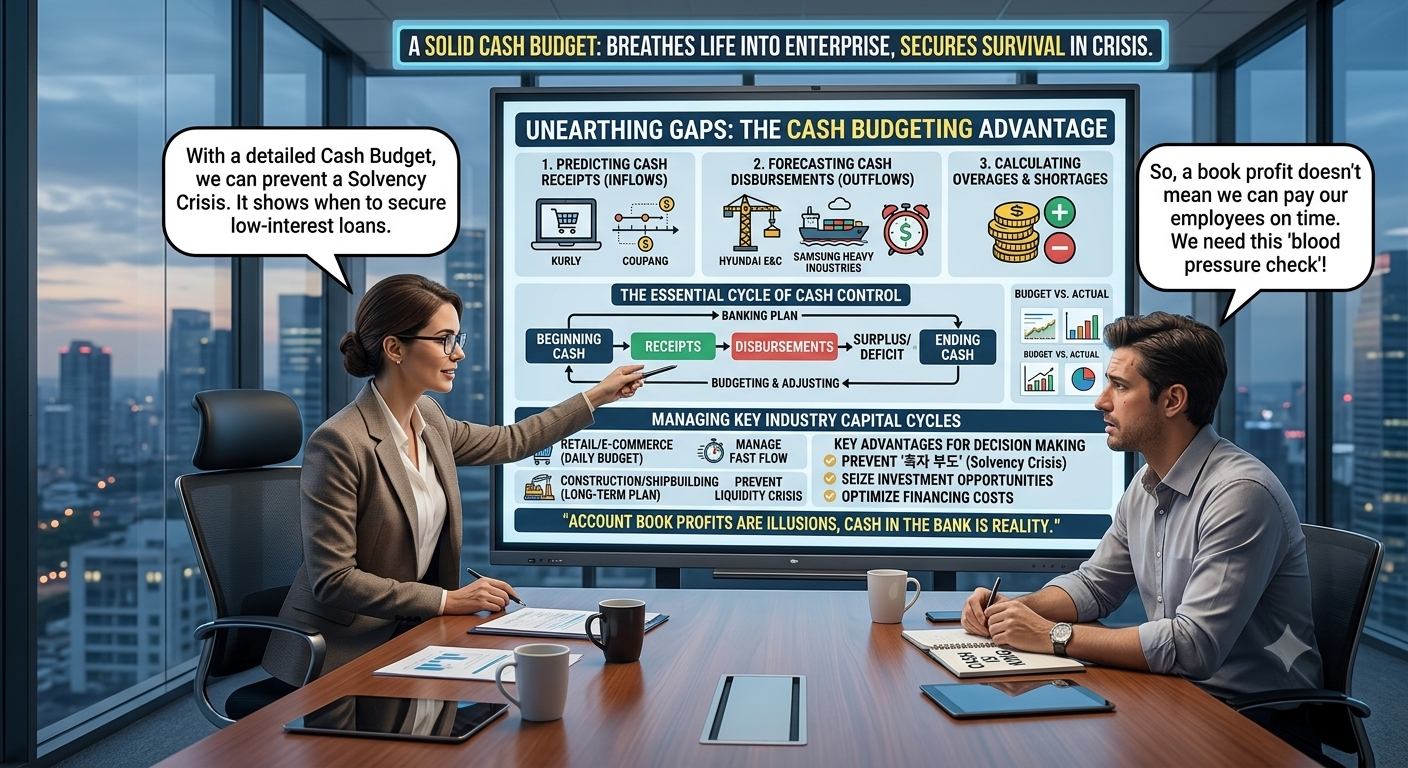
Think of a cash budget like a personal travel itinerary for your wallet. It isn’t just about having money; it’s about knowing exactly when you’ll receive funds and when you need to pay for your next expenses. Even if your net worth is high, you can still face a crisis if you lack the cash for a deadline today. A cash budget is a time-dated financial blueprint that estimates the timing and volume of cash inflows and outflows.
2. The Vital Importance of Cash Flow
- The Bloodstream of Business: While a company might show a profit on paper due to credit-based sales, it cannot pay employees or suppliers with “accounts receivable.” A cash budget acts as a financial pacemaker, ensuring that the company never runs dry.
- Preventing “Profitable Bankruptcy”: Many firms fail not because they lack orders, but because they suffer from timing mismatches between cash-in and cash-out. A cash budget serves as a safety net, preventing the tragedy of insolvency amidst paper profitability.
3. Industry Applications
- E-commerce (e.g., Coupang, Market Kurly): Because these companies deal with massive volumes of daily transactions, they must maintain a daily cash budget to cover warehouse operations and vendor payments.
- Construction & Heavy Industry (e.g., Hyundai Engineering, Samsung Heavy Industries): These sectors have long project lifecycles. They may not receive payment for years. Without a granular cash budget, these firms face the high risk of a liquidity crisis midway through a project.
4. The 5-Stage Cash Budgeting Process
- Beginning Cash Balance: Accurately audit the actual liquid cash currently available in the bank.
- Forecasting Cash Receipts: Calculate the exact date and amount of money entering the bank (e.g., payments for goods sold, collection of loans).
- Forecasting Cash Disbursements: Record the actual dates and amounts of money leaving the account, including payroll, materials, taxes, and utilities.
- Calculating Surplus or Deficit: Subtract expenses from inflows to determine if the period will result in a cash surplus or a cash deficit.
- Ending Cash Balance & Adjustment: If a surplus exists, plan to invest in short-term interest-bearing assets; if a deficit is imminent, plan for a bridge loan.
5. Pros and Cons of Cash Budgeting
| Perspective | Advantages | Disadvantages |
| Solvency | Prevents bankruptcy due to immediate cash shortages. | Difficult to predict future cash flows with 100% accuracy. |
| Financing | Allows for low-cost borrowing by predicting deficits early. | Susceptible to sudden market shocks or payment delays. |
| Investing | Enables interest income from temporary surplus. | Over-focus on cash may lead to missed growth opportunities. |
| Credibility | Ensures reliable payments to vendors and partners. | Tight budget constraints can create high employee stress. |
6. Cash Budget vs. Single-Entry Accounting
Many confuse simple accounting with strategic budgeting. A simple ledger is like a diary reflecting on yesterday’s spending, whereas a cash budget is a flight plan preparing for tomorrow’s voyage.
| Perspective | Single-Entry Accounting | Cash Budget |
| Time Orientation | Past-oriented (records what happened) | Future-oriented (predicts what will happen) |
| Primary Goal | Recording expenses and remaining cash | Forecasting liquidity and deficits |
| Methodology | Recording after cash is spent | Planning based on payment terms and collections |
| Strategic Utility | Simple balance confirmation | Planning loans, investments, and growth |
7. Strategic Differences
- The Compass for Timing: Accounting records events after the fact. Cash budgeting calculates “funding gaps.” If a company faces a multi-month lag in international capital transfers, a cash budget forces the manager to arrange financing months in advance rather than waiting until the account hits zero.
- Operational Strategy: Simple records show that money is gone; cash budgets allow you to decide whether to hold excess cash in high-yield accounts or strategically utilize it for short-term opportunities, directly influencing corporate survival.
Conclusion: Key Takeaways
- Cash is Not Paper Profit: A company can be profitable on paper but still die without liquidity. Never mistake accounting records for cash status.
- Anticipate the Gaps: The primary goal of a cash budget is to identify the “timing gap” between cash inflows and outflows and manage it before a crisis hits.
- Proactive vs. Reactive: A diary (accounting) helps you regret your past, but a flight plan (cash budget) prevents future disasters.
- Manage Your Lifeblood: Treat cash as the blood of your organization. Review your cash budget regularly to ensure it is always flowing, and you will secure your survival in volatile markets.
*This post was created in collaboration with Google Gemini AI. The author independently created, reviewed, and edited the content to ensure professional quality.