
Management expert Philip Kotler once emphasized a fundamental truth within the marketing mix (the 4Ps): “Only price generates revenue; all other elements—product, place, and promotion—represent costs.”
Even the most innovative product paired with brilliant marketing will fail if the pricing strategy is flawed. A poor pricing decision can trap a company in a cycle of losses or lead to customer abandonment. To master this, we must move beyond simple arithmetic and understand the complex equation that balances corporate survival with customer psychology.
1. A Relatable Analogy: The Local Bakery
To understand the weight of pricing, imagine a local artisan bakery owner deciding how much to charge for a new organic sourdough loaf. Their deliberation usually falls into one of three categories:
- Cost-Based Approach: “It costs $3 to make, including ingredients, labor, and rent. I’ll add a $1 markup and sell it for $4.”
- Competition-Based Approach: “The big franchise bakery across town sells theirs for $4.50. I should price mine at $4.30 to stay competitive.”
- Value-Based Approach: “My loaf uses 100% natural yeast, which is easier to digest. Health-conscious customers would happily pay $7 for this quality.”
If the owner relies solely on the cost or competitive approaches, they essentially throw away potential profit (opportunity cost) from customers who recognize and are willing to pay for the true value of the product. Conversely, setting the price too high without substantiating the value will result in zero sales. Pricing is not just math; it is a strategic balancing act.
2. Why Pricing is Your Most Powerful Leverage
Price is the most immediate and impactful lever for a company’s financial health.
- Profitability Maximization: McKinsey research consistently shows that a 1% improvement in price typically results in an 11% increase in operating profit—a far more significant impact than a 1% improvement in sales volume or variable costs.
- Brand Positioning: Price serves as a powerful signal of quality. High prices cultivate a “premium” brand identity, while low prices signal “value” or “budget-friendly” positioning.
- Demand Regulation: Pricing allows firms to control demand, build barriers to entry, and deter competitors.
3. Cost-Based Pricing: The Foundation
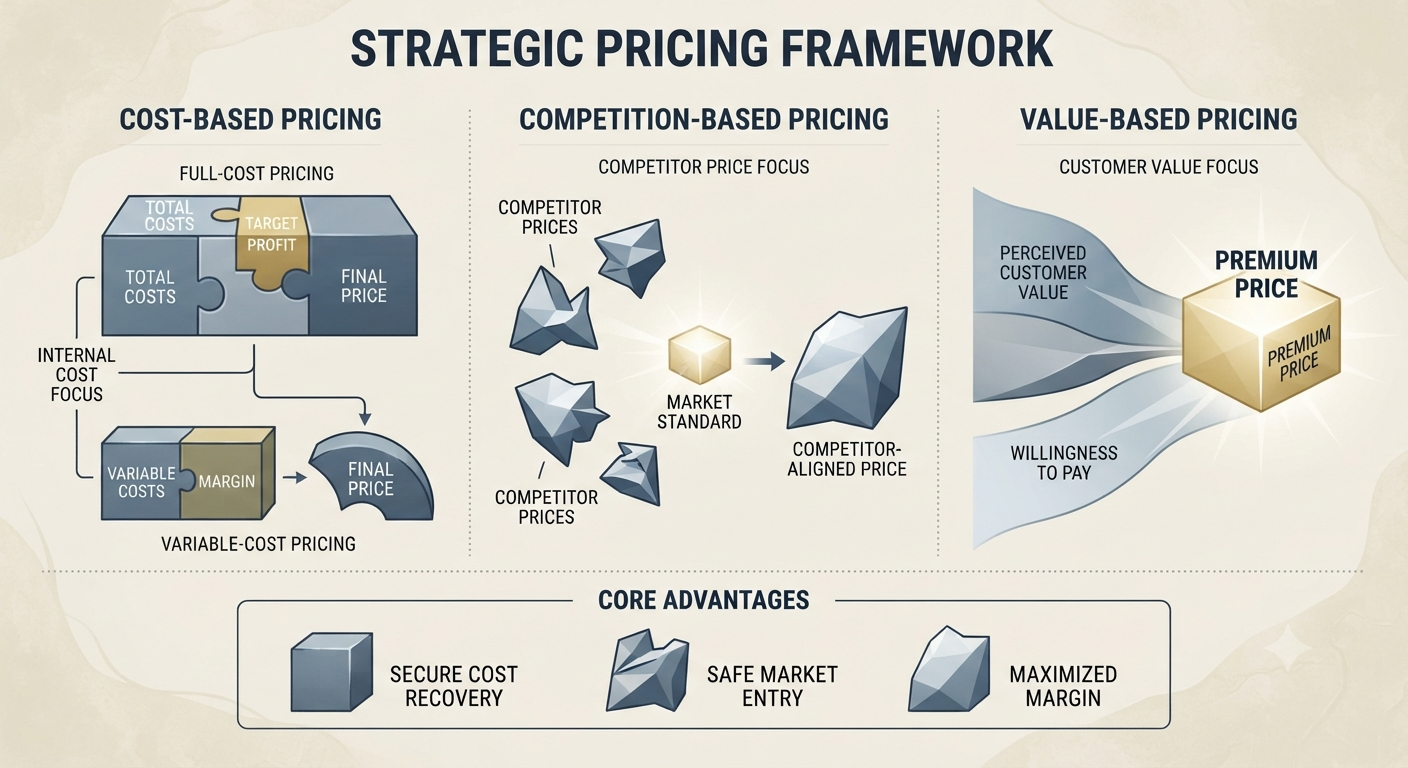
Widely used in traditional manufacturing and management accounting, this method adds a margin to the costs incurred to produce the product.
Full-Cost Pricing
This method aggregates all costs—direct materials, direct labor, variable overhead, and allocated fixed overhead—and adds a target markup. While it ensures long-term cost recovery and financial safety, it often ignores market demand and competition.
Variable-Cost Pricing
This approach focuses only on costs that change with production (materials, labor, etc.). It is highly flexible for short-term decisions or special orders during slow seasons. However, relying on this long-term can lead to total losses, as fixed costs may remain unrecovered.
4. Comparing Pricing Strategies
| Strategy | Focus | Main Advantage | Main Disadvantage | Best For |
| Cost-Based | Internal Costs | Clear, ensures cost recovery | Ignores demand/value | Standardized goods |
| Competition-Based | Market Rivals | Easy entry, avoids price wars | Leads to “race to the bottom” | Commodity products |
| Value-Based | Customer Value | Maximized margins | Hard to measure value | Innovative/Luxury goods |
5. Strategic Pricing in Action: Global Case Studies
Price Skimming: The Apple Approach
This strategy sets a high price at launch to “skim” profits from early adopters. As time passes, the company lowers the price to capture the mass market. Apple maximizes early margins from brand loyalists, then sweeps up price-sensitive customers as the product matures.
Penetration Pricing: Netflix and Coupang
Here, prices are set low—sometimes at or below cost—to quickly capture market share. By sacrificing initial margins, companies like Netflix and Coupang built massive user bases, normalizing prices only after achieving a dominant market position.
Captive Product Pricing: Gillette and Nespresso
The “Razor and Blades” model involves selling the primary hardware (a coffee machine or shaver) at a low margin to “lock in” the customer. The company then generates consistent, high-margin revenue from recurring sales of essential consumables (coffee capsules or razor blades).
6. Pricing Under Constraints: The Bottleneck Principle
Production capacity is rarely infinite. When faced with a bottleneck—limited machine hours or raw material supply—the management accounting rule is simple: prioritize the product with the highest Contribution Margin per unit of the constrained resource, not the highest margin per product.
- Practical Guide: If a product has high margins but consumes 5 hours of machine time, it may be less profitable than a product with lower margins that only requires 1 hour of machine time. Adjust prices to throttle demand for bottleneck-heavy items or reflect their true scarcity value.
7. Final Advice for Executives
The biggest mistake a CEO can make is relying solely on cost reports. Costs determine the “floor” of your price, but only the customer determines the “ceiling.” To mitigate price sensitivity when raising rates, consider tactics like “shrinkflation” (reducing package size) or adding premium tiers to avoid diluting brand value.
“Cost-based pricing that ignores customer value is narrow-minded; pricing that ignores costs is a disservice to your own efforts.”
Conclusion: Key Takeaways
- Pricing is Strategy: It is a tool for brand positioning and profit optimization, not just a mathematical formula.
- Know Your Ceiling: While internal costs set your price floor, the perceived value provided to the customer dictates your upper limit.
- Strategic Flexibility: Choose your pricing model based on your market phase—use skimming for innovation, penetration for market share, and captive models for recurring revenue.
- Constraint Awareness: Always evaluate profitability based on constrained resources to ensure maximum organizational throughput and profit.
Disclaimer: This post was created in collaboration with Google Gemini AI. The content has been researched, authored, reviewed, and edited by the author to ensure professional quality and accuracy.