
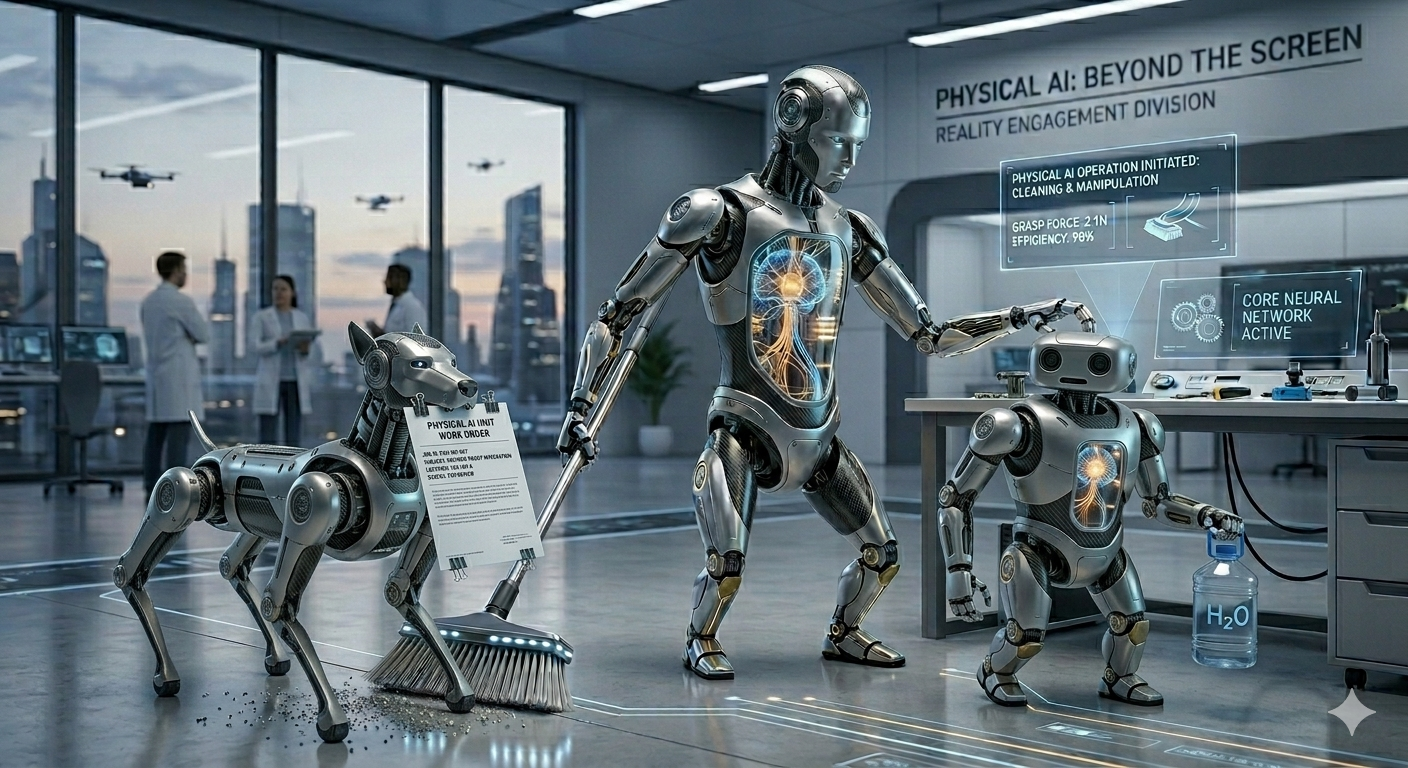
In the past, artificial intelligence was largely a “smart friend inside a screen” that played chess, beat human masters at Go, or generated digital artwork. If you asked that AI to “clean the room,” it would simply provide you with a step-by-step text instruction manual on how to sweep and tidy up. Today, however, artificial intelligence is evolving into a “real-world worker” equipped with physical limbs, torsos, and sensory receptors. AI has officially picked up the broom and begun sweeping the floor.
We are living in the era of “Physical AI”—a time when artificial intelligence, once confined purely to data systems, is being permanently grafted into physical bodies like robots, industrial machinery, and autonomous vehicles. This shift represents a monumental leap forward. AI is escaping the prison of the monitor, stepping into our shared physical space, and directly interacting with the tangible world.
1. Understanding Physical AI Through Everyday Analogies
To truly grasp Physical AI, it helps to think of a professional athlete. No matter how brilliant a strategist an athlete is, they cannot win a game if their physical body cannot execute the plays. For AI to move the real world, a precise and seamless harmony between the “digital brain” and the “physical body” is mandatory.
The Anatomy of Physical AI
- Physical (The Body): This represents the tangible, touchable hardware—the robots, autonomous vehicles, and drones.
- AI (The Brain): This represents the cognitive engine that senses situations, makes real-time decisions, and learns independently.
- The Integration: Physical AI occurs when these two forces combine, allowing the digital brain to control the physical body to execute complex real-world tasks.
The “Smart Puppy” Analogy
Think of the difference between a wind-up toy and a living puppy. A wind-up toy moves blindly in a straight line only because a human cranked it up; it will crash straight into a wall. A puppy, however, hears its owner call, analyzes the room, dynamically dodges obstacles, and runs straight to them.
This capability to perceive surroundings and execute real-time physical actions is the core of Physical AI. Traditional AI acted like an eloquent, well-spoken administrative secretary. Physical AI operates as an efficient, highly capable physical laborer.
2. The Origins and Evolution of Embodied AI
This technological shift did not happen overnight. It is the culmination of humanity’s long-standing pursuit of automation.
- The Roots in Traditional Robotics: In the 1960s, the first industrial robotic arms appeared on factory assembly lines. While these machines could move, they were merely “dumb laborers” restricted to repeating rigid, hard-coded commands. If a part was slightly out of place, the machine failed.
- The Cognitive Upgrade (LLMs): The massive turning point arrived with the explosion of Large Language Models (LLMs) like ChatGPT. Instead of humans programming every single micro-movement, machines can now process situational context through natural language and visual data, giving them an actual reasoning “brain.”
- Sim-to-Real Technology: AI can now practice moving, balancing, and grasping objects hundreds of millions of times inside hyper-realistic virtual simulations. Once the brain masters the physics inside the computer, it is downloaded into a physical robot body. This “Simulation-to-Reality” process has caused Physical AI capabilities to explode.
3. Current Market Trends and Key Players
Physical AI is rapidly moving past basic locomotion and is now mimicking the micro-muscular precision of human hands.
- Robotics Foundation Models: Global tech giants like Google and OpenAI are aggressively developing foundational AI models built specifically for physical bodies. Because of these models, a robot can now hear the phrase “pick up the apple,” identify the apple out of thousands of random objects, and apply the exact amount of delicate pressure needed to lift it without crushing it.
- The Humanoid Revolution: Companies like Tesla with its “Optimus” robot, alongside specialized firms like Figure AI, are building humanoid robots designed to mirror the human form. By building robots that match our shape, these machines can seamlessly use human tools, climb existing stairs, move through narrow corridors, and operate within infrastructure originally built exclusively for humans.
4. The Balance of Physical AI: Strengths and Weaknesses
While Physical AI unlocks unprecedented economic value, it introduces real-world variables and distinct social responsibilities.
“We are moving beyond the era of the ‘click’ and entering the era of the ‘touch.’ Physical AI is officially moving our reality.”
Strengths
- Replacing High-Risk Labor: Physical AI can be deployed directly into toxic waste environments, deep-sea exploration, burning buildings, and nuclear power plants, protecting human lives from extreme danger.
- 24/7 Precision Operations: These systems do not suffer from physical fatigue or shifting focus. They can perform highly intricate medical surgeries or assemble micro-components with a level of precision that surpasses human physical limitations.
Weaknesses & Operational Risks
- Physical Safety Vulnerabilities: When a software-based AI glitches, you simply reboot the application. When a 300-pound Physical AI robot malfunctions or an autonomous vehicle miscalculates, it results in immediate, real-world property damage or severe human injury.
- Socioeconomic and Labor Shifts: As robots begin replacing both blue-collar manual labor and high-precision technical work, society faces a massive structural shift. This transition requires proactive educational systems and economic frameworks to retrain the human workforce.
5. Side-by-Side Comparison: Digital AI vs. Physical AI
| Core Category | Digital AI (In the Screen) | Physical AI (In the Reality) |
| Operational Domain | Computers, smartphones, cloud servers | Living rooms, manufacturing plants, roads, skies |
| Primary Role | Information indexing, copywriting, coding, digital art | Asset assembly, product delivery, autonomous driving, house chore execution |
| Core Senses | Data patterns, text corpora, code repositories | Visual sensor arrays, spatial tracking, physical dynamics learning |
6. Investment Strategies for the Physical AI Era
Investing in the age of Physical AI requires identifying who builds the cognitive brain and who manufactures the critical infrastructure components.
1) Industrial Infrastructure Play
- Advanced Hardware Semiconductors: Physical AI must process massive streams of real-time visual and spatial data simultaneously. Companies designing high-performance GPUs and ultra-low-power NPUs (Neural Processing Units) act as the foundational suppliers for the entire robotics industry.
- Mobility and Advanced Logistics: The earliest commercial adoption of Physical AI is happening across global supply chains, autonomous transit, and defense infrastructure. Companies like Hyundai—through their acquisition of Boston Dynamics—and tech-forward logistics giants are leading the charge by integrating physical intelligence directly into global fleet systems.
2) Investor Persona Customization
- Growth-Oriented Investors (Aggressive): Focus your research on specialized micro-cap engineering firms that manufacture high-precision reducers, joints, and “actuators.” No matter which front-facing consumer robot brand wins the market, every single physical machine requires these exact hardware components to move.
- Retirement-Focused Investors (Conservative): Align your capital with dominant mega-cap platform enterprises like Tesla or Amazon. These corporations possess the massive capital pools, proprietary data pipelines, and real-world testing environments necessary to scale Physical AI, allowing them to permanently lower their structural operating costs.
Conclusion: Key Takeaways for Today’s Investors
The transition from digital software to Physical AI is one of the most significant industrial shifts of our generation.
- The Evolution is Real: AI is no longer just processing words; it is actively manipulating matter. The companies mastering the convergence of software brains and hardware bodies will command the future economy.
- Look at the Supply Chain: Do not just look at the coolest-looking robot. True value often sits quietly in the specialized semiconductor chips and mechanical components that make real-world movement possible.
- Balance Your Risk: Determine your investment style. Whether you target high-growth robotic component manufacturers or stable, cash-rich tech conglomerates deploying automation at scale, ensure your portfolio matches your long-term wealth timeline.
AI Disclosure: Created in collaboration with Google Gemini. All core content was authored, reviewed, and edited by the author.