
When listing various types of intangible assets, one particular asset stands out due to its unique nature: Goodwill.
Unlike patents or trademarks, goodwill comes with no visible registration certificate, nor can it be carved out and sold independently. It is an unidentifiable, non-legal intangible asset. In practical business terms, goodwill is what practitioners often refer to as a “key money premium” or an “acquisition premium.”
Understanding the essence of goodwill along with its core accounting and tax treatments is essential for sound executive decision-making.
1. What Is Goodwill? The “Invisible Premium”
Goodwill represents the intangible strength that allows a company to generate excess earnings compared to competitors in the same industry.
Consider two coffee shops using identical espresso machines and sourcing the exact same beans. One shop generates three times more revenue because it boasts a loyal customer base, a stellar brand reputation, and highly skilled baristas.
The monetary valuation of these combined invisible elements—customer trust, prime location, and operational expertise—is precisely what accountants define as goodwill.
2. When Does Goodwill Appear on the Balance Sheet?
A common point of confusion among executives is self-valuation: “Our brand is strong, so let’s record $1 million in goodwill on our balance sheet.”
This is strictly prohibited.
Under standard accounting frameworks (IFRS and US GAAP), internally generated goodwill cannot be recognized as an asset. Because its value cannot be objectively measured, allowing internal recognition creates a high risk of inflated asset values by management.
Goodwill can only be recorded when it is explicitly paid for through a business combination (such as a merger or acquisition).
To visualize how goodwill is calculated during an acquisition, consider the following structural breakdown:
The Goodwill Formula
Goodwill=Purchase Price−Fair Value of Net Assets
Real-World Example: If you acquire a target company with net assets (Assets minus Liabilities) valued at fair market price of $10 million, but pay $15 million due to high growth prospects and proprietary technical know-how, the remaining $5 million difference is recognized on your balance sheet as goodwill.
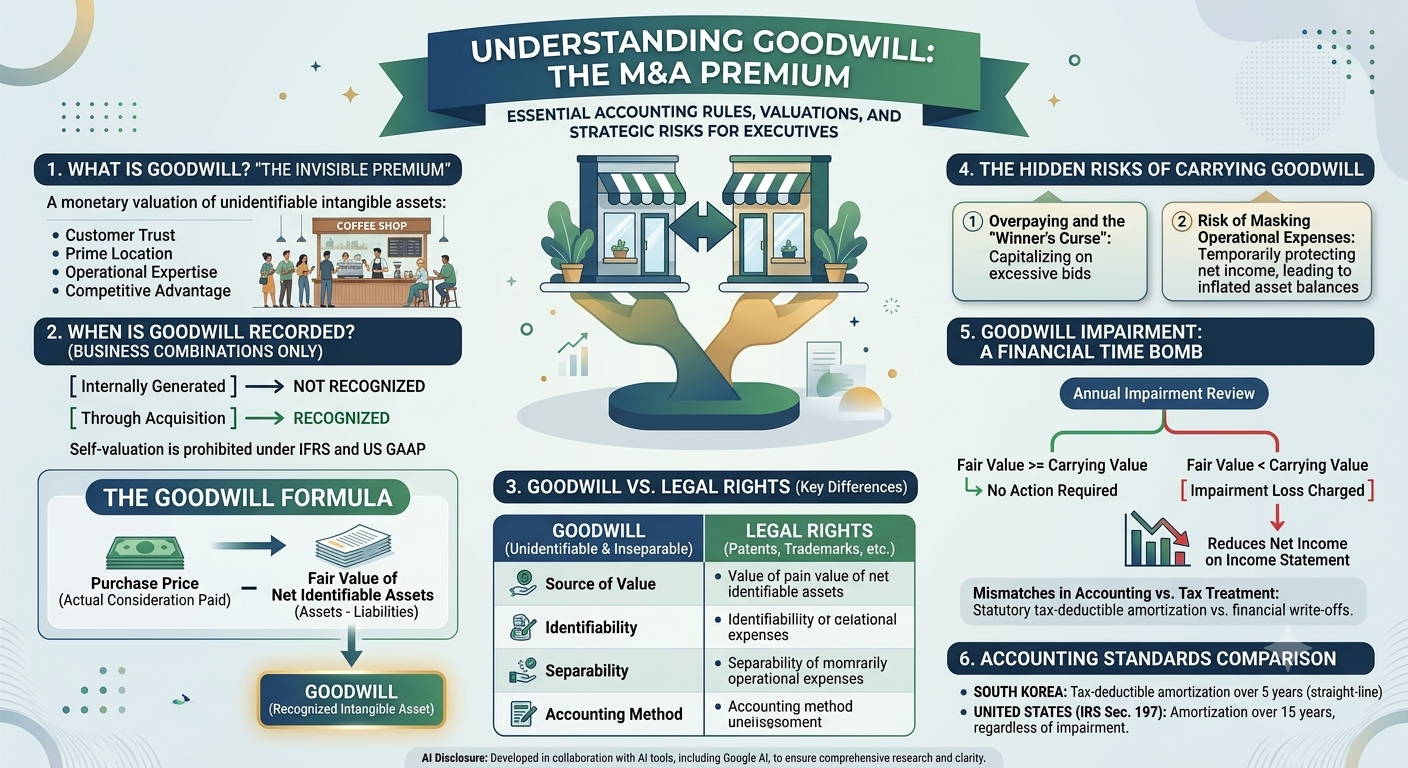
3. Goodwill vs. Legal Rights: Key Differences
Goodwill behaves fundamentally differently from legally enforceable rights such as patents, trademarks, or utility models. The most decisive distinctions lie in identifiability and separability.
Executive Takeaway: Patents or trademarks serve as standalone tools that can be detached and liquidated. Goodwill is the overall corporate synergy—an inherent brand magnetism that cannot exist apart from the business itself.
4. The Hidden Risks of Carrying Goodwill on Balance Sheets
Capitalizing massive amounts of goodwill following an M&A transaction introduces notable strategic and balance-sheet risks.
Overpaying and the “Winner’s Curse”
In competitive bidding wars, corporate buyers frequently overpay relative to the target’s standalone fair market value. Every excess dollar paid beyond fair value shifts directly into recorded goodwill. While this initially prevents reporting an instant loss, it essentially anchors an overvalued asset onto the balance sheet.
Risk of Masking Poor Operational Expenses
Capitalization can occasionally be mismanaged to hide underlying operational weak points. Capitalizing costs into goodwill rather than recognizing immediate integration expenses temporarily protects current net income, but creates an artificially inflated asset balance that risks future write-downs.
5. Goodwill Impairment: A Financial Time Bomb
Because goodwill has an indefinite useful life, accounting standards prohibit gradual, scheduled amortization under US GAAP and IFRS. Instead, managers must perform an annual impairment test.
Operational Downturns and Financial Distress
If an acquired subsidiary underperforms, loses major client contracts, or faces shifting market trends, auditors will require an immediate write-down.
Goodwill impairment is recognized as a non-operating expense. While it does not trigger an immediate cash outflow, it reduces net income on the income statement, directly impacting retained earnings, credit ratings, and shareholder confidence.
Mismatches in Accounting vs. Tax Treatment
In corporate tax jurisdictions like the United States under IRS Section 197, tax rules permit statutory tax-deductible amortization over 15 years (180 months) for eligible acquired goodwill.
This discrepancy creates a structural mismatch:
- Financial Reporting: Goodwill remains unamortized until an unexpected impairment loss hits the income statement in a single large wave.
- Tax Reporting: Tax savings accumulate steadily year-over-year.
A sudden financial reporting write-off can cause reported net income to plummet while tax shield benefits continue at their steady statutory pace, complicating cash flow projections and investor communications.
6. Accounting Standards Comparison: Korea vs. United States
Tax and regulatory authorities audit goodwill transactions carefully due to their scale.
South Korea
Korean Tax Law permits acquired goodwill—when supported by an independent valuation—to be amortized for tax purposes evenly over 5 years using the straight-line method. This provides an expedited tax shield for corporate buyers.
United States (IRS Sec. 197)
Regardless of whether financial accounting records an impairment loss, the IRS requires tax-deductible goodwill to be amortized linearly over 15 years.
7. Conclusion: Key Takeaways
- Acquisition-Only Recognition: Goodwill cannot be self-created on financial statements; it only arises when an acquisition price exceeds the fair value of net identifiable assets.
- Inseparable Synergy: Unlike patents or trade secrets, goodwill cannot be carved out, licensed, or sold separately from the core business.
- Impairment Risk Management: Because goodwill is not amortized under financial reporting standards, executives must carefully track goodwill balance trends. Annual impairment tests carry the risk of sudden earnings drops if acquired units underperform.
- Tax Mismatches: Management must account for differences between financial impairment rules and tax amortization schedules (e.g., 15-year IRS Sec. 197 deductions) when forecasting long-term cash flows.
AI Disclosure: This article was developed in collaboration with AI tools, including Google AI, to ensure comprehensive research, structured analytical insights, and technical clarity.