
n the past, investing was simply about becoming an “owner of a company that earns money well.” Today, however, investing has evolved into a sophisticated game of “predicting a company’s future report card.” Some companies may not give you much pocket money right now but have the potential to make you incredibly wealthy in the future. Others may not be flashy, but they possess the steady strength to consistently fill your piggy bank every single month.
As of 2026, we live in an era where we must make a wise choice between the flashy “sports car” of Growth Stocks and the sturdy, heavy-duty “truck” of Value Stocks. It is a dilemma between having the sharp insight to identify tomorrow’s superstar today and the unwavering faith to protect a timeless, reliable local business.
1. Understanding the Market Through Everyday Analogies
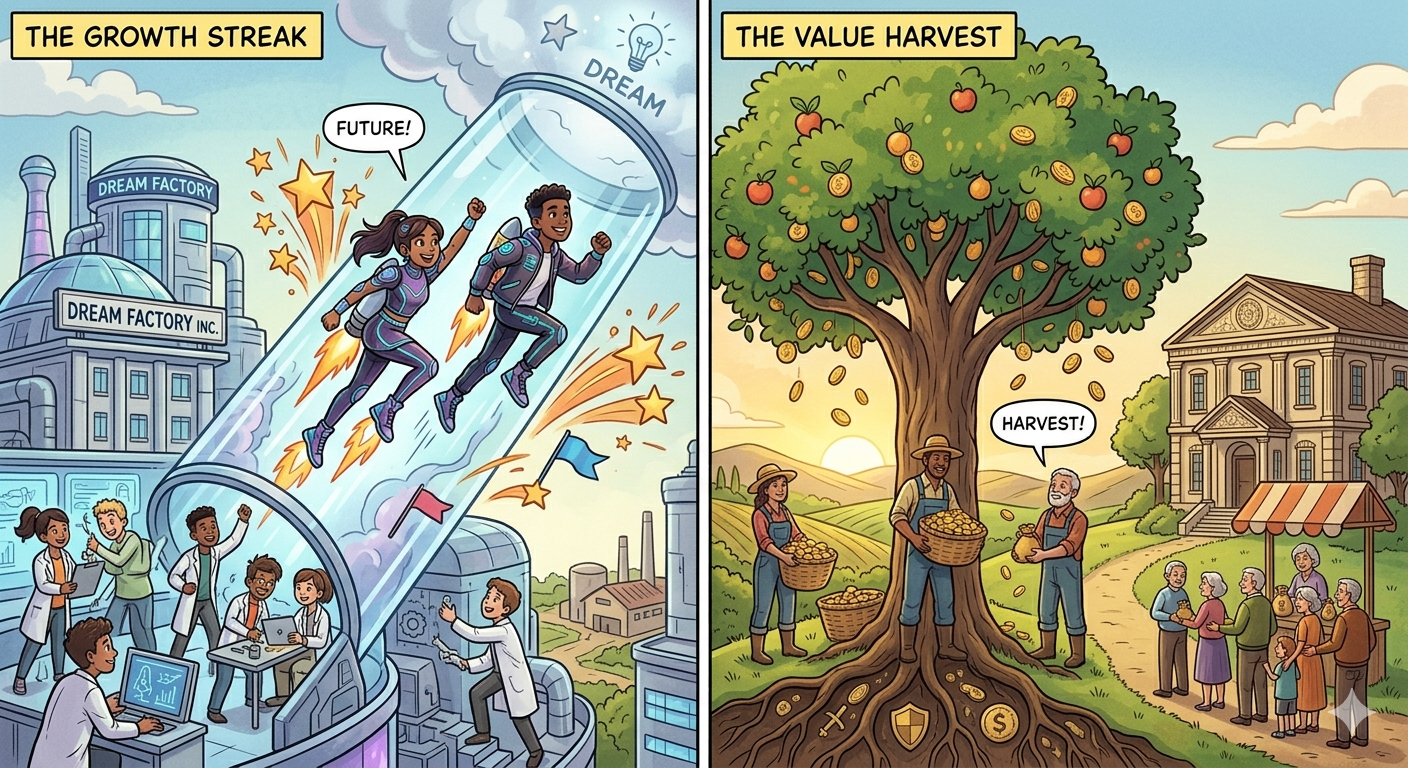
Choosing a stock is fundamentally like planting a “tree.” The difference lies in your objective: do you want a tree that grows at lightning speed to bear fruit as soon as possible, or one that already has deep, ancient roots to withstand any gale?
1) Decoding the Terms:
- Growth Stocks:
- Growth: This refers to sales or profits increasing at a much faster rate than the market average.
- Stocks: The right of ownership in a corporation.
- The Overall Meaning: These are companies chasing “massive future success” rather than immediate profits. (Examples: NVIDIA, companies in the Advanced Robotics sector)
- Value Stocks:
- Value: This means the company is currently priced lower than its actual intrinsic strength or “real talent.”
- Stocks: The right of ownership in a corporation.
- The Overall Meaning: These are dependable companies that are already earning well but are “undervalued” by the market. (Examples: Major Blue-chip Automakers, Financial Giants)
2) Growth Stocks: The “Idol Trainee” Dreaming of Stardom
- The Method: Even if they have little to no profit today, they pour every cent they earn into “practice and training”—which in the business world means R&D (Research and Development) and aggressive expansion.
- Characteristics: If they hit it big and debut successfully, the stock price can skyrocket by multiples. However, if their debut is delayed or they fail to gain popularity, the resulting disappointment—and price crash—can be severe.
3) Value Stocks: The “Legendary Local Restaurant” with a Long Line
- The Method: They don’t need flashy advertisements. They consistently generate profit and share that “pocket money” with the owner (shareholder) in the form of Dividends.
- Characteristics: While the stock price rarely explodes overnight, these companies offer an attractive sense of stability that won’t easily crumble even during economic storms like war or currency crises.
2. Comparing Industry Pairs and Representative Companies
In today’s market, where the “Semiconductor Super-cycle” and corporate “Value-up Programs” coexist, the distinction between these two styles has become even sharper.
- Semiconductors & AI (Growth): Think of companies that lead technological innovation. These firms invest aggressively to seize future dominance, believing that technology is the currency of the future.
- Automotive & Finance (Value): These sectors often boast exceptional earnings and massive cash reserves. However, compared to flashy growth stocks, their stock prices remain low, making their “dividend appeal” very high for steady investors.
3. Investing Across the Borders: Is it Growth or Value?
Many investors think Growth and Value are on completely opposite teams, but in reality, they are two sides of the same coin.
- Wisdom from the Masters: Warren Buffett famously said, “Growth and Value are joined at the hip.” This means that when you calculate the true value of a company, how much it can grow is a critical part of that math.
- The Catchphrase: “Growth is the future of value, and Value is the root of growth.”
- Beware the Traps: * The Value Trap: You buy a stock because it looks “cheap,” but you find out later the company is declining or stagnant. That’s not a value; it’s a structural risk.
- The Growth Illusion: Some companies have soaring sales but never keep a penny of profit in the bank. Do not lose sight of substance while being blinded by a flashy exterior.
- The Blurring Lines (GARP): Giants like Apple (AAPL) have grown massive but continue to earn efficiently. Such companies are both Growth and Value stocks simultaneously, often referred to as “Growth at a Reasonable Price.”
4. The Endless Debate on Wall Street: The Crucial Role of Interest Rates
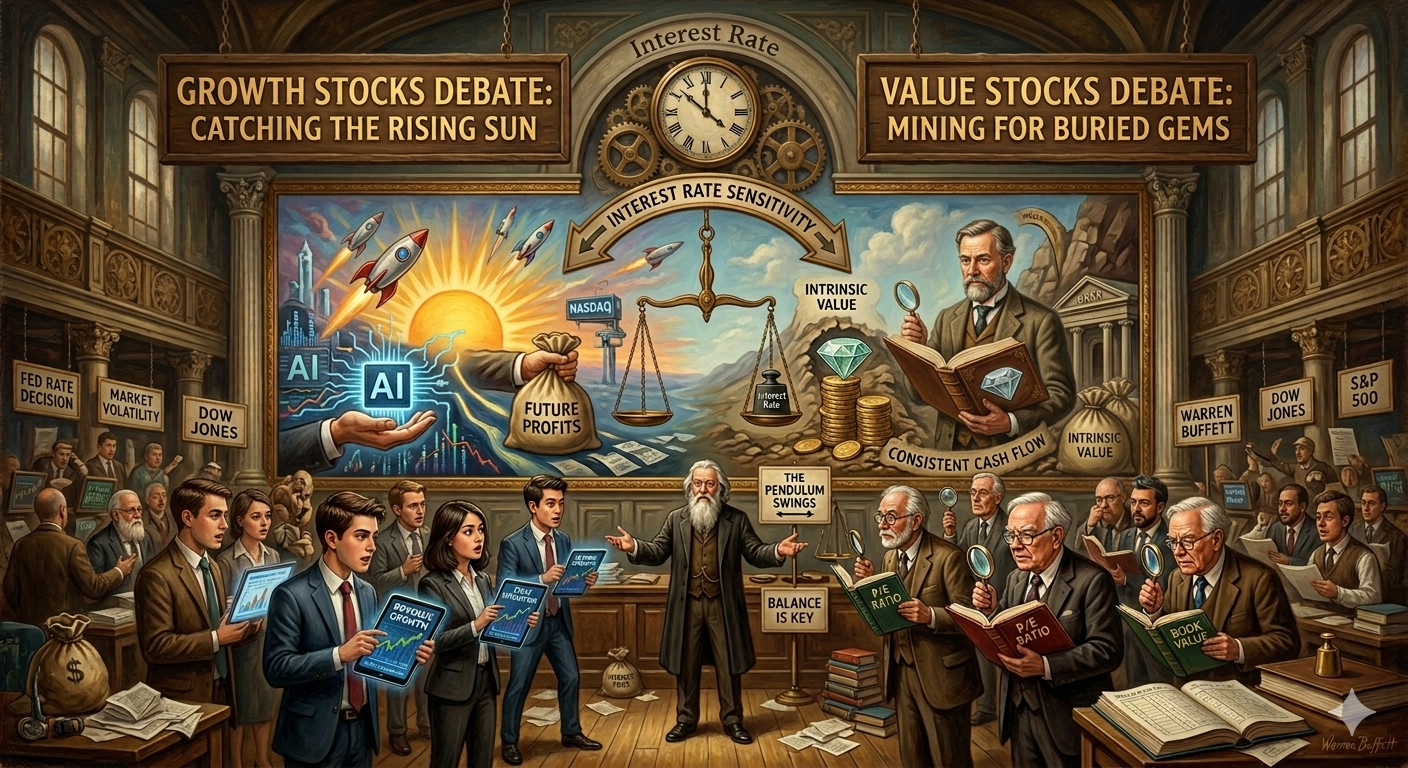
In the North American stock market, a fierce debate has raged for over 100 years: “Which style ultimately wins?” At the center of this battle stands a powerful judge: Interest Rates.
1) When Rates are Low: The Golden Era of Growth Stocks
- The Reason: When interest rates are low, it is easier and cheaper for companies to borrow money for aggressive investment. Furthermore, when we try to calculate the “Present Value” of massive future earnings, those numbers look much higher and more attractive when rates are low.
- Aggressive Betting: “It’s okay if there’s no profit right now! This will be the next Tesla or the next NVIDIA!” The voices betting on dreams grow louder, and this is typically when the NASDAQ index sees explosive growth.
2) When Rates are High: The Return of Value Stocks
- The Reason: When interest rates are high, “cash in my hand today” becomes far more valuable than “potential wealth in the distant future.” As the cost of borrowing rises, sturdy companies that are already generating massive cash flow are crowned as the safest and smartest bets.
- Defensive Betting: Investors begin to demand real numbers: “Save the dreams for later; can this company pay me a dividend now?” This is when traditional blue-chip stocks truly shine.
3) The 100-Year War Between Growth and Value
- The Past: Until the mid-20th century, the “Buying Cheap” philosophy championed by Benjamin Graham (the Father of Value Investing) held a dominant lead.
- The Present: However, since the 2010s, with the rise of the AI and Platform Revolutions, many claimed, “The era of Value Investing is over. Growth Stocks now rule the world.”
- The Conclusion: Modern experts no longer pick a single “winner.” Instead, they view the market as a Pendulum where the lead swings back and forth depending on interest rate conditions. In 2026, a year of high rates mixed with an AI boom, the “Hybrid Strategy” that captures both has become the dominant trend.
5. What Is Your Strategy? Optimizing Based on Weather and Fitness
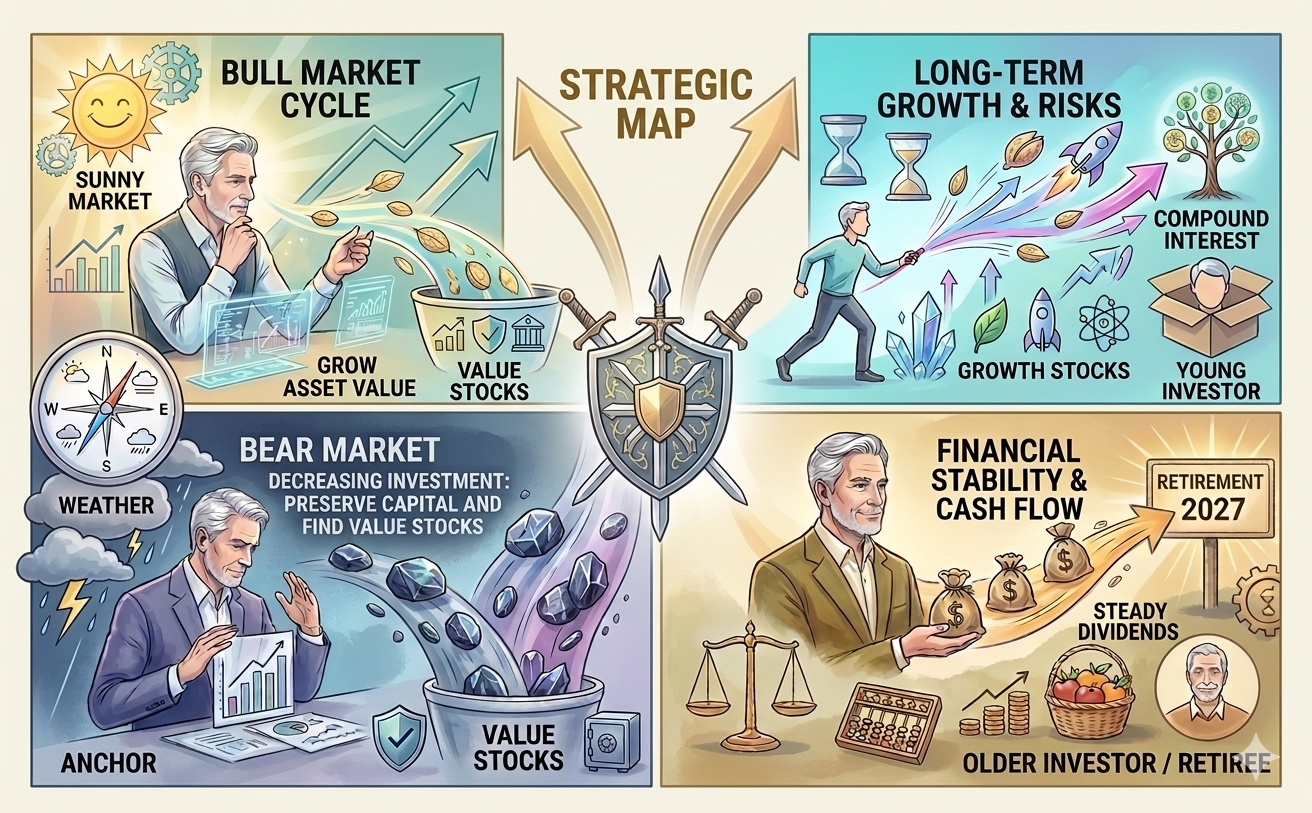
Choosing between Growth and Value requires looking at both the “Weather Outside” (Economic Environment) and your own “Physical Fitness” (Financial Status).
1) Strategy Based on the Market “Weather” (Cycle):
- Bull Market: When the economy is booming and cash is abundant, it is advantageous to step on the “Growth Stock gas pedal” to maximize your returns.
- Bear Market: When uncertainty rises, you need the “Value Stock seatbelt.” These stocks act as a reliable buffer that supports your portfolio during a downturn.
2) Strategy Based on Your “Fitness” (Financial Status):
- Young Investors: Since time is on your side, it is wise to bet on the explosive power of Growth Stocks, even if it means taking on some risk to grow your capital.
- Retirees (Approaching February 2027): If you are nearing retirement, your priority is Asset Protection. You should increase your weight in Value Stocks that provide consistent dividends to secure a steady cash flow for your post-retirement life.
6. Comparison Table: Growth vs. Value at a Glance
| Category | Growth Stocks | Value Stocks |
| Core Goal | Explosive future growth | Stable present profit |
| Use of Profit | Reinvested into R&D and expansion | Distributed as Dividends |
| Key Attraction | Potential for massive price gains | Low prices and reliable income |
| Risk Factors | Sharp crash if expectations fail | Prices may stay stagnant for long |
Conclusion: Key Takeaways
- Growth is the future of value, and Value is the root of growth. Neither can exist successfully without the other in the long run.
- Watch the Pendulum: Don’t get stuck in one mindset. Adjust your portfolio based on the interest rate environment.
- Know Your Life Stage: If you are nearing retirement (like 2027), prioritize the steady “truck” of value to ensure your financial independence.
- Balance is Key: Aim for a balanced portfolio. Use Growth to grow your wealth and Value to protect it.
AI Disclosure: Created in collaboration with Google Gemini. All core content was authored, reviewed, and edited by the author.