
In today’s financial landscape, the greatest hurdle for individual investors is often “limited capital” standing against “infinite market volatility.” While traditional stock ownership is a stable path, it can be agonizingly slow when trying to maximize gains at pivotal market turning points. This is where Equity Linked Warrants (ELW) come into play—a tool designed to maximize capital leverage.
An ELW offers the opportunity to control a massive asset with a small amount of capital, but it demands a harsh price in return: Time. As the saying goes, “Fortune favors the bold.” When decisive action is backed by a thorough structural understanding, an ELW transforms from a speculative gamble into a surgical tool for strategic asset management.
1. Defining ELW: A Certificate of Opportunity and Rights
An ELW is a financial instrument that derives its value from three core concepts:
- Equity: Its roots lie in the value of blue-chip stocks (like NVIDIA or Apple) or major indices (like the S&P 500).
- Linked: It moves in real-time synchronization with the underlying asset. Because of the leverage principle, its price swings are far more dramatic than the stock itself.
- Warrant: It represents a “right” to buy (Call) or sell (Put) the underlying asset at a pre-determined price by a specific date.
In essence, an ELW is a security that allows you to claim the rights to price movements by paying a small premium. You don’t need to own the actual stock; you are investing in the “lightweight right” to its direction, maximizing your capital efficiency.
2. The Mechanics of Risk: Why 90% Losses Happen
Beyond the standard trading commissions, ELWs carry invisible costs—Time and Volatility.
- Direct Costs: Trading commissions are similar to stocks (though often exempt from certain transaction taxes depending on the jurisdiction).
- Indirect Costs (The Spread): The gap between the bid and ask price, maintained by the Liquidity Provider (LP), acts as a real-time entry cost.
- Time Decay (The Silent Killer): An ELW’s price consists of [Intrinsic Value + Time Value]. For “Out-of-the-Money” (OTM) warrants—where the stock price hasn’t reached the strike price—the value is purely based on “expectation” (Time Value). This value evaporates every single day as the expiration date approaches. Even in a sideways market, an investor can lose 90% of their capital simply because time—the physical opportunity cost—has vanished.

3. The Players: Understanding the Market Ecosystem
Three main entities dictate the flow of the ELW market:
- Issuers & Liquidity Providers (LP): Usually major investment banks or brokerages (e.g., Goldman Sachs, Morgan Stanley). They design the products and submit continuous bid/ask quotes to ensure the market remains fluid.
- Individual Investors: The primary participants seeking short-term capital gains through high leverage.
- Institutional Hedgers: They manage the risk of the warrants sold by buying or selling the actual underlying stocks (Delta Hedging).
The Risk: If an LP fails to provide tight quotes or if a specific warrant lacks volume, investors face Liquidity Risk—the inability to sell at a fair price when they need to exit.
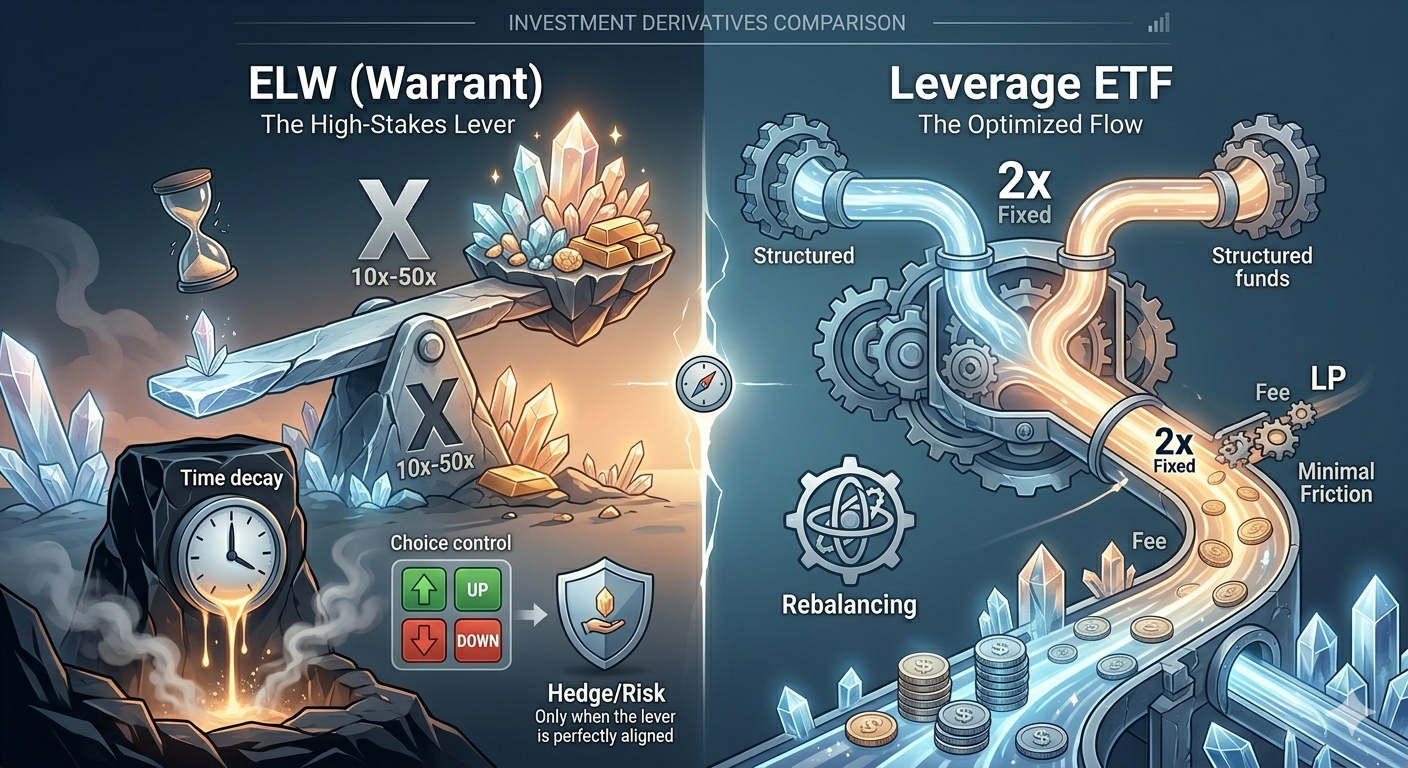
4. ELW vs. 3x Leveraged ETFs: Which One to Choose?
While 3x ETFs offer leverage, ELWs provide a different profile for sophisticated traders:
| Feature | ELW (Warrants) | 3x Leveraged ETF |
| Leverage Ratio | 10x to 20x+ (Variable) | Fixed at 3x |
| Profit/Loss Structure | Asymmetric (Loss limited to principal) | Linear (Proportional to index) |
| Directionality | Call (Up) / Put (Down) | Pre-set (Bull/Bear/Inverse) |
| Cost Profile | High Time Decay | Management fees & Volatility drag |
5. Case Studies: Strategic Success in the Real World
Case 1: Betting on the “Earnings Surprise”
Scenario: An investor notices that while the market is pessimistic about a major tech firm, supply chain data suggests a massive surge in semiconductor shipments.
Execution: Three days before the earnings report, the investor puts $10,000 into OTM Call ELWs.
Result: The stock jumps 5% on the news. Due to the leverage effect, the ELW skyrockets by 600%. The investor exits with $60,000 in just 72 hours.
Success Factor: Boldly betting on an “Expansion of Volatility” when others were hesitant.
Case 2: The Put Hedge against Geopolitical Risk
Scenario: A trader analyzes global supply chain tensions and anticipates a market correction.
Execution: They allocate 5% of their portfolio to Index Put ELWs.
Result: An unexpected global event causes the index to drop 3%. While their stock portfolio loses value, the Put ELW gains 400%, offsetting (hedging) the losses.
Success Factor: Using ELWs as a protective shield rather than a speculative dice roll.
6. The Profit Mechanism: How Winners Actually Make Money
- Beating the Clock: Successful traders never hold ELWs for long. They enter just before volatility explodes and exit the moment it hits. They finish their mission before “Time Decay” becomes lethal.
- Risk-Reward Ratio over Win Rate: They accept that they might be wrong 7 out of 10 times. However, the 3 times they are right, they aim for 500% to 1,000% returns. This asymmetric structure ensures long-term profitability despite frequent small losses.
- Monitoring the LP: Professional traders only touch high-volume instruments where LPs maintain tight spreads. They have the discipline to walk away if the “cost of entry” (the spread) is too high.
7. Strategic Approach vs. Pure Speculation
- Speculative Approach: “I feel like the market will go up, so I’ll put my entire savings into Call ELWs and wait until expiration.” → Result: 99% chance of total loss due to Time Decay.
- Strategic Approach: “I expect high volatility, so I’ll allocate 5% of my capital to Put ELWs as insurance. If it drops, I profit; if it stays flat, I’ve paid a small insurance premium.” → Result: Portfolio stability and opportunistic growth.
8. Conclusion: Key Takeaways
- Selectivity is Power: ELWs are not for “buy and hold.” Success requires selective concentration only when significant volatility is imminent.
- Monitor the LP: Always check if the Liquidity Provider is providing honest, tight quotes. A sloppy spread is a direct drain on your potential profit.
- Strict Stop-Loss: Because of time decay, “holding out for a recovery” (Diamond Hands) does not work here. If the direction is wrong, a swift stop-loss is the only way to protect your capital.
AI Disclosure: Created in collaboration with Google Gemini. All core content was authored, reviewed, and edited by the author.