
When beginners first encounter options, they are often baffled by one specific scenario: “If the strike price is $100 and the current stock price is only $80, a right to buy at $100 is technically useless today. So why is this contract trading for $5?”
The answer lies in the fact that the $5 isn’t paying for “current value.” Instead, it is a price set for the probability and hope that the $0 asset today could become a $100 asset tomorrow. Today, we will explore the mechanics of how these prices are determined and how to use them to build intelligent investment strategies.
1. The Two Pillars of Option Pricing: Reality and Hope
An option’s price, known as the Premium, is composed of two distinct elements.
Intrinsic Value: “Present Reality”
This is the immediate profit you would pocket if you exercised the option right this second.
- In our example (Stock at $80, Strike at $100), the Intrinsic Value of a Call option is $0. Exercising it now would mean buying at $100 what you could buy for $80 in the market—a guaranteed loss.
Time Value: “Future Hope”
This represents the expectation that before the expiration date, the stock price might surge past $100 to reach $110, $120, or higher.
- The $5 mentioned earlier is entirely Time Value. This “price of hope” becomes more expensive if the market is volatile (high uncertainty) or if there is a long time left until the expiration date.
2. Why Out-of-the-Money (OTM) Options Have Value: The Power of Probability
Why do people trade OTM options that currently have zero intrinsic value? It works exactly like a lottery ticket or an insurance policy.
- The Lottery Metaphor: Before the drawing, a lottery ticket is just a piece of paper. People buy it because they are purchasing the probability of a win.
- The Magic of Volatility: If a market event suggests a massive price swing is coming, the probability of an $80 stock hitting $110 increases. Suddenly, that $5 option might jump to $10 or $20, even if the stock hasn’t moved yet.
- The Insurance Function: An auto insurance policy has value even if you don’t crash your car today. The cost of an OTM option is the fee you pay to be protected against a “what if” scenario tomorrow.

3. Three Essential Real-World Option Strategies
Once you understand how options are priced, you can use them to enhance your portfolio.
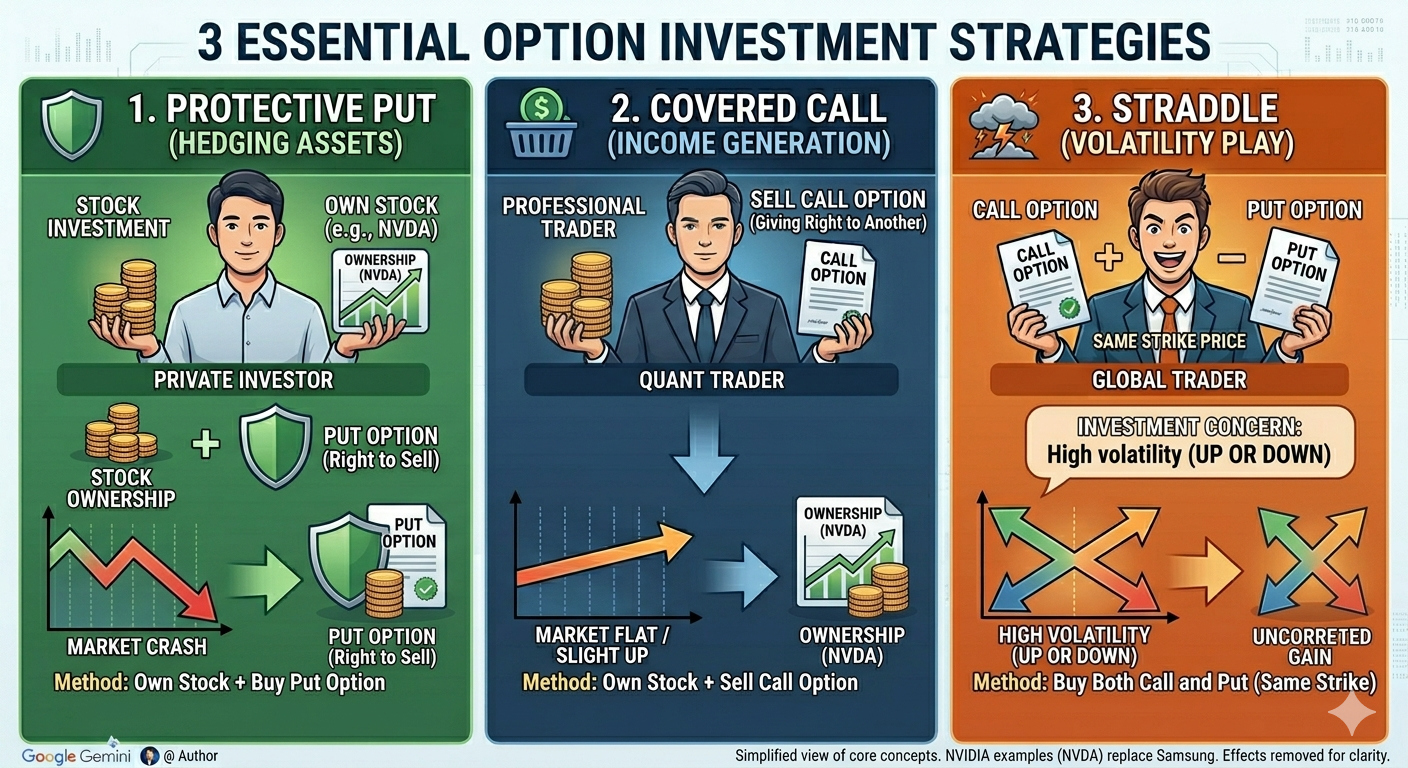
1) Protective Put: The Seatbelt for Your Stocks
- The Method: You own a stock (e.g., NVIDIA) and simultaneously buy a Put Option (the right to sell).
- The Effect: If the stock price crashes, you still have the right to sell at your predetermined strike price. You are essentially paying a small premium to set a “floor” for your potential losses.
2) Covered Call: Adding “Rent” to Your Stock Profits
- The Method: You own a stock and sell a Call Option (the right to buy) to someone else.
- The Effect: You give up the potential for massive gains if the stock skyrockets, but in exchange, you collect the upfront premium. This is a “rental income strategy,” ideal for stagnant or slightly bullish markets where you want to generate consistent cash flow.
3) Straddle: Betting on Volatility, Not Direction
- The Method: You buy both a Call and a Put with the same strike price and expiration.
- The Effect: You don’t care if the market goes up or down. As long as it moves big in either direction—due to an earnings report or an election—you profit.
4. Strategy Comparison Matrix
| Strategy Name | Components | Expected Effect | Ideal Market Condition |
| Protective Put | Buy Stock + Buy Put | Downside Protection | Volatile/Bearish Fear |
| Covered Call | Buy Stock + Sell Call | Generate “Rental” Income | Flat or Slightly Bullish |
| Straddle | Buy Call + Buy Put | Profit from Big Moves | High Volatility Expected |
5. The Five Golden Rules of Options Trading
Options are powerful tools, but without discipline, they are merely “melting ice cubes.” Before you trade, internalize these rules:
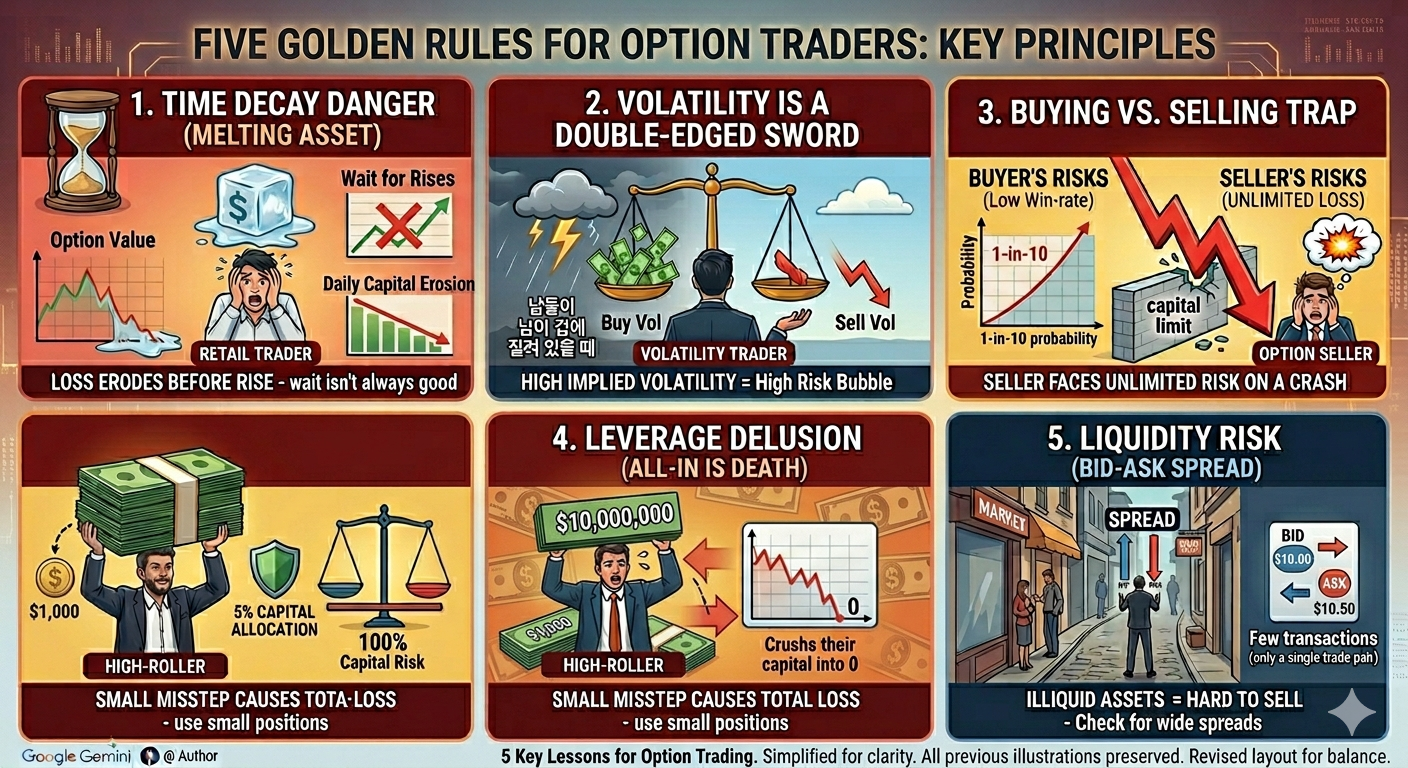
1) Respect the Time Decay (Theta)
Unlike stocks, options have an expiration date. Even if you are right about the direction, you lose money if the stock moves too slowly. Time value evaporates every single day.
2) Volatility is a Double-Edged Sword
Options are most expensive when the market is “scared.” If you buy options when “Implied Volatility” (IV) is at its peak, you are paying a massive premium. Often, the best time to buy is when things are quiet but a storm is brewing.
3) The Probability Trap: Buyers vs. Sellers
- Buyers: Usually suffer 9 small losses for 1 big win. Most beginners lose their capital and mental stamina before that 1 big win arrives.
- Sellers: Usually have a high win rate but face “unlimited risk” if a black swan event occurs. Never sell options without professional-grade risk management.
4) The Delusion of Leverage
Options allow you to control $100,000 of assets with $5,000. This is a miracle when you’re right, but a nightmare when you’re wrong. A single mistake can wipe out 100% of your investment. Always limit your options exposure to a small fraction (1-5%) of your total portfolio.
5) The Liquidity Risk
In low-volume options, the gap between the buying price and selling price (Bid-Ask Spread) can be massive. You might buy an option for $5 and find that the best offer to sell it back is only $4, even if the stock hasn’t moved. Stick to high-volume, liquid tickers.
Conclusion: Key Takeaways
- Intrinsic vs. Time Value: Always know how much “reality” versus “hope” you are paying for.
- Strategic Utility: Use Protective Puts for safety and Covered Calls for income.
- The Clock is Ticking: Options are wasting assets; direction is not enough—timing is everything.
- Risk Discipline: Leverage is a tool, not a toy. Manage your position sizes to survive the learning curve.
AI Disclosure: This post, including images and certain descriptions, was created in collaboration with Google Gemini AI, then authored, reviewed, and edited by the creator.