
Where corporate management in the past operated under a massive, unified umbrella—treating internal goods and services as a single consolidated bundle—modern multinational enterprise management demands an architecture where individual business units and global subsidiaries issue strict, formalized billing statements to each other. In 2026, enterprise leadership faces a defining operational choice: will they continue to navigate blindly through a thick fog of arbitrary internal prices that spark bitter interdepartmental friction and heavy regulatory audits? Or will they act as agile captains, utilizing Transfer Pricing as a precision financial control tool to maximize consolidated corporate wealth? For large-scale conglomerates, establishing clear, highly strategic internal transaction boundaries is absolute necessary to balance local divisional accountability with global tax risk management.
1. Demystifying Intercompany Transactions Through an Everyday Metaphor
To understand transfer pricing control systems intuitively, imagine managing a premier, national bakery brand. Your enterprise owns a centralized, commercial baking facility and a network of premium local retail storefronts located in nearby commercial districts.
When the commercial baking facility transfers an inventory batch of fresh sandwich bread to one of the local retail storefronts, executive leadership must determine exactly what dollar amount to record on the intercompany general ledger. The industrial plant manager aims for a premium transaction price to maximize their facility’s localized performance review. Meanwhile, the retail storefront manager demands a deep discount to protect their local retail profit margins. Transfer pricing is the formal process of calculating an objective transaction value that serves as a fair report card for both operating units without compromising corporate harmony.
Key Conceptual Definitions within Intercompany Frameworks
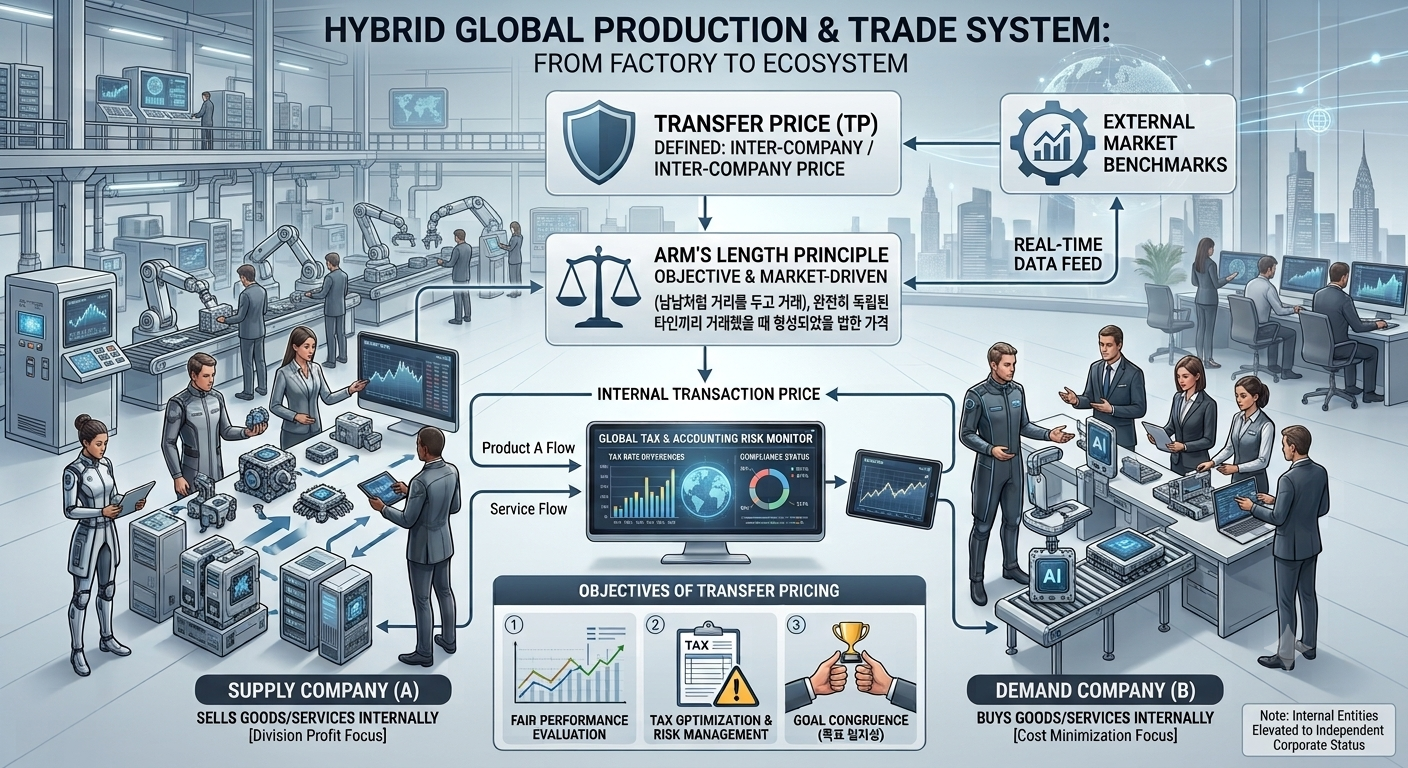
- Transfer Price: The internal dollar value assigned to transactions involving goods, intellectual property, or operational services exchanged between independent business segments, separate subsidiaries, or international legal entities operating under the same corporate umbrella.
- Arm’s Length Principle: The foundational global standard requiring that intercompany transactions be priced as if they occurred between entirely unrelated, independent parties acting under free-market conditions. This metric eliminates artificial internal cross-subsidization and is rigorously monitored by international tax authorities.
- Strategic Ecosystem Creation: Instead of senior leadership imposing absolute pricing mandates from the top down, the corporate controller establishes a rational pricing window backed by objective market data or structured internal negotiations. This baseline ensures that as individual division managers aggressively pursue localized profitability, their actions naturally align with the profit maximization of the entire parent company, achieving true goal congruence.
2. Comprehensive Comparison of Transfer Pricing Methods
To maintain operational agility, corporate accounting departments utilize three primary methodologies to evaluate intercompany trade, each presenting distinct trade-offs.
1) Market-Based Approach: “Matching the Open Market Price”
If a component manufactured by an internal segment is traded actively on a transparent open market—such as a commodity exchange or a public digital marketplace—for $10, the supplying division bills the buying division exactly $10 per unit.
- Core Advantages: This method provides unmatched transparency and objectivity. It completely removes allegations of internal bias or corporate favoritism, allowing division executives to operate with the authentic accountability of independent business owners.
- Operational Pitfalls: If the component is a proprietary, highly specialized asset with no public market equivalent, this approach becomes impossible to implement. Additionally, internal transactions eliminate traditional third-party frictional expenses like external marketing or retail shipping fees; determining how to calculate and subtract these internal savings requires continuous accounting maintenance.
2) Negotiated Approach: “Divisional Autonomy Through Bilateral Trade”
Under this framework, the respective division executives meet directly to hammer out a mutually agreeable price, operating like independent commercial entities.
- The Negotiation Range: The supplying division establishes a floor price based on the absolute minimum capital required to produce the asset. The buying division sets a ceiling price based on what it would cost to completely bypass the internal supplier and source from an external vendor. If the supplying plant has considerable idle capacity (unused factory machinery), it is highly incentivized to lower its floor to secure an internal order.
- Core Advantages: It protects decentralized decision-making power, fostering entrepreneurial discipline and high manager morale by allowing local teams to control their financial destiny.
- Operational Pitfalls: Final transaction values can be heavily distorted by the personal bargaining skills or corporate leverage of individual managers, decoupling financial performance from true operational efficiency. Furthermore, bilateral negotiations can consume massive amounts of executive management time.
3) Cost-Based Approach: “Leveraging Production Metrics”
When open-market benchmarks are unavailable and internal negotiations stall, corporations rely on manufacturing cost structures as the primary pricing anchor. This methodology splits into three distinct operational execution paths:
- Variable Cost Basis: Intercompany billing is tied strictly to the incremental cash required to produce one additional unit (such as raw material inputs and direct factory labor). While ideal for maximizing total enterprise output during economic downturns, it leaves the supplier unable to recover fixed overhead liabilities like factory property leases, leading to severe division complaints.
- Full Cost Basis: The transfer price incorporates both direct variable manufacturing inputs and a fully allocated share of fixed factory overhead and machine depreciation. This provides a more balanced approach for long-term internal planning.
- Cost-Plus Basis: This method builds upon the full cost foundation by adding an approved, fixed profit markup percentage (e.g., Full Cost plus a 10% margin), ensuring the supplying unit records a positive return on its operational investment.
Pro Accounting Tip: When implementing a cost-based framework, controllers must utilize predetermined standard costs rather than actual real-world expenditures. Utilizing actual expenditures allows an inefficient supplier to pass its financial waste, labor overruns, and material overspends directly onto the buying division’s balance sheet, destroying any incentive for factory cost discipline.
3. At-a-Glance Strategic Evaluation Dashboard
| Methodology | Primary Pricing Baseline | Core Operational Advantage | Primary Risk Indicator |
| Market-Based | Prevailing external market rate | Maximum objectivity, completely eliminates internal political bias | Entirely unusable if the asset is unique or proprietary |
| Negotiated | Bilateral business unit compromise | Maximizes divisional autonomy and managerial accountability | Consumes excessive time and risks favoring stronger negotiators |
| Cost-Based | Manufacturing standard cost (+ margin) | Highly predictable and easy to execute without active markets | Can inadvertently pass production inefficiencies downstream |
4. Dual Operational Domains: Domestic Accountability vs. Global Supply Chain Strategy
Modern transfer pricing spans two distinct organizational domains, requiring unique tactical approaches depending on whether transactions stay domestic or cross international borders.
Allocation, Antitrust Compliance
Tax Risk, & APA Treaties
1) Domestic Intercompany Trade: Protecting Accountability and Legal Compliance
- The Context: Transactions occurring between specialized manufacturing subsidiaries and domestic retail distribution segments within the same home country.
- Managerial Strategy (Internal Balance): Leadership must maintain a level playing field for all domestic profit centers. Forcing an artificially depressed transfer price onto a manufacturing subsidiary to inflate the retail segment’s margins destroys employee morale, undermines performance metrics, and starves the factory of the capital reserves needed for future research and development.
- External Environment (Antitrust Risks): Domestically, arbitrary internal pricing structures face heavy oversight regarding corporate wealth siphoning, unlawful corporate support, and unfair trade advantages under national antitrust laws. Enterprise compliance requires a verifiable, auditable internal audit trail.
2) Global Subsidiary Trade: International Taxation and Capital Deployment
- The Context: Cross-border trade executed between the corporate headquarters and overseas manufacturing or assembly facilities.
- Managerial Strategy (Capital Allocation): On the global stage, transfer pricing serves as a primary tool for corporate capital allocation. For example, corporate planners might legally adjust transfer prices to build up cash reserves in a developing subsidiary to fund infrastructure expansions, or accelerate capital remittance back to corporate headquarters from regions experiencing high political instability or severe currency volatility.
- External Environment (Tax Audits & APA Systems): Global tax authorities monitor cross-border intercompany transactions under a microscope to prevent multinational corporations from shifting profits to low-tax jurisdictions. To insulate the enterprise from multi-million dollar back-tax penalties and double taxation disputes, corporations must rigorously enforce the Arm’s Length Principle and aggressively pursue Advance Pricing Agreements (APAs) to secure binding, pre-approved pricing treaties with foreign tax agencies.
5. Mathematical Pricing Boundaries Across Production Capacities
To achieve optimal resource allocation, corporate financial teams must dynamically adjust pricing boundaries based on the supplier’s active manufacturing capacity.
5. Mathematical Pricing Boundaries Across Production Capacities
To achieve optimal resource allocation, corporate financial teams must dynamically adjust pricing boundaries based on the supplier’s active manufacturing capacity.
Scenario ①: Supplying Division Maintains Idle Production Capacity
- The Baseline: The factory has unused machinery available; taking on internal orders requires zero sacrifice of external commercial sales.
- Supplier Floor Price: Variable Cost per Unit + Opportunity Cost = Variable Cost
- Buyer Ceiling Price: External Market Price
- The Negotiation Range: Variable Cost ≤ Transfer Price ≤ External Market Price
- Executive Action: Allow business units to negotiate freely within this window. Any settled price within these boundaries guarantees a positive contribution margin for the supplier while giving the buyer a below-market discount, maximizing consolidated corporate wealth.
Scenario ②: Supplying Division Operates at Full 100% Production Capacity
- The Baseline: The factory is completely booked; fulfilling an internal request requires canceling orders from profitable external clients.
- Supplier Floor Price: Variable Cost + Lost External Contribution Margin = External Market Price
- Buyer Ceiling Price: External Market Price
- The Negotiation Range: Transfer Price = External Market Price
- Executive Action: Traditional bargaining is ineffective here. The baseline price must match the open-market rate. However, if the internal transaction eliminates standard third-party shipping fees or brokerage commissions, that exact savings should be deducted from the final internal invoice: Adjusted Transfer Price = External Market Price – Internal Frictional Savings
Scenario ③: Highly Specialized Asset with Non-Existent External Markets
- The Baseline: The component is a proprietary, custom-engineered asset with no external market alternative.
- Supplier Floor Price: Variable Cost per Unit
- Buyer Ceiling Price: Final Consumer Retail Price – Buyer’s Internal Processing and Assembly Costs
- The Negotiation Range: Supplier Variable Cost ≤ Transfer Price ≤ Final Price – Buyer Processing Cost
- Executive Action: Leaving divisions to navigate this scenario independently leads to operational gridlock. Corporate headquarters must step in directly and mandate a standard cost-plus framework, establishing an objective baseline that protects divisional cooperation.
Conclusion: Key Takeaways
- Prioritize Consolidated Corporate Wealth: Executive leadership must manage transfer pricing from a global perspective, ensuring that localized segment goals never trigger corporate suboptimization or undermine consolidated profit.
- Incorporate Real Opportunity Costs: Always audit the supplier’s capacity constraints. When idle machinery exists, keep internal prices near variable costs; when the factory is fully utilized, the baseline must reflect market rates to account for sacrificed external sales.
- Isolate Frictional Savings: Capitalize on internal trade by identifying and stripping out avoidable third-party distribution fees, and pass those structural savings directly to the trading subsidiaries.
- Build Institutionalized Compliance: Establish transparent, verifiable transfer pricing policies across all regional segments to protect employee engagement, maintain rigorous corporate governance, and eliminate global tax exposure.
* This article was created in collaboration with Google Gemini AI. The author independently created, reviewed, and edited the content to ensure professional quality.