
There is an old saying: “After long deliberation comes a bad move.” If you look at goods piling up in a warehouse and comfort yourself by thinking, “It’ll sell eventually,” your company’s profits might be deteriorating right at that moment.
Inventory is not just a arbitrary line item on a balance sheet. It is a “different form of cash” that a business has temporarily paused in order to convert back into liquid cash in the future.
However, many business leaders mistake the goods in their warehouse for actual money, overlooking the fact that their value erodes day by day. Depending on how you record and evaluate inventory, a company’s net income for the year can stretch or shrink by hundreds of thousands of dollars like a rubber band. To avoid being fooled by fake profits on paper and to diagnose the true foundational strength of a business, we must understand the core accounting logic and management principles behind inventory evaluation.
1. Core Concepts Simplified
1) Inventory: Cash Frozen in the Warehouse
To use a clear business analogy, inventory is “cash you have temporarily placed in a freezer.” It refers to merchandise or finished goods held for sale in the normal course of business, as well as raw materials waiting to be transformed into products.
While frozen, no matter how much you have stacked up, it cannot be used to pay employee salaries or rent. If you fail to thaw it out (sell it) and convert it into liquid cash in a timely manner, it eventually spoils—meaning it suffers from obsolescence and physical deterioration right inside the warehouse.
2) Quality of Earnings
Quality of Earnings is an indicator of how sustainable, repeatable, and backed by actual cash inflows a company’s reported net income really is. If a company artificially inflates its paper profits by changing inventory valuation methods or by abnormally stacking up excess inventory, analysts judge the business as having low quality of earnings.
2. Recording Methods: Periodic vs. Perpetual Systems
The methods used to record this “frozen cash” in the accounting ledger are broadly divided into two approaches. Thanks to technological advancements, the boundaries between them are rapidly dissolving.
1) Perpetual Inventory System
- Traditional Concept: Every time inventory enters or leaves the facility, the quantity and dollar amount are continuously logged in real time.
- Pros & Cons: Looking at the ledger gives an immediate view of current inventory levels, making management straightforward. However, back in the era of manual record-keeping, it required an immense amount of physical labor.
2) Periodic Inventory System
- Traditional Concept: Purchases are recorded as they come in, but individual sales are not tracked against inventory daily. Instead, at the end of an accounting period (such as month-end or year-end), managers open the warehouse doors to physically count remaining stock. Cost of Goods Sold (COGS) is calculated backward using the standard formula:
- Beginning Inventory + Purchases – Ending Inventory = COGS
- Pros & Cons: Record-keeping during the period is simple. However, its fatal flaw is that management cannot detect theft, damage, or inventory shrinkage until a physical audit takes place.
3) Modern Evolution via Digital Integration
Today, businesses no longer choose one over the other; a hybrid approach is the standard. Powered by barcodes, RFID tags, and smart Warehouse Management Systems (WMS) integrated with logistics robotics, companies track inventory continuously via the perpetual system.
Concurrently, automated physical audits using drones or AI vision cameras are conducted unexpectedly to catch discrepancies between digital records and physical stock (shrinkage losses) in real time, creating a tight control network.
3. Cost Flow Assumptions: How Inventory Valuation Transforms Profits
If a convenience store has ten identical chocolate bars on the shelf, tracking exactly which one came in first and which was sold first (known as the Specific Identification Method) is practically impossible. Therefore, accounting relies on assumptions. These assumptions can completely rewrite a company’s financial narrative.
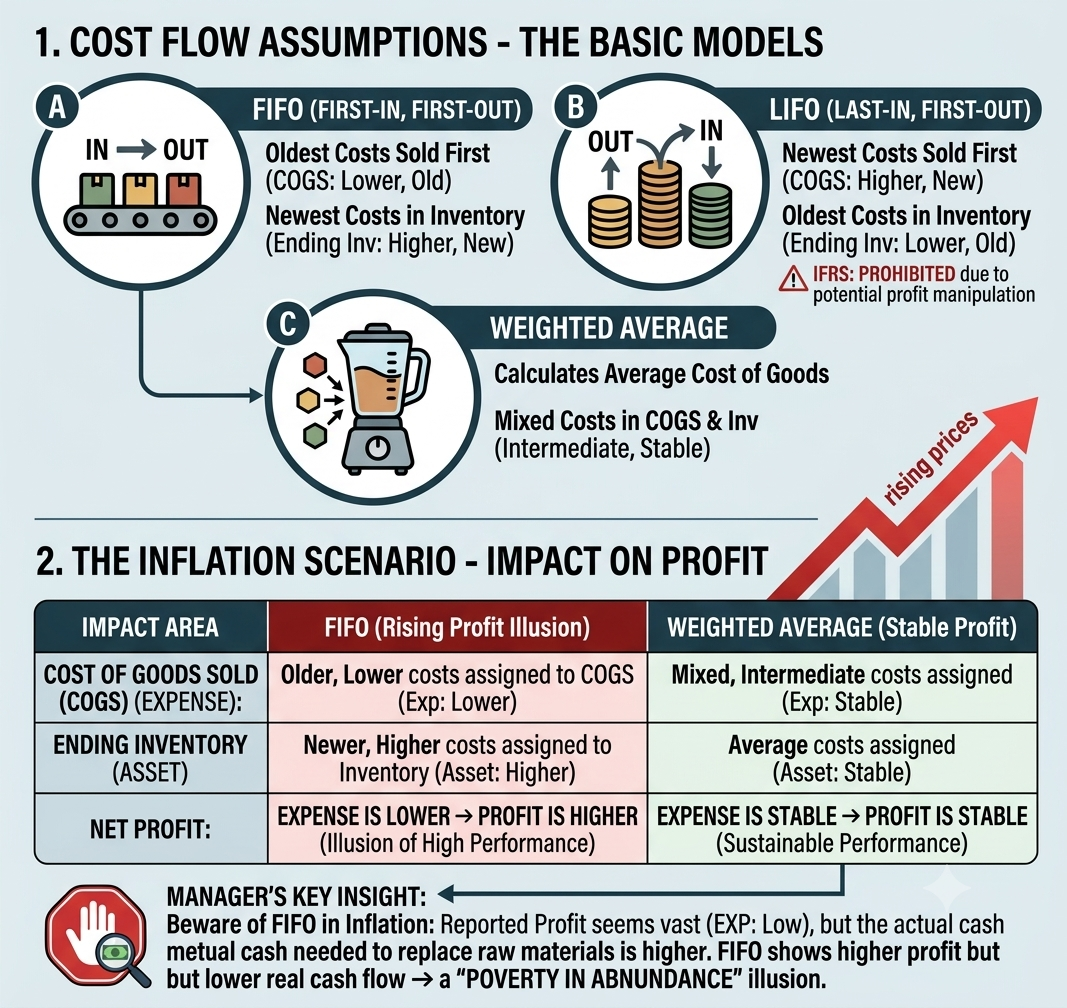
1) FIFO vs. LIFO vs. Weighted-Average
- First-In, First-Out (FIFO): Assumes that the oldest inventory items are sold first.
- Last-In, First-Out (LIFO): Assumes that the most recently acquired, often more expensive items are sold first. (Note: International Financial Reporting Standards [IFRS] prohibit LIFO due to the potential for income manipulation, though it remains an option under US GAAP.)
- Weighted-Average Method: Calculates unit cost by averaging the costs of all inventory available for sale during the period.
2) The Impact of Inflation on Paper Profits
When prices rise steadily over time, how do these methods alter the financial statement numbers?
| Metric | First-In, First-Out (FIFO) | Moving / Weighted-Average |
| Cost of Goods Sold (Expense) | Older, cheaper costs applied (COGS is lower) | Blends recent expensive costs with older costs (COGS is moderate) |
| Ending Inventory (Asset) | Recent, more expensive costs remain (Asset value is higher) | Average costs remain in stock (Asset value is moderate) |
| Net Income | Profits are overstated (Illusion of prosperity) | Profit growth is reflected smoothly |
Managerial Warning: During inflationary periods, using FIFO makes paper profits look exceptionally high. However, this is an optical illusion. Because replacing sold inventory requires buying new raw materials at higher current market prices, the company experiences a “poverty of cash amid abundance on paper.” Paper profits soar, but actual cash reserves dry up.
4. The Critical Role of Lower of Cost or Market (LCM)
The crowning highlight of sound inventory management is the Lower of Cost or Market (LCM) valuation rule (or Net Realizable Value [NRV] under IFRS). If the market value or sellable price of an asset drops below what you originally paid for it (historical cost), you must immediately write down the book value and recognize that difference as an Inventory Valuation Loss (Expense).
Why is LCM so vital?
Keeping outdated fashion apparel or last-generation electronic components sitting in a warehouse while listing them on the balance sheet at their original cost is a form of self-deception that misleads shareholders and executives alike.
The True Benchmark of Earnings Quality
If a enterprise’s revenues remain stagnant while its inventory balance continuously inflates, and management fails to recognize valuation losses on that inventory, the company’s quality of earnings is extremely poor. Holding onto spoiled stock to prop up paper assets and net income creates a ticking financial time bomb that inevitably triggers massive future write-downs and earnings shocks down the road.
5. Strategic Takeaways for Executives
- Maximize Inventory Turnover: Assets tied up in a warehouse generate daily opportunity costs. Executives must constantly monitor Inventory Turnover—the speed at which inventory converts into revenue. Declining turnover is a red flag indicating that frozen cash is failing to thaw, placing severe pressure on enterprise liquidity.
- Embrace Conservative Valuation: Postponing inventory write-downs to make short-term earnings look attractive is like drinking poison to quench thirst. Leadership must decisively identify bad stock, apply the lower-of-cost-or-market rule, and execute clean-ups. Only then can a business build realistic operational plans grounded in true cash flows.
Conclusion: Key Takeaways
- Inventory is Frozen Cash: Stock sitting in a warehouse cannot pay bills; it erodes in value daily unless converted to revenue.
- Beware of Inflation Illusions: Methods like FIFO can artificially inflate reported net income during inflationary cycles while simultaneously draining operational cash flows needed for replenishment.
- Prioritize Earnings Quality: Failing to write down obsolete inventory creates fake paper profits that undermine long-term financial health.
- Drive Inventory Turnover: Continuous monitoring using modern hybrid systems (WMS, AI tracking) is essential to maintain liquidity and prevent earnings shocks.
AI Disclosure: This content was developed through a collaborative process between the author and Google Gemini AI. The author outlined, translated, verified, and refined the concepts to ensure accurate accounting standards and business analysis.