
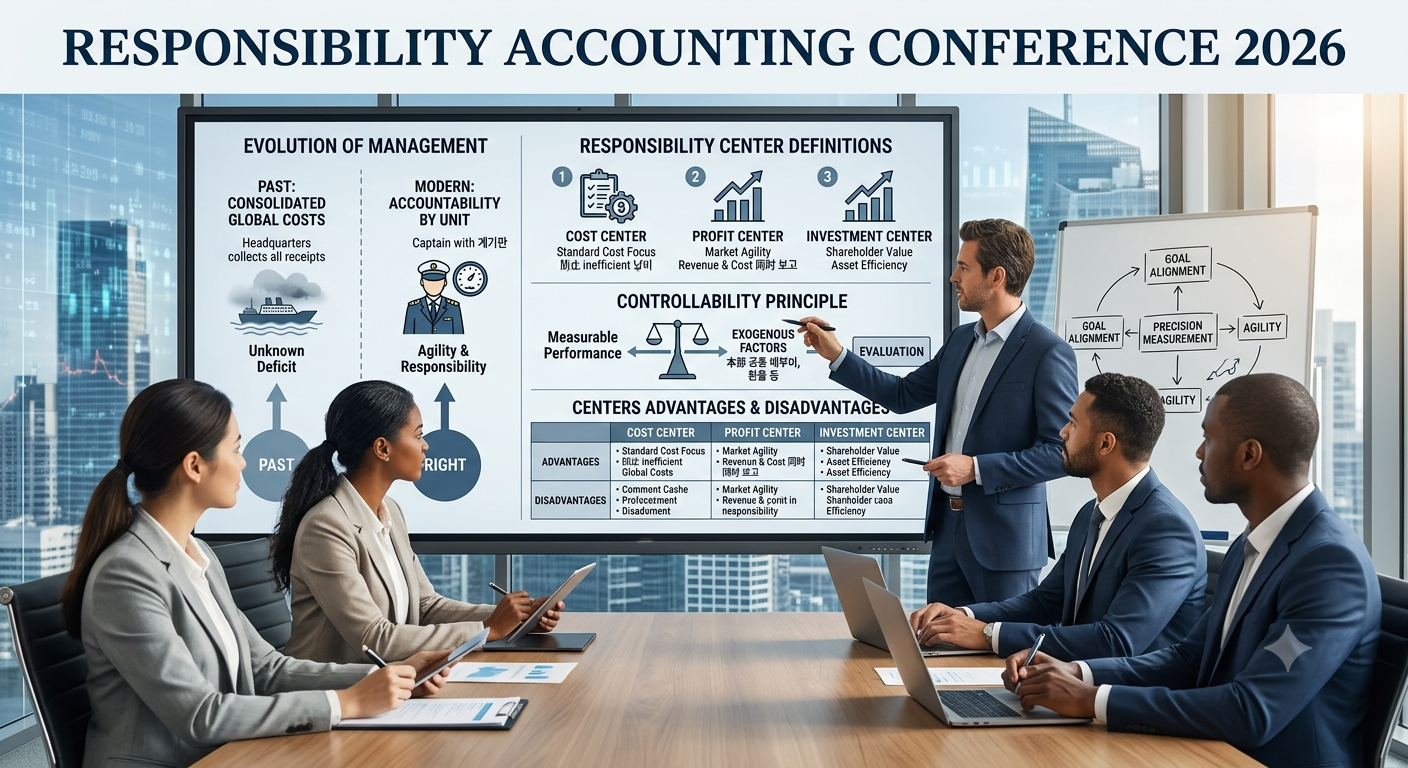
If traditional corporate management relied on a single unified structure—where corporate headquarters bundled every single departmental receipt together into a massive “total cost” bucket—modern business execution relies on drawing a sharp line between those who spend corporate capital and those who generate it. In 2026, enterprise leadership faces a clear strategic choice: will they continue to navigate a ship through a thick fog of unknown divisional contributions, or will they act as agile captains utilizing Responsibility Accounting as a high-precision corporate instrument panel?
For large, complex enterprises, long-term survival demands a sophisticated management architecture that divides the organization into distinct accountability units and evaluates local executives strictly on performance drivers they can actively control.
1. Demystifying Accountability Frameworks Through Everyday Metaphors
To understand accountability framework units intuitively, imagine managing a premier, multi-tier metropolitan shopping mall. To evaluate performance fairly, executive leadership must design completely different report cards for the customer parking logistics crew, the ground-floor premium cosmetics boutique, and the corporate development committee deciding where to break ground on a new regional mall location.
If corporate headquarters were to judge the parking logistics crew based on the mall’s retail sales volumes, or force the cosmetic boutique to pay for structural building depreciation, the local teams would reject the evaluation process as unfair. Responsibility accounting is the process of separating these operational boundaries so each manager receives a customized financial scorecard mapping to their real-world authority.
Key Structural Concepts within Control Systems
- Responsibility Center: A dedicated operational subunit within an enterprise where a designated manager is granted explicit decision-making autonomy and held directly accountable for that unit’s localized financial outcomes.
- Controllability Principle: The governing rule of corporate accountability stating that a manager should be evaluated strictly on financial variables and operational outcomes that they can directly influence through their personal efforts or tactical decisions. Under this rule, external macro elements—such as centralized corporate overhead allocations or volatile foreign exchange rates—are excluded from the manager’s performance evaluation.
- Core Meaning: This corporate control mechanism divides a complex enterprise into clear, localized centers based on explicit scopes of authority (cost, profit, or investment). By ensuring that every divisional executive is evaluated solely on controllable key performance indicators, the parent company drives local autonomy, maximizes employee engagement, and aligns individual management actions with larger corporate goals.
2. Strategic Comparison of Responsibility Centers
Before designing a decentralized control system, executive committees must analyze the strategic trade-offs inherent in each responsibility center architecture.
| Responsibility Center Type | Core Strategic Advantages (Center-Aligned) | Potential Operational Risks (Center-Aligned) |
| Cost Center | Minimizes operational waste and stops resource leakage through engineered cost standards. | Can inadvertently trigger a drop in product quality or customer service if cost-cutting is too aggressive. |
| Profit Center | Maximizes operational agility by empowering managers to react quickly to local market demand. | Risks driving short-term profit maximization at the expense of necessary capital infrastructure upkeep. |
| Investment Center | Optimizes capital efficiency and resource allocation to increase true long-term shareholder value. | Can trigger corporate suboptimization if managers refuse projects to protect localized return metrics. |
3. Industrial Application and Corporate Frameworks
The real-world implementation of a responsibility center framework varies significantly depending on an enterprise’s industrial focus and operational structure.
Cost Center Management (Manufacturing & Support Divisions)
- Corporate Examples: An automotive assembly plant for Ford, or a centralized human resources department at Samsung Electronics.
- Operational Mandate: These business units do not directly market products to external consumer bases to generate top-line revenue. Consequently, corporate controllers evaluate these segments strictly on their ability to manufacture a specified quota of high-quality goods at or below a predetermined standard cost, or their success in executing corporate support functions within an approved annual budget.
Profit Center Management (Sales & Distribution Networks)
- Corporate Examples: Individual Starbucks retail locations, or regional storefronts of a national distributor like Sephora.
- Operational Mandate: Each store manager operates within a fixed physical asset base provided by corporate headquarters but exercises full daily control over local commercial activities. They are tasked with driving top-line revenue while managing local labor costs and inventory expenses. Their ultimate report card is based on the net operating income their specific location generates each month.
Investment Center Management (Autonomous Divisions & Conglomerates)
- Corporate Examples: The electric vehicle battery segment of an industrial conglomerate like SK Innovation, or the commercial real estate development arm of a major retailer.
- Operational Mandate: These executive teams look beyond basic sales margins and short-term operational expenses. They hold full authority over large capital investments, infrastructure projects, and land acquisitions. Accordingly, their financial scorecards combine operating income with capital efficiency metrics to measure how effectively they deploy large sums of corporate wealth.
4. Tailoring Performance Metrics to Match Scopes of Authority
Because each responsibility center operates with a different level of executive power, corporate accounting teams must deploy distinct metrics to evaluate their success.
① Cost Centers: Flexible Budgeting and Variance Control
- Methodology: Instead of comparing real-world expenditures against a static annual budget built on assumed production levels, controllers use flexible budgeting. This method recalculates what costs should have been based on the actual volume of goods produced, and compares that benchmark to the money spent.
- Management Focus: Rather than celebrating a basic drop in total spending, analysts split the total variance into granular components. They check if savings stemmed from true labor efficiency (Efficiency Variance) or if the procurement team simply sourced cheaper, lower-grade components (Price Variance).
② Profit Centers: Segment Margins and Contribution Metrics
- Methodology: Financial analysts isolate a segment’s true performance by subtracting direct variable manufacturing expenses from top-line revenues to find the total contribution margin, then deducting traceable fixed expenses to establish the segment margin.
- Management Focus: Corporate controllers must avoid the temptation to arbitrarily allocate shared corporate overhead—such as main corporate office leases or executive salaries—to local profit centers. Forcing these fixed expenses onto local scorecards distorts profit margins and holds managers accountable for costs they cannot control.
③ Investment Centers: Comprehensive Capital Return Optimization
- Methodology: Corporate controllers use a combination of Return on Investment (ROI), Residual Income (RI), and Economic Value Added (EVA).
- Management Focus: While ROI allows executives to compare performance across divisions of different sizes, it can sometimes lead to suboptimization. To keep goals aligned, companies use absolute dollar metrics like Residual Income as a balancing metric. This ensures division managers pursue large, profitable projects that exceed the company’s cost of capital, even if the new project slightly dilutes their local ROI percentage.
5. The Downstream Risks of Operating Without Clear Accountability Units
Failing to establish clear boundaries for responsibility centers can lead to severe operational vulnerabilities within an enterprise:
- Unmapped Capital Leaks: When all expenditures are pooled into a single corporate bucket, leadership cannot see which divisions are generating healthy cash flows and which are wasting resources, leaving the enterprise exposed to sudden financial losses.
- Organizational Conflict and Blame-Shifting: When quarterly financial targets are missed in a poorly structured system, departments often protect themselves by blaming others. Sales teams blame factory efficiency, factory managers blame procurement quality, and everyone complains about corporate overhead allocations, eroding internal trust and collaboration.
6. Executive Action Tips: Avoiding the Overhead Allocation Trap
When building a responsibility accounting system, the most frequent error committed by executive committees is the arbitrary distribution of non-controllable corporate overhead. Splitting centralized administrative or legal expenses across local business units based on a simple percentage of sales revenue frustrates local managers, distorts performance metrics, and undermines the credibility of the review process.
To build a reliable system, senior leadership must base all evaluations on the principle of controllability, keeping non-controllable corporate costs separated from divisional scorecards. By pairing these numbers with non-financial indicators like quality control and customer loyalty, companies can establish a balanced, high-performing responsibility framework that drives continuous growth.
Conclusion: Key Takeaways
- Enforce the Controllability Principle: Evaluate divisional executives strictly on the specific revenues, costs, and capital resources they directly manage.
- Select Metrics Based on Divisional Scope: Deploy flexible budgeting for cost centers, utilize segment margins for profit centers, and pair ROI with Residual Income (RI) to guide investment centers.
- Eradicate Arbitrary Overhead Allocations: Stop distributing fixed corporate headquarters expenses across local scorecards, as it distorts true profitability and discourages local managers.
- Prioritize Total Enterprise Alignment: Balance localized financial metrics with non-financial key performance indicators to prevent suboptimization and protect long-term enterprise value.
* This article was created in collaboration with Google Gemini AI. The author independently created, reviewed, and edited the content to ensure professional quality.