
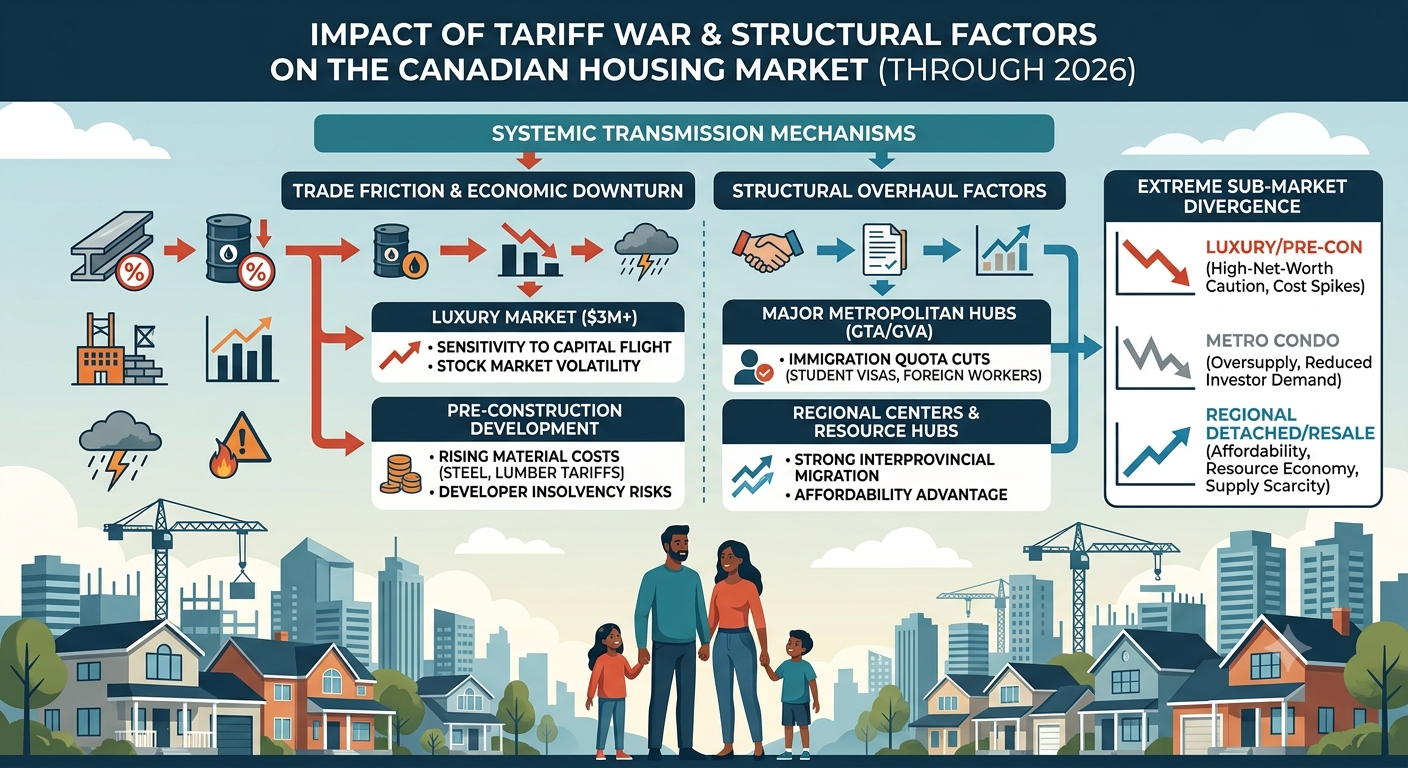
The ongoing U.S.-Canada tariff disputes and the resulting economic downturn have shifted the Canadian real estate landscape from a simple macro issue into a deep structural overhaul. Through 2026, high economic uncertainty continues to divide the Canadian housing market into distinct micro-segments. We are observing an extreme “sub-market divergence” characterized by stark splits: luxury versus entry-level, major metropolitan hubs versus regional centers, and pre-construction developments versus existing resale inventory.
Amid shifts in federal immigration quotas, persistent productivity bottlenecks, and sticky mortgage rates, this analysis breaks down the systemic transmission mechanisms affecting each asset class and outlines actionable strategies for prospective homebuyers and real estate investors.
1. Transmission Mechanisms Across Real Estate Sub-Markets
Trade friction and systemic economic risks cascade into individual residential real estate segments through clear financial and demographic channels.
- Luxury Segment ($3M+): Heavily sensitive to capital flight toward foreign markets, broader stock market volatility, and wealth management sentiment rather than standard mortgage rate swings. High-net-worth buyers move money strategically or wait on the sidelines during trade conflicts.
- Metropolitan vs. Regional Markets: Major metropolitan hubs bear the brunt of federal cutbacks in international student visas, temporary foreign worker permits, and reduced permanent residency quotas. Conversely, regional centers and resource-rich provinces offer superior housing affordability and remain anchored by local end-user demand.
- Pre-Construction vs. Resale Inventory: Import tariffs on lumber, steel, and building supplies spike hard construction costs. Coupled with developer financing distress, the pre-construction market faces severe project cancellations and delays. Completed resale homes stand out as lower-risk alternatives with no delivery delay risk.
2. Deep-Dive Sector Analysis and Forecasts
Luxury Residential ($3M+)
High-net-worth individuals are keeping their liquidity parked in cash equivalents or stable international financial assets during trade tensions. Because high-end real estate performance mirrors equities and corporate profitability more than retail mortgage rate movements, prolonged trade friction stifles buyer urgency. Expect luxury volume to stay low, driven almost entirely by motivated sellers or estate liquidations until international trade relationships stabilize.
Metropolitan Hubs vs. Regional Markets
- Major Urban Metros (Greater Toronto Area & Greater Vancouver Area): The federal government’s policy pivot to lower non-permanent resident quotas hits urban apartment rental and starter-home markets directly. Speculative investor-owned condos face elevated inventory levels as rental income streams drop relative to monthly carrying costs.
- Regional & Resource Hubs (Alberta, Saskatchewan, Regional Outskirts): Interprovincial migration remains strong as families relocate out of high-cost Ontario and British Columbia. Regions with low living costs and solid energy or resource bases continue to demonstrate steady demand and price stability.
Pre-Construction vs. Existing Resale Inventory
- Pre-Construction: Rising tariffs on imported steel, aluminum, and manufactured goods have created a structural floor below which developers cannot price units without going into negative margin. Combined with cautious bank lending to builders, new project launches face prolonged stagnation.
- Resale Homes: Resale inventory carries no construction delivery risk or unexpected closing adjustment fees. Buyers leverage market conditions to negotiate price concessions, making existing homes the primary engine of actual transactions.
| Category | Primary Impact Factors | 2026 Current Market Conditions |
|---|---|---|
| Luxury Homes | Financial market volatility, high-net-worth sentiment, estate/capital flight. | Buyers entrenched in a wait-and-see stance; intermittent transactions driven mostly by distressed sales. |
| Major Metros (GTA/GVA) | Immigration cutbacks, high mortgage rates, condo oversupply. | Sharpest price adjustments; inventory building up as speculative investor demand exits. |
| Regional Cities (e.g., Prairies) | High housing affordability, net population inflows, strong resource economy. | Strong price resilience; end-user buying power keeps sales activity steady. |
| Pre-Con / New Builds | Building material tariffs, developer insolvency risk, construction delays. | Soaring costs halt new project launches, triggering developer liquidity crises. |
| Resale Homes | Immediate occupancy, zero cost-overrun risk, strong buyer bargaining power. | Clear price advantage over new builds; end-user buyers heavily focus on resale stock. |
3. Comprehensive SWOT Analysis by Housing Type
4. Ontario Real Estate Timeline Scenarios (2026–2030)
Rationale for the Mid-Term Outlook
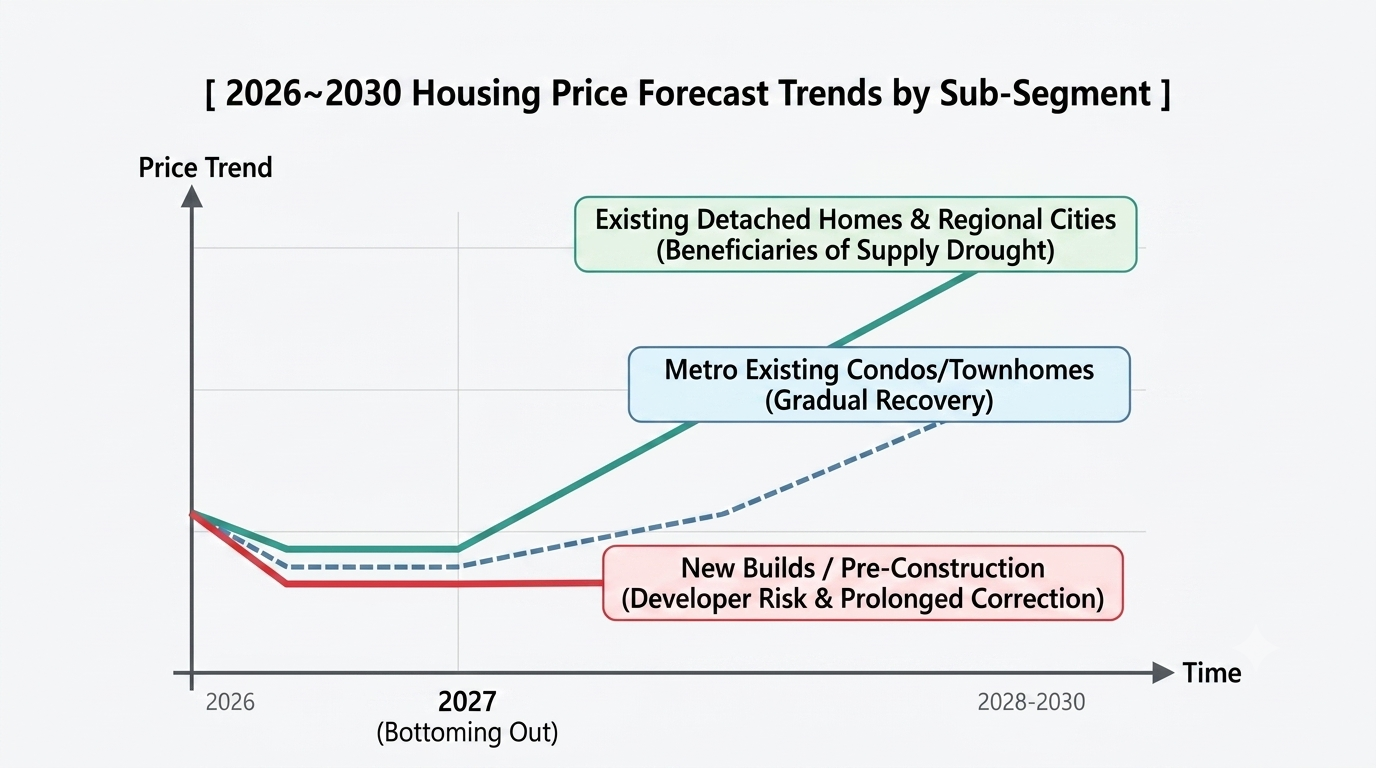
- The Construction Deficit: High financing costs and elevated material prices caused housing starts to drop sharply over recent cycles. By 2028, this shortfall will manifest as a acute supply shortage, driving up prices for completed, move-in-ready resale detached homes.
- Immigration Shift Impacts: Structural policy changes regarding non-permanent residents suppress rental yields and delay inventory absorption across investor-heavy high-density condo towers in major urban hubs.
- Material Tariff Pressures: Protective trade tariffs on raw construction inputs keep development costs high, making it difficult for builders to launch affordable new projects.
Key Risk Variables That Could Alter the Forecast
- Aggressive Rate Cuts by Bank of Canada: Rapid monetary easing to prevent broader economic fallout could ignite credit-sensitive segments like urban condos faster than expected.
- Reversal of Immigration Policies: A pivot in federal policy to address labor shortages could bring back population inflows, accelerating inventory absorption in urban hubs.
- Supply Chain Cost Normalization: A swift resolution to trade frictions and a drop in raw material tariffs would restore developer margins and shorten the pre-construction recovery timeline.
5. Tactical Buyer Strategies by Profile
- Primary Residence Buyers in Metro Hubs: Avoid pre-construction floor plans entirely. Instead, negotiate aggressively on existing resale detached or townhouse inventory in established neighborhoods that have undergone price corrections.
- Investors & Wealth Managers: Shift away from speculative downtown condo units. Reallocate capital toward resale assets in stable, energy- and resource-backed regional centers (such as Alberta) or key detached residential parcels poised to benefit from supply shortages by 2028.
- Mortgage & Financing Tactics: Pass on long-term fixed rates at current levels. Opt for short-term 2- to 3-year fixed or adjustable-rate mortgages to maintain flexibility for future debt refinancing once rate conditions normalize.
Conclusion: Key Takeaways
Navigate the Canadian real estate market in 2026 by focusing on asset location, property type, and execution risk rather than relying on broad regional averages.
- Prioritize Resale Over Pre-Construction: High building costs and builder risk make completed homes the safer choice over pre-construction investments.
- Focus on Structural Supply Scarcity: Ground-oriented resale homes in established communities will benefit most from construction slowdowns starting in 2028.
- Target Affordability and End-User Demand: Regional centers backed by solid employment bases offer stable cash flows and stronger downside protection than investor-heavy metro condo buildings.
※ This post is provided strictly for informational purposes and does not constitute a recommendation or solicitation to buy, sell, or invest in any specific financial instruments, securities, or real estate assets. The analysis and opinions expressed herein are based on information available at the time of writing, but no guarantee is made regarding their accuracy, completeness, or timeliness. All real estate and investment decisions and risk exposures are solely the responsibility of the individual investor.
※ Some images and technical descriptions in this post were created in collaboration with Google Gemini AI, and were finalized after direct creation, review, revision, and editing by the author.