
In the traditional landscape of corporate governance, operations moved in lockstep according to the centralized directives of a single top-down corporate leader. Today, modern business enterprises function far more like complex living organisms, where distributed business units must independently evaluate immediate conditions and act autonomously. In 2026, companies face a pivotal crossroads: remain a lumbering vessel tethered to corporate headquarters for every routine sign-off, or transform into an agile fleet led by nimble captains equipped with dynamic decision-making frameworks.
For large-scale organizations, the ultimate priority is delegating authority to local business segments while maintaining the rigorous analytical foresight to evaluate capital performance and instill genuine accountability. However, reliance on long-standing traditional capital budgeting metrics—such as Net Present Value or Internal Rate of Return—often fails to capture the latent value of intellectual property, intangible assets, or the strategic optionality of unproven, volatile business ventures.
To escape the traps of short-termism and excessive risk aversion, forward-thinking enterprises are adopting Real Options Analysis. This article provides an executive roadmap for integrating this advanced financial tool into corporate workflows to turn market uncertainty into a measurable strategic advantage.
1. An Everyday Analogy: Commit for Five Years vs. Run a Pop-Up
To understand the difference between traditional capital budgeting and Real Options Analysis, consider a hospitality entrepreneur planning to launch a new restaurant concept in a trendy urban market.
- The Traditional Approach (NPV, IRR): Before signing a commercial lease, the entrepreneur builds a complex spreadsheet forecasting exactly how many meals will be sold each month for the next five years. Based entirely on these static projections, they sign a binding, five-year lease with massive upfront capital expenditure. If consumer tastes shift, a pandemic occurs, or local foot traffic plummets, the firm is locked in. Because the upfront risk is so high, many profitable but highly volatile concepts are rejected before they ever begin.
- The Real Options Approach: The entrepreneur negotiates an alternative agreement: they pay a non-refundable premium to secure a temporary space for a six-month “pop-up” pilot. The contract dictates that if the concept proves highly successful, they hold the exclusive right to execute a long-term commercial lease. If the pilot fails, they simply let the agreement expire and walk away. While the initial option premium is lost, the firm avoids a catastrophic downside by securing the flexibility to expand or abandon the venture based on real market data.
2. The Operational Mechanics of Real Options
Real Options Analysis is exceptionally powerful because it assigns a concrete, quantifiable financial value to managerial flexibility and staged decision-making. Rather than treating an investment as a binary “go/no-go” decision, it models projects as evolving initiatives where managers can execute an option to expand, an option to defer, or an option to abandon.
To apply this framework in practice, corporate finance teams must first map everyday operational data points to traditional financial option variables:
3. Decision Framework and Quantitative Models
① The Staged Investment Process Flow
In corporate practice, the most prevalent application is a two-stage sequential investment process. By structuring capital allocation this way, the total expanded strategic value of a project is unlocked.
② Quantitative Valuation: The Black-Scholes Formula
To compute the exact mathematical dollar premium added by managerial flexibility, corporate treasuries utilize the Black-Scholes-Merton option pricing model tailored for physical assets:
- C (Option Value): The strategic financial premium generated by retaining the right to make a flexible choice.
- N(d_1), N(d_2): Cumulative standard normal distribution functions representing the risk-adjusted mathematical probability that the project finishes “in-the-money.”
- e^{-rT}: The continuous discounting factor that reduces the future capital expenditure ($K$) to its present value equivalent.
4. Operational Implementation Guide for Corporate Finance Teams
Transitioning Real Options from an academic theory to a core operational corporate process requires rigorous financial controls. Executive teams should implement the following three corporate mandates:
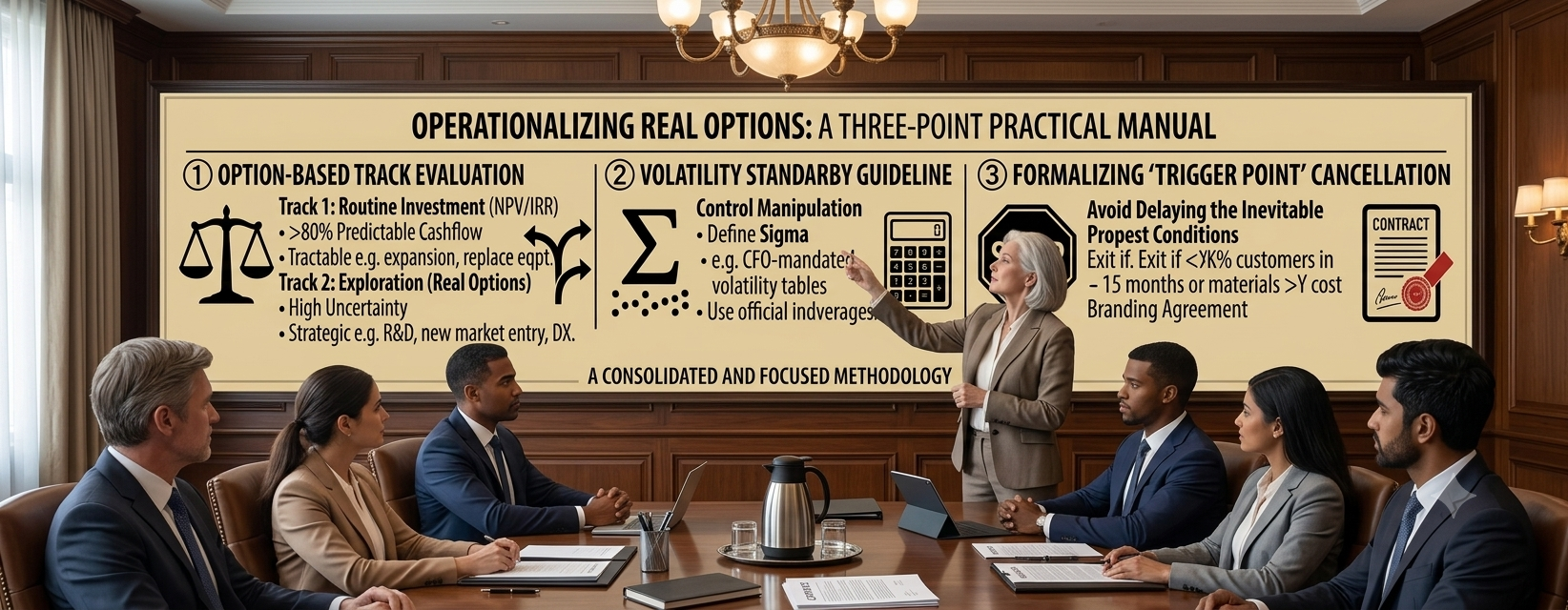
① Establish a “Two-Track” Capital Allocation Framework
Not every corporate expenditure requires complex financial engineering. Finance committees should segment requests based on predictable cash flows:
- Track 1 (Standard Expenditures): Routine asset allocations—such as expanding an active manufacturing facility, replacing end-of-life logistics hardware, or acquiring standard commercial real estate—should continue to be evaluated using standard NPV and IRR metrics where cash flow predictability exceeds 80%.
- Track 2 (Exploratory Capital): High-uncertainty, high-upside initiatives—such as novel biopharmaceutical research, international market penetration, or building AI-driven enterprise platforms—must be explicitly structured as staged options.
② Standardize Volatility ($\sigma$) Inputs to Prevent Data Manipulation
A notable risk in real options modeling is that inflating the uncertainty variable ($\sigma$) automatically inflates the calculated option value ($C$). Project teams seeking funding may intentionally overestimate market volatility to push sub-optimal projects past the finance committee.
To prevent this moral hazard, the Corporate Controller or CFO organization must establish a centralized, audited volatility directory. This index should compile historical three-to-five-year asset volatilities from public equity peers and public macroeconomic indices, forcing teams to select standardized inputs based on objective industry classifications.
③ Formalize Contractual “Trigger Points” for Abandonment
The primary structural flaw in real options deployment is the human tendency to fall into the sunk-cost fallacy. A poorly performing pilot venture can easily devolve into a perpetual drain on resources if managers refuse to accept defeat.
To guard against this, the corporate charter for any exploratory project must contain legally binding, non-negotiable exit triggers before a single dollar is deployed. For example: “If consumer adoption fails to cross a defined percentage threshold within ninety days, or if underlying material costs break an upper bound, the abandonment option will execute automatically.”
5. Balancing Analytics with Corporate Leadership
While quantitative options models provide vital clarity, sophisticated mathematical frameworks are ultimately meant to augment, not replace, executive vision. When iconic leaders like Steve Jobs developed the iPhone, or Elon Musk founded SpaceX, they did not base their multi-billion-dollar bets entirely on static spreadsheet models.
True corporate leadership requires fusing quantitative rigor with deep strategic intuition. Recognizing when to rely on numbers and when to back a visionary gamble is the defining hallmark of robust, accountable modern governance.
Conclusion: Key Takeaways
- Quantify the Value of Agility: Traditional NPV models ignore the financial value of flexibility; Real Options Analysis explicitly Prices the benefit of being able to pivot as data emerges.
- Mitigate Large-Scale Downside: By breaking large capital allocations into staged options, corporate enterprises ensure that downstream failures only incur the cost of the initial pilot phase.
- Control Strategic Volatility: Implement central guidelines for uncertainty inputs to keep corporate project teams from manipulating financial models to pass reviews.
- Enforce Hard Stop Conditions: Always combine real options with predetermined operational trigger points to ensure failing initiatives are cut without emotional bias.