
The semiconductor boom powered by the AI revolution is reshaping global financial markets. However, one of the most debated developments in the tech sector revolves around SK Hynix’s listing on the Nasdaq via American Depositary Receipts (ADRs) and the friction surrounding it.
Investors often wonder: “Why is the home market stock lagging when a global semiconductor leader lists in the US?” or “Why do foreign investors capture gains while domestic retail shareholders feel left behind?”
At the center of this controversy are two financial concepts: ADRs and Fungibility. This analysis breaks down the core mechanics of this listing, the regulatory roadblocks preventing seamless trading, Samsung Electronics’ contrasting strategy, and what it all means for the broader semiconductor landscape.
1. Core Financial Concepts Explained
To grasp the situation, three fundamental market mechanisms must be understood:
- Original Shares (KOSPI Ordinary Shares): These are the standard equity shares of SK Hynix traded directly on the South Korean exchange (KOSPI).
- American Depositary Receipts (ADR): Direct listings by non-US companies on American stock exchanges involve high administrative hurdles. To simplify access, the underlying ordinary shares are held securely in a custodian bank in Korea, while dollar-denominated negotiable certificates (ADRs) are issued and traded on US exchanges like Nasdaq.
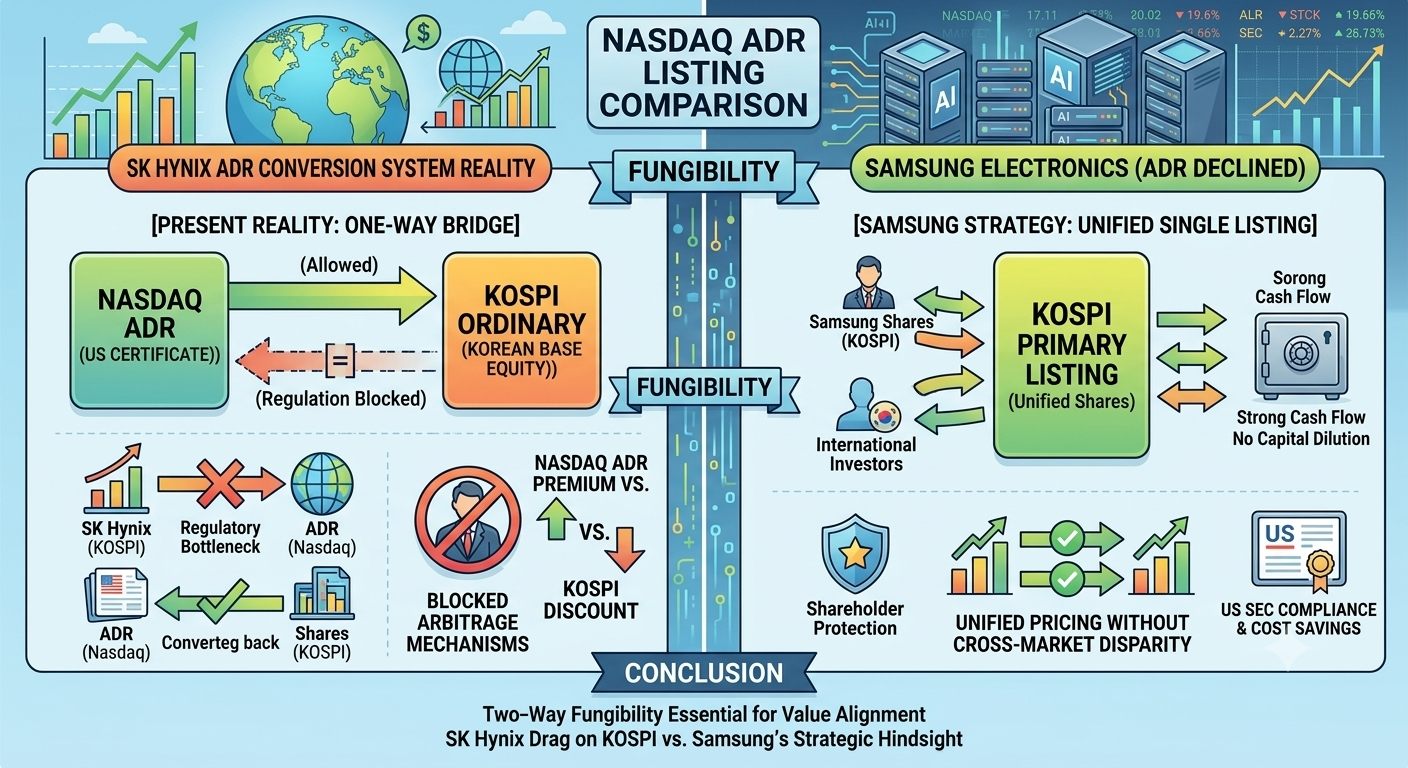
- Fungibility (Cross-Market Share Conversion): This refers to the ability to convert ordinary shares into ADRs and vice versa. When two-way fungibility functions properly, an arbitrage window opens: if domestic shares are cheaper than US-traded ADRs, traders buy domestic shares, convert them to ADRs, and sell them in the US for a profit. This arbitrage mechanism naturally aligns prices across both exchanges.
2. SK Hynix’s Nasdaq ADR: The “One-Way Bridge” Problem
SK Hynix pursued a Nasdaq ADR listing not merely for liquidity, but to attract major US institutional capital and achieve a higher valuation reflective of its leadership in high-bandwidth memory (HBM) and AI hardware.
However, regulatory bottlenecks created an asymmetric conversion mechanism—effectively a one-way bridge.
- US ADR to Korean Ordinary Shares (Allowed): Converting US-purchased ADRs back into domestic Korean shares is unrestricted and fully functional.
- Korean Ordinary Shares to US ADRs (Restricted): Financial regulations require full re-filing of registration statements every time domestic shares are converted into ADRs. This administrative obstacle halts automated cross-border conversions from Korea to the US.
3. Why Domestic Shareholders Suffer (Valuation Disparities)
Because cross-border conversion operates in only one direction, price imbalances naturally occur between the two markets:
- Nasdaq ADR Premium: Only a limited float (approximately 2.5% of total shares) was made available as ADRs on Nasdaq. Driven by high demand from Wall Street for AI hardware exposure, ADR prices command a significant premium over domestic Korean shares.
- Blocked Arbitrage Mechanisms: In an open market, institutional traders would buy cheaper Korean shares, convert them into ADRs, and sell them in New York to capture the price differential. This trading activity would lift the domestic stock price until both quotes reached parity. However, because conversion requires repetitive regulatory filings, real-time arbitrage is impossible, leaving Korean domestic shares stagnating despite strong performance on the Nasdaq.
4. Why Samsung Electronics Rejected an ADR Listing
During a quarterly earnings call, Samsung Electronics addressed rumors of a potential US ADR listing by explicitly dismissing the plan. Samsung’s management cited three core strategic considerations:
- Sufficient Balance Sheet Strength: Samsung generates substantial operating cash flows driven by its diversified technology portfolio. The company has no immediate need to raise capital overseas, especially through structures that might dilute existing equity.
- Protection Against Shareholder Disparity: Management noted that floating a limited supply of shares on foreign exchanges risks creating price disconnects driven by localized supply-demand dynamics. Without full two-way fungibility, an ADR listing risks benefiting foreign holders while leaving domestic investors with discounted local valuations.
- Regulatory Compliance Costs: Operating an ADR program requires full compliance with US Securities and Exchange Commission (SEC) reporting requirements and accounting standards, adding ongoing administrative expenses without proportional benefit.
5. Comparative Overview: SK Hynix vs. Samsung Electronics
HTML
| Category | SK Hynix (ADR Pursued) | Samsung Electronics (ADR Declined) |
|---|---|---|
| Listing Structure | Nasdaq ADR (~2.5% of total shares) | Single Primary Listing on KOSPI |
| Fungibility Status | One-Way (Ordinary ➔ ADR restricted) | Not Applicable |
| Core Objective | Access US capital and revalue market cap | Protect domestic shareholders & rely on cash reserves |
| Stock Price Impact | US ADR premium vs. domestic share discount | Unified pricing without cross-market disparity |
| Current Challenge | Arbitrage blocked; drags on domestic valuation | Avoids added US SEC compliance overhead |
6. Why Regulatory Reforms Remain Delayed
Updating administrative guidelines might seem straightforward, but regulatory adjustments faced delays due to institutional dynamics:
- Sensitivity to Preferential Treatment Debates: Relaxing filing rules specifically benefiting large conglomerates risks backlash over allegations of corporate favoritism.
- Regulatory Risk Aversion: Financial authorities remain cautious regarding market volatility, potential capital flight, and legislative oversight. Regulators often prefer maintaining existing compliance frameworks to avoid exposure to policy liability.
- Establishing Objective Frameworks: Creating workable policy changes requires setting generalized legal standards—defining clear market cap thresholds and SEC registration requirements—rather than issuing ad-hoc exemptions for individual corporations.
Conclusion: Key Takeaways
- Two-Way Fungibility is Essential: For cross-border listings like SK Hynix’s Nasdaq ADR to reflect true underlying value in domestic markets, regulatory frameworks must support seamless two-way conversion between domestic shares and foreign depository receipts.
- Impact on Broader Indices: SK Hynix represents a significant share of the overall KOSPI market capitalization. Valuation bottlenecks affecting its primary domestic stock can influence index performance across the broader Korean market.
- Strategic Alignment Matters: Samsung Electronics’ decision to focus on its primary listing highlights how capital structure choices affect domestic shareholder alignment during global tech expansion cycles.
- Policy Monitoring for Investors: Clear guidelines from financial regulators regarding streamlined ADR conversions remain a key factor for market participants tracking semiconductor equity valuations.
⚠️ Investment Disclaimer The stock analysis and related materials provided on this blog are intended solely as supplementary reference for investment evaluation. This content does not, under any circumstances, constitute a recommendation or solicitation to buy or sell any security. All final investment decisions, as well as any resulting profits or losses, rest entirely with the individual investor. This blog does not guarantee the accuracy or completeness of the information provided and assumes no legal liability for any investment outcomes.
AI Disclosure: This analysis was prepared using research, structuring, and editorial assistance powered by Google AI technologies.