
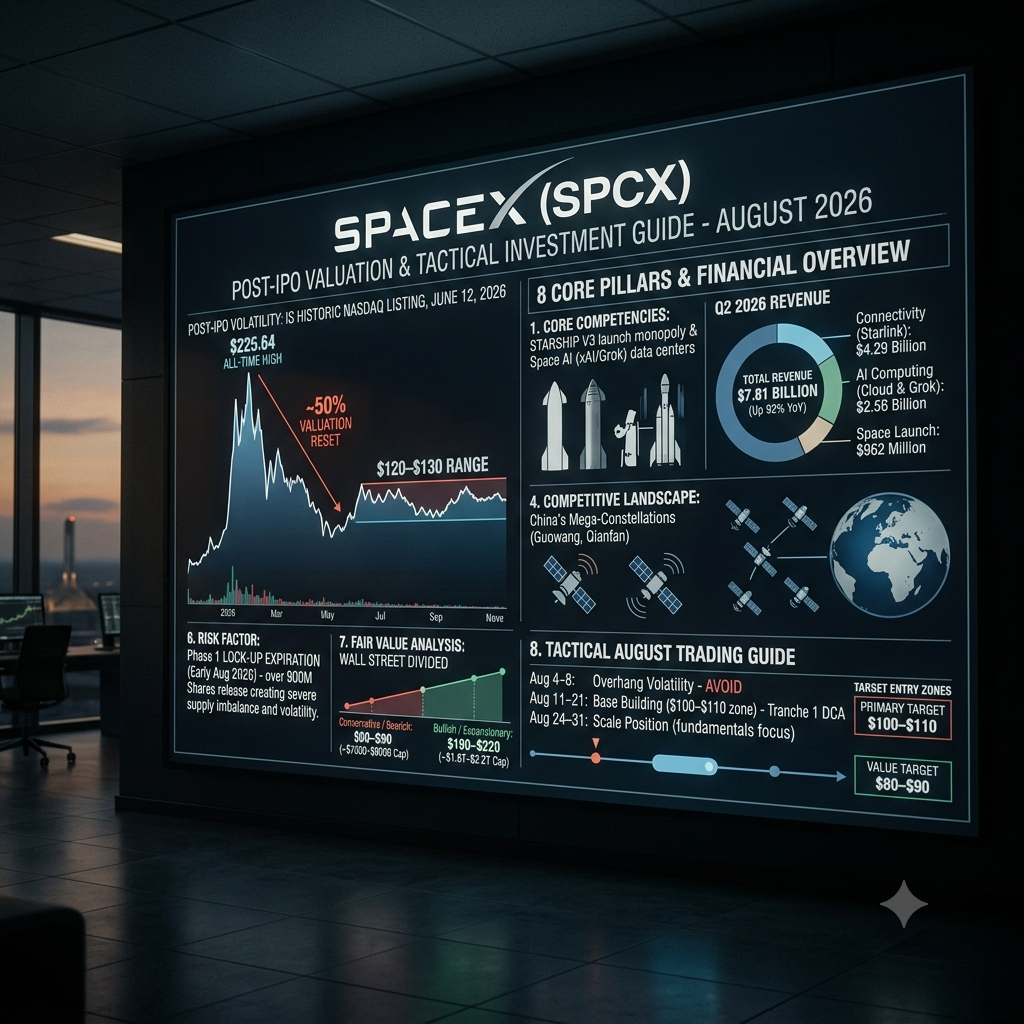
Following its historic Nasdaq listing on June 12, 2026 (IPO price: $135 per share), SpaceX (SPCX) rapidly reached an all-time high of $225.64, propelling its market capitalization to a staggering $2.1 trillion. However, the stock has since experienced a ~50% valuation reset, currently consolidating around the $120–$130 range.
With the release of Q2 2026 earnings on August 4 and the onset of the first major Lock-Up expiration, the market is sharply divided on fair value. Below is a comprehensive breakdown of SPCX across 8 core pillars and a tactical investment guide for August 2026.
1. Core Competencies: Irreplaceable Launch Monopoly & Space AI Computing
- Monopolistic Launch Reusability: Building on the dominance of Falcon 9, successful flight tests (Flights 12 & 13) for Starship V3 have solidified a technical monopoly, reducing orbital transport costs by over 99%.
- Vertical Integration (Telecom + Transport + AI): Beyond launch services, SpaceX is uniquely positioning itself as a vertically integrated platform by pairing the Starlink satellite network with xAI (Grok) infrastructure to pioneer orbital AI data centers.
2. Growth Trajectory: Q2 Revenue Surges 92%
SpaceX reported Q2 2026 revenue of $7.81 billion (up 92% YoY), comfortably beating Wall Street consensus ($6.93 billion):
| Segment | Q2 2026 Revenue | Highlights / Key Drivers |
| Connectivity (Starlink) | $4.29 Billion | Subscriber base doubled YoY; strong growth in enterprise & defense. |
| AI Computing (Cloud & Grok) | $2.56 Billion | Fueled by compute/cloud infrastructure contracts. |
| Space Launch | $962 Million | Stable core launch operations supporting commercial and government payloads. |
3. Profitability & Cost Dynamics: Net Loss Shrinks Amid Heavy CapEx
- Narrowing Net Losses: Q2 net loss came in at -$541 million, cutting losses nearly in half compared to -$1.0 billion in Q2 2025.
- CapEx Pressure: Massive capital expenditure (~$10B+ per quarter, led by AI infrastructure and Starship mass production) continues to weigh on short-term Free Cash Flow (FCF), capping immediate stock upside.
4. Competitive Landscape: China’s Mega-Constellations
- State-Backed Constellations: China’s Guowang (~13,000 planned satellites) and Shanghai-backed Qianfan / G60 (~15,000 planned satellites) are aggressively expanding into Global South markets (Latin America, Southeast Asia).
- Closing the Reusability Gap: Test flights of methane-based reusable rockets (e.g., LandSpace’s Zhuque-3, Long March 12A) signal mounting price competition over a 3- to 5-year horizon.
5. Financial Health: $86 Billion IPO War Chest
With approximately $75B–$86B raised via the IPO, SpaceX holds substantial cash and liquid assets. This provides a massive balance sheet runway to execute multi-year AI and space data center R&D without diluting equity or issuing high-yield debt.
6. Risk Factors & Overhang: The Lock-Up Expiration
- Phase 1 Lock-Up Expiration (Early August 2026): Over 900 million shares held by early institutional backers and employees become eligible for sale.
- Severe Supply Imbalance: This lock-up release represents more than double the original public float (~555 million shares), creating significant short-term overhang and price volatility.
- Phase 2 Lock-Up (June 2027): Elon Musk and key insiders holding ~82–85% of voting control remain locked up for 366 days post-IPO.
7. Fair Value Analysis: Wall Street Consensus Divided
| Outlook | Financial Institutions | Target Price / Fair Valuation | Core Thesis |
| Conservative / Bearish | Morningstar, Select Hedge Funds | $60 – $90 (~$700B – $900B Cap) | • Trailing/forward P/S multiples exceeding 70x indicate bubble territory. • High CapEx requirements and ongoing net losses make the $135 IPO price overpriced. |
| Bullish / Expansionary | Goldman Sachs, Morgan Stanley | $180 – $220 (~$1.8T – $2.2T Cap) | • Accelerating Starlink profitability. • Near-monopolistic capture of the space AI computing market with Starship launch unit economics. |
- Short-Term Outlook (Q3 2026): Supply overhang will dominate as the market absorbs the ~900M share lock-up release. However, the $100–$110 range serves as a strong fundamental floor below the $135 IPO price.
- Medium-to-Long Term (2026 H2 – 2027): As new AI cloud backlog revenue ($14.1B in Q2 bookings) flows through the income statement and Starship V3 transitions to regular operations, valuation multiples should normalize upward.
8. Tactical Investment Strategy & August Trading Guide
(Please note that this section reflects subjective analysis and should be used for informational reference only. Investors should exercise their own independent judgment and decision-making when investing.)
A. August Timeline & Action Plan
- Early August (Aug 4–8): Overhang Volatility Phase
- Action: Avoid rushing in with new capital. Wait for institutional selling volume to settle following the earnings report and initial lock-up release.
- Mid-August (Aug 11–21): Base Building Phase
- Action: If SPCX stabilizes in the $100–$110 zone with declining red volume over three consecutive sessions, begin executing Tranche 1 dollar-cost averaging (DCA).
- Late August (Aug 24–31): Re-evaluation & Position Sizing
- Action: Shift focus back to core fundamentals (92% revenue growth). Scale up to 30–40% of your total intended SPCX allocation.
B. Target Entry Zones
- Primary Target ($100 – $110): A 20–25% discount to the $135 IPO price, backed by the company’s massive cash balance.
- Value Target ($80 – $90): Corresponds to conservative institutional fair value. Downside risk is heavily limited at this level for long-term investors.
C. Risk & Portfolio Rules
- Allocation Cap: Keep SPCX capped at 5% to 10% of total equity holdings due to high growth-stock volatility.
- Key Monitoring Metrics: Daily institutional volume post-lockup, Starship V3 launch cadence, and Chinese constellation expansion.
Investment Disclaimer The stock analysis and related materials provided on this blog are intended solely as supplementary reference for investment evaluation. This content does not, under any circumstances, constitute a recommendation or solicitation to buy or sell any security. All final investment decisions, as well as any resulting profits or losses, rest entirely with the individual investor. This blog does not guarantee the accuracy or completeness of the information provided and assumes no legal liability for any investment outcomes.
AI Disclosure: This post was written, reviewed, and edited by the author in collaboration with Google Gemini AI. All featured images, and visual materials were generated using Google Gemini AI to enhance technical clarity, readability, and overall visual presentation