
Imagine if every corporation created its own unique rules when issuing financial report cards to the public. Investors and creditors would be left comparing apples to oranges, cross-border capital flow would grind to a halt, and market trust would collapse overnight.
To prevent this chaos, the business world relies on a universal framework: Accounting Standards.
These standardized principles ensure that financial statements serve as clear, transparent, and trustworthy communication tools across global capital markets.
1. Key Terminology
Understanding the global language of business requires mastering a few foundational concepts:
HTML
Core Accounting Terms
- Accounting Standards: Standardized principles and procedures that govern how financial statements must be prepared.
- Financial Statements: Formal, structured reports detailing a company’s performance, financial position, and cash flows.
- Disclosure: The act of releasing material financial and operational information to investors and the public.
- Compliance: The mandatory obligation to maintain records and report financials strictly according to established standards.
- Audit: An independent examination conducted by a third-party professional to verify financial accuracy and compliance.
2. Major Global Accounting Frameworks
Financial reporting standards vary depending on jurisdiction, market size, and regulatory philosophy. The global landscape is largely dominated by two primary frameworks, alongside localized standards for smaller entities.
HTML
| Standard | Core Philosophy | Global Reach & Scope |
|---|---|---|
| IFRS | Principle-based: Offers high-level guidelines and operational flexibility. | Adopted by over 140 nations including the EU, South Korea, Canada, and Australia. |
| US GAAP | Rule-based: Delivers detailed, specific criteria and bright-line rules. | Mandatory for US public companies; holds massive international influence due to US capital markets. |
| Local GAAP (e.g., K-IFRS / Private GAAP) | Tailored for regional markets, public entities, or private middle-market enterprises. | Varies by corporate structure; provides simplified reporting for non-listed SMBs. |
International Financial Reporting Standards (IFRS)
- Definition: Issued by the International Accounting Standards Board (IASB), an independent body under the IFRS Foundation based in London.
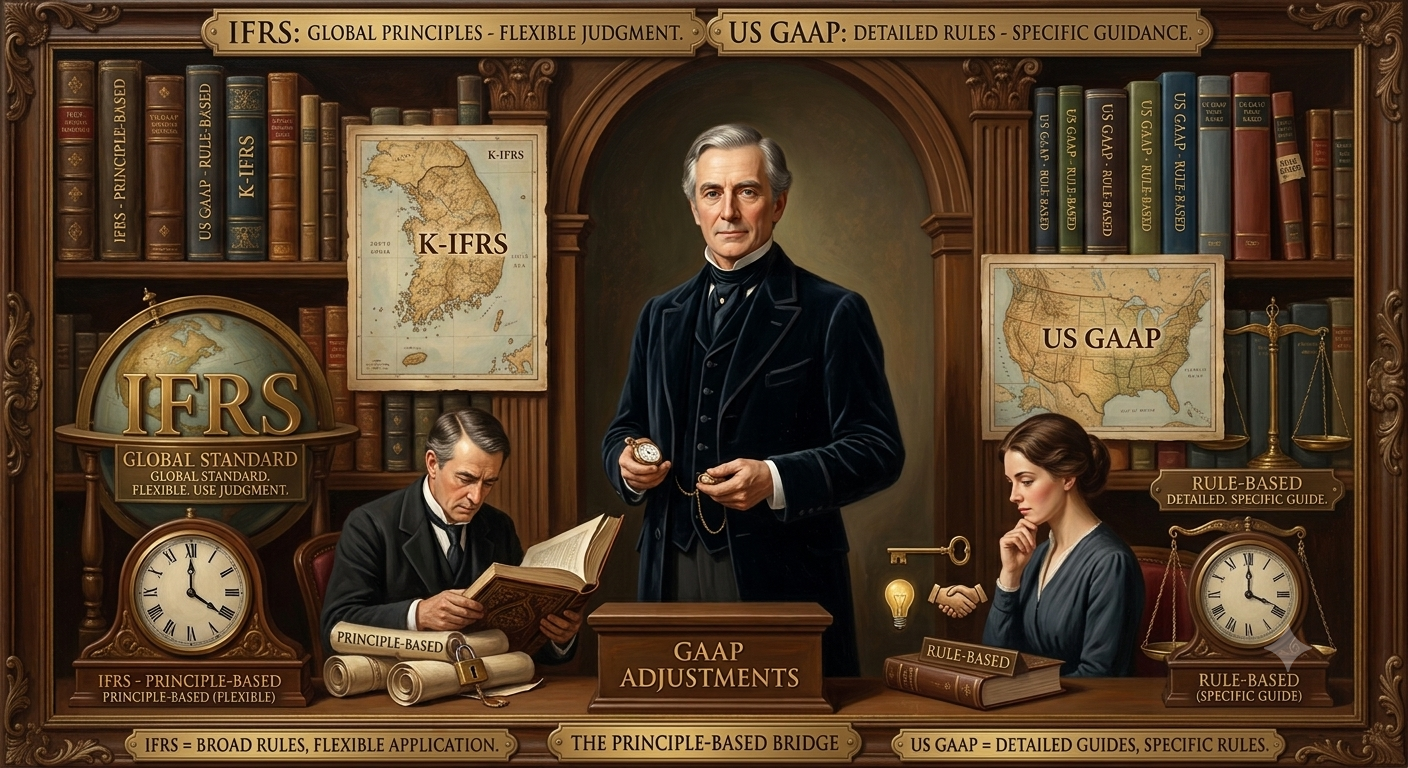
- Key Features: IFRS relies on a principle-based philosophy. Instead of prescribing rigid rules for every scenario, it establishes overarching principles, allowing management to apply professional judgment based on economic substance.
- Global Footprint: Over 140 countries have adopted IFRS as their primary financial language, making it the definitive worldwide standard.
US Generally Accepted Accounting Principles (US GAAP)
- Definition: Established by the Financial Accounting Standards Board (FASB) in the United States.
- Key Features: US GAAP is a rule-based framework. It provides explicit guidelines, strict tests, and detailed rules for virtually every transaction type to minimize ambiguity and legal exposure.
- Global Impact: Given the immense depth and liquidity of North American capital markets, US GAAP commands enormous prestige and influences global financial practices.
Domestic Adaptations (The Korean Context: K-IFRS vs. Local GAAP)
- K-IFRS: Publicly traded companies and major financial institutions in South Korea must fully comply with K-IFRS, which directly mirrors IFRS standards.
- Korean GAAP for Private Enterprises: Unlisted small and medium-sized businesses use a streamlined local framework designed to minimize administrative burdens while supporting practical tax reporting.
3. Standard-Setting Bodies
Independent private organizations lead standard-setting to shield financial regulation from political bias and capture true economic reality.
HTML
| Standard | Organization Name | Institutional Nature |
|---|---|---|
| IFRS | International Accounting Standards Board (IASB) | Independent international private organization based in London. |
| US GAAP | Financial Accounting Standards Board (FASB) | Independent private non-profit body in the United States. |
| K-IFRS | Korea Accounting Standards Board (KASB) | Independent private standard-setting body operating under regulatory oversight. |
4. How Company Size Dictates Compliance
Accounting obligations scale based on corporate size and public exposure. Regulatory frameworks balance reporting burdens against market risk:
HTML
| Category | Large Enterprises & Public Companies | Private Companies & SMBs |
|---|---|---|
| Applicable Standards | Full IFRS / K-IFRS / US GAAP | Simplified Private GAAP / Local Standards |
| Primary Objective | Protect capital markets & enable global peer comparison | Tax reporting & operational efficiency |
| Disclosure Burden | Extremely High (Quarterly, Annual SEC/FSC Filings) | Moderate to Low |
5. Regulatory Enforcement and Non-Compliance Penalties
Accounting rules are meaningless without strict enforcement. When management intentionally manipulates financial records—engaging in fraudulent financial reporting or accounting fraud—the penalties are severe:
- Financial Fines & Sanctions: Substantial corporate fines designed to penalize non-compliance.
- Delisting & Trading Suspensions: Removal from public stock exchanges, cutting off access to equity capital.
- Criminal Liability: Prison terms and heavy personal fines for executive officers, board members, and bad actors.
- Auditor Suspensions: Sanctions or temporary practice bans against accounting firms that fail to uphold professional auditing standards.
6. Strategies for Harmonizing International Accounting Differences
When multinational firms operate across borders or list on overseas exchanges, conflicting accounting standards present real operational challenges. Resolving these differences requires institutional standard-setting alongside practical corporate solutions.
HTML
Global Accounting Alignment Roadmap
Institutional Frameworks (Policy Level)
- Full Adoption: Fully replacing national standards with IFRS. Over 140 nations use this approach to maximize international comparability.
- Convergence: Aligning independent national standards gradually with IFRS. The long-standing collaboration between the FASB and the IASB to narrow differences between US GAAP and IFRS serves as a primary example.
- Mutual Recognition: Allowing cross-border issuers to present financial statements under their home country’s standards when regulatory equivalence exists between jurisdictions.
Corporate Practical Solutions (Operational Level)
- Reconciliation Schedules: Presenting net income and shareholders’ equity under local GAAP first, followed by an itemized reconciliation schedule adjusting figures to IFRS or US GAAP.
- Dual Bookkeeping & Conversion: Building Enterprise Resource Planning (ERP) accounting workflows that tag transactions under multiple standard codes simultaneously, or applying closing conversion entries at fiscal year-end.
7. Key Career Paths in Financial Reporting
The complexity of accounting standards drives strong demand for skilled financial professionals:
- Certified Public Accountant (CPA): Trusted advisers who perform external audits, tax consulting, and strategic financial advisory services.
- Corporate Controller / Chief Financial Officer (CFO): Executive leaders responsible for financial reporting compliance, internal controls, and corporate strategy.
- Accounting Advisory Consultant: Technical experts hired to design ERP workflows and guide transitions when major accounting standards change (such as new lease or revenue recognition rules).
- Financial Regulator: Public enforcement officials (such as SEC or SEC-equivalent regulators) who oversee reporting transparency and protect investor interests.
Strategic Leadership Takeaways
In today’s global economy, accounting differences are no longer mere regulatory hurdles—they are opportunities to demonstrate transparency:
- Leverage Transparency as a Asset: Proactively disclosing financial reconciliation details builds institutional credibility with international rating agencies and lenders.
- Standardize Internal Systems: Aligning internal management reporting tools with IFRS or US GAAP simplifies global M&A activity and lowers cross-border borrowing costs.
- Engage Technical Advisory Early: Working with experienced CPA advisors helps identify tax liabilities and financial reporting risks before closing complex international transactions.
At its core, navigating international accounting standards is about far more than balancing spreadsheets—it is the process of building lasting credibility with investors worldwide using a single, unified language of trust.
Conclusion: Key Takeaways
- The Core Purpose: Accounting standards maintain financial integrity, ensuring company reports remain transparent, verifiable, and comparable across industries.
- Global Frameworks: IFRS offers a flexible, principle-based model used worldwide, while US GAAP relies on a comprehensive, rule-based system tailored for North American capital markets.
- Cross-Border Flexibility: Multinationals bridge regulatory gaps through formal policy convergence and operational reconciliation adjustments.
- Enforcement: Compliance is monitored by independent bodies and regulators, with severe criminal and market penalties for financial manipulation.
AI Disclosure: This article was created, structured, and refined through a collaborative process using Google Gemini AI, with final author review, technical editing, and content oversight.