
When preparing to launch a new venture or expanding an existing enterprise into international markets, founders inevitably encounter a fundamental legal hurdle: “What form of legal business entity should we register?”
If financial accounting standards serve as the universal language of business, legal entity structures represent the foundation of liability, governance, and taxation. Choosing an ill-fitting corporate structure can lead to severe tax penalties, bitter legal disputes among co-founders, or missed opportunities to secure institutional venture funding.
Whether you are deciding between a C-Corporation, a Limited Liability Company (LLC), a Partnership, or a Sole Proprietorship, selecting the correct legal structure is critical. This guide breaks down the primary business structures, compares international frameworks, and highlights key strategic considerations for entrepreneurs.
1. Key Terminology and Foundation Concepts
Before evaluating specific business structures, it is essential to clarify the foundational legal concepts governing entity formation:
- Legal Entity: A legally recognized organization created under statutory law that possesses distinct rights and obligations separate from its individual owners, including the right to enter contracts, sue, and be sued.
- Limited Liability: A protective legal barrier ensuring that shareholders or investors are liable for company debt only up to the amount of their capital investment, safeguarding their personal assets from business liabilities.
- Unlimited Liability: A high-risk legal condition where business owners remain personally responsible for all debts, judgments, and legal claims incurred by the business, exposing personal bank accounts and real estate.
- Incorporation: The formal legal process of forming a corporate entity separate from its owners to achieve independent legal standing.
- Corporate Governance: The framework of rules, relationships, systems, and processes by which corporations are directed and controlled, balancing the interests of shareholders, the board of directors, and executive management.
2. Primary Types of Business Structures
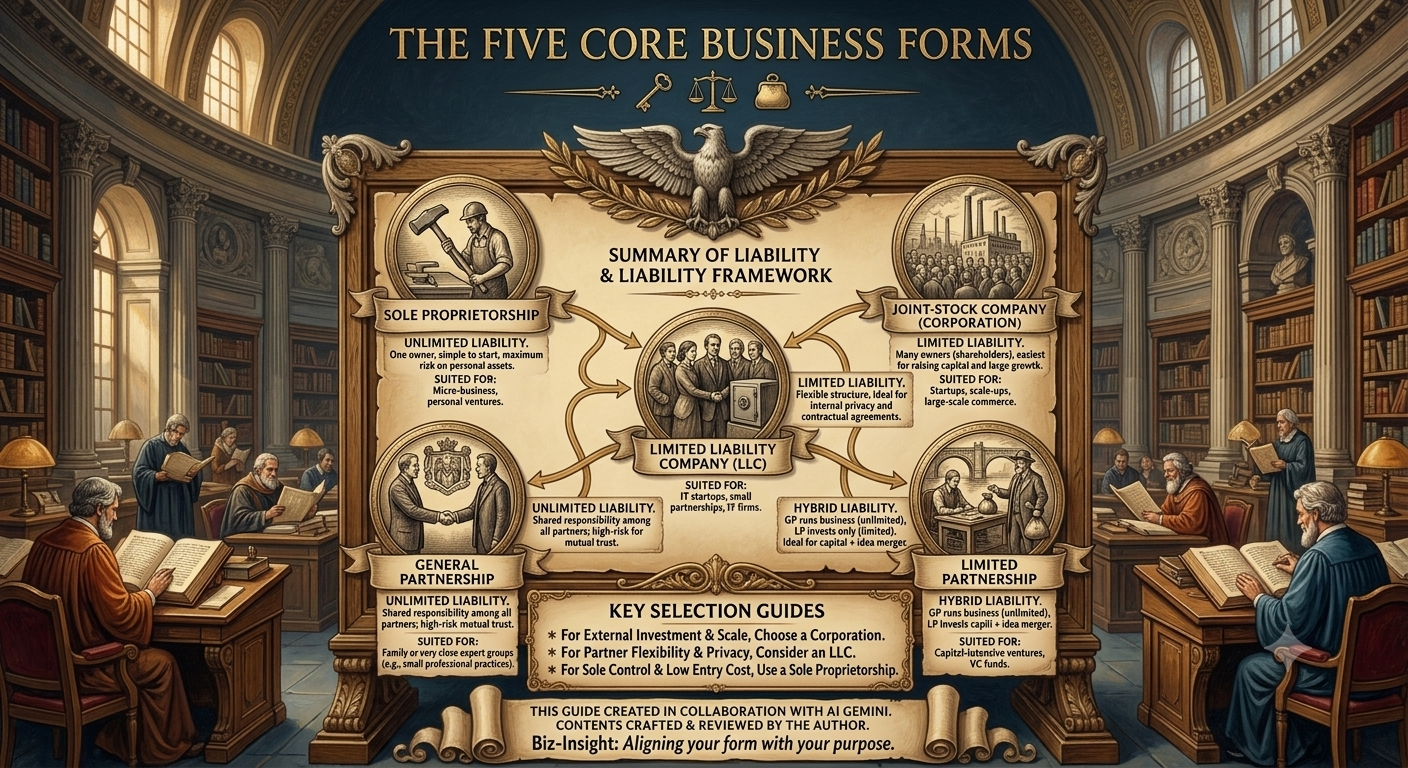
Under statutory corporate law, business entities generally fall into five distinct categories, each designed to balance managerial control, liability exposure, and fundraising potential.
① Sole Proprietorship
A Sole Proprietorship is an unincorporated business owned and operated by a single individual without creating a formal legal entity. It is the most common model for independent consultants, local shop owners, and freelancers.
- Key Characteristics: Setup is simple, regulatory burdens are low, and the owner retains complete discretionary control over all profits. However, the business and the owner are legally indistinguishable. This means the owner carries unlimited liability—if the business incurs debt or faces a lawsuit, the owner’s personal wealth, real estate, and assets are fully on the line.
② Joint-Stock Corporation (C-Corporation)
A Joint-Stock Corporation is a standalone legal entity that raises capital by issuing shares of stock to equity investors.
- Key Characteristics: Shareholders benefit from limited liability protection, meaning their risk is capped strictly at their equity investment. Because ownership (shareholders) can be decoupled from management (board of directors and officers), corporations are ideally structured to raise institutional venture capital, issue corporate bonds, and scale toward an Initial Public Offering (IPO).
③ Limited Liability Company (LLC)
An LLC blends the corporate liability shield with the operational flexibility and pass-through tax benefits of a general partnership.
- Key Characteristics: Owners (referred to as members) are shielded by limited liability. Unlike traditional corporations, LLCs face fewer rigid administrative rules regarding shareholder meetings or mandatory board oversight. Foreign subsidiaries, closely held family businesses, tech startups, and private equity firms frequently utilize LLC structures due to their structural adaptability.
④ General Partnership
A General Partnership is an association of two or more co-owners who join together to operate a commercial business for profit.
- Key Characteristics: All partners actively participate in management and share unlimited personal liability for the firm’s obligations. If the business fails or faces legal claims, every partner’s personal wealth can be attached to settle the firm’s liabilities. Consequently, this model is rarely recommended for commercial startups unless constrained to specialized professional associations (such as labor or legal practices).
⑤ Limited Partnership (LP)
A Limited Partnership divides ownership into two distinct classes of partners: General Partners (GPs) and Limited Partners (LPs).
- Key Characteristics: The General Partner manages daily operations and assumes full personal liability, while the Limited Partners contribute financial capital as passive investors without participating in management decisions. Their legal liability is strictly capped at their invested capital. This structure is the industry standard for venture capital funds, private equity funds, and real estate investment syndicates.
3. Comprehensive Business Entity Comparison Matrix
4. Cross-Border Comparison: United States vs. International Standards
For international businesses expanding into North America or cross-border investors, matching corporate entities correctly is critical for regulatory compliance and tax optimization.
Strategic Insights for US Market Entry
- Delaware C-Corp Standard for Venture Capital: International founders executing a corporate “flip” (moving ultimate corporate holding ownership to the US) or raising Silicon Valley venture capital are almost universally required to incorporate as a Delaware C-Corporation. Delaware offers corporate case law precedents, protective shareholder statutes, and standardized VC term sheet integration.
- Taxation Nuances Across Jurisdictions: In the United States, an LLC can elect “pass-through” taxation, allowing corporate profits to pass directly to individual tax returns to prevent corporate-level double taxation. However, foreign tax authorities often classify foreign LLCs as standard corporations, imposing local corporate income taxes regardless of US tax elections. Cross-border founders must align their corporate legal structuring with international tax treaties.
5. Strategic Selection Framework for Founders
When finalizing your corporate legal structure, evaluate your venture against three key decision criteria:
Conclusion: Key Takeaways
- Match Your Structure to Your Scale: Sole Proprietorships offer cheap, rapid launch capability but lack liability protection; C-Corporations unlock institutional investment and liability shielding at the cost of formal administrative oversight.
- Understand Regional Nuances: US venture capital ecosystems demand a Delaware C-Corp structure, whereas flexible closely held operations thrive under an LLC.
- Protect Personal Assets: Never compromise on limited liability when entering commercial partnerships or taking on operational debt.
AI Disclosure: This post was written, reviewed, and edited by the author in collaboration with Google Gemini AI. All featured images and visual materials were generated using Google Gemini AI to enhance technical clarity, readability, and overall visual presentation.