
A corporation’s asset base extends far beyond the physical goods stacked in a warehouse. The stocks and bonds acquired to deploy idle cash effectively or to facilitate strategic partnerships are also core corporate assets. In the field of accounting, these are formally referred to as Marketable Securities or, more broadly, Financial Assets.
While physical inventory carries the relatively straightforward operational purpose of being held for sale, financial assets are far more complex. Their valuation is a multi-dimensional challenge because it combines the inherent volatility of market prices, which can fluctuate wildly second by second, with corporate management’s specific intent for holding them. To prevent subjective manipulation by management, major international accounting standards—specifically IFRS 9, used by large and publicly traded corporations globally—have erected a complex barricade of strict, seemingly cryptic tests and alphabet-soup acronyms.
1. A Plain-English Dictionary for the Four Essential Accounting Acronyms
The algebraic acronyms that populate financial statements are surprisingly simple when translated into their direct meanings:
- IFRS (International Financial Reporting Standards): These are the universal, common ground rules for how publicly traded companies worldwide must maintain their financial ledgers. IFRS 9 is the specific, ninth rule set within this framework that governs the treatment of financial assets.
- FVTPL (Fair Value Through Profit or Loss): This refers to measuring assets at their Fair Value—meaning their current market price—and immediately passing any resulting changes directly Through Profit or Loss. In the performance scorecard for the current year, this is essentially a mark-to-market method where value fluctuations have an immediate bottom-line impact. A clear analogy is a “day-trading stock portfolio” box.
- FVOCI (Fair Value Through Other Comprehensive Income): This means measuring assets at their Fair Value—the current market price—but bypassing the current year’s performance scorecard. Instead, fluctuations are recognized Through Other Comprehensive Income, which is a separate, temporary holding bin in the Equity section of the balance sheet. This can be understood as a “long-term strategic investment” box.
- AC (Amortized Cost): This is a combination of two concepts: Amortized, which refers to allocating costs or income incrementally over time, much like a payment plan, and Cost, the original historical purchase price. This method ignores market fluctuations and incrementally increases the asset’s book value to reflect the interest that will accrue until the asset matures. This is analogous to a “predictable, fixed-income bond” box.
2. The Two Gates of IFRS 9: Verifying Facts Over Management Intent
Under the IFRS 9 framework, accounting does not permit corporate executives to simply declare, “This stock is for long-term strategic investment.” Instead, the standards administer two highly objective, fact-based tests to accurately classify the asset’s true nature.
I. The First Gate: The Solely Payments of Principal and Interest (SPPI) Test
This test asks whether the asset structurally functions like a standard savings account or a straightforward loan. It determines if the contractual cash flows are Solely Payments of Principal and Interest (SPPI).
- Equities/Stocks: A share of stock may become worthless if the company fails, and it does not pay contractual interest; therefore, equities fundamentally fail this test.
- Bonds/Debt Instruments: A standard government or corporate bond, which guarantees payments of principal and interest on specific dates, passes this test.
II. The Second Gate: The Business Model Test
This test evaluates how the enterprise actually plans to generate cash from the asset—its real-world business model. This is like buying a gold ring with one of three fundamental mindsets:
- Passive Income Only: “I am buying this to generate a predictable stream of cash through interest payments, and I have no intention to ever sell it before maturity.” (Held for Interest Collection $\rightarrow$ Classify as AC).
- Mixed Purpose: “I am holding this to receive interest, but I will not hesitate to sell if the market rises or if the company needs liquidity suddenly.” (Held for Collection & Sale $\rightarrow$ Classify as FVOCI).
- Active Trading: “My sole goal is to sell this immediately as soon as the price moves up, strictly to generate short-term gains.” (Held for Trading $\rightarrow$ Classify as FVTPL).
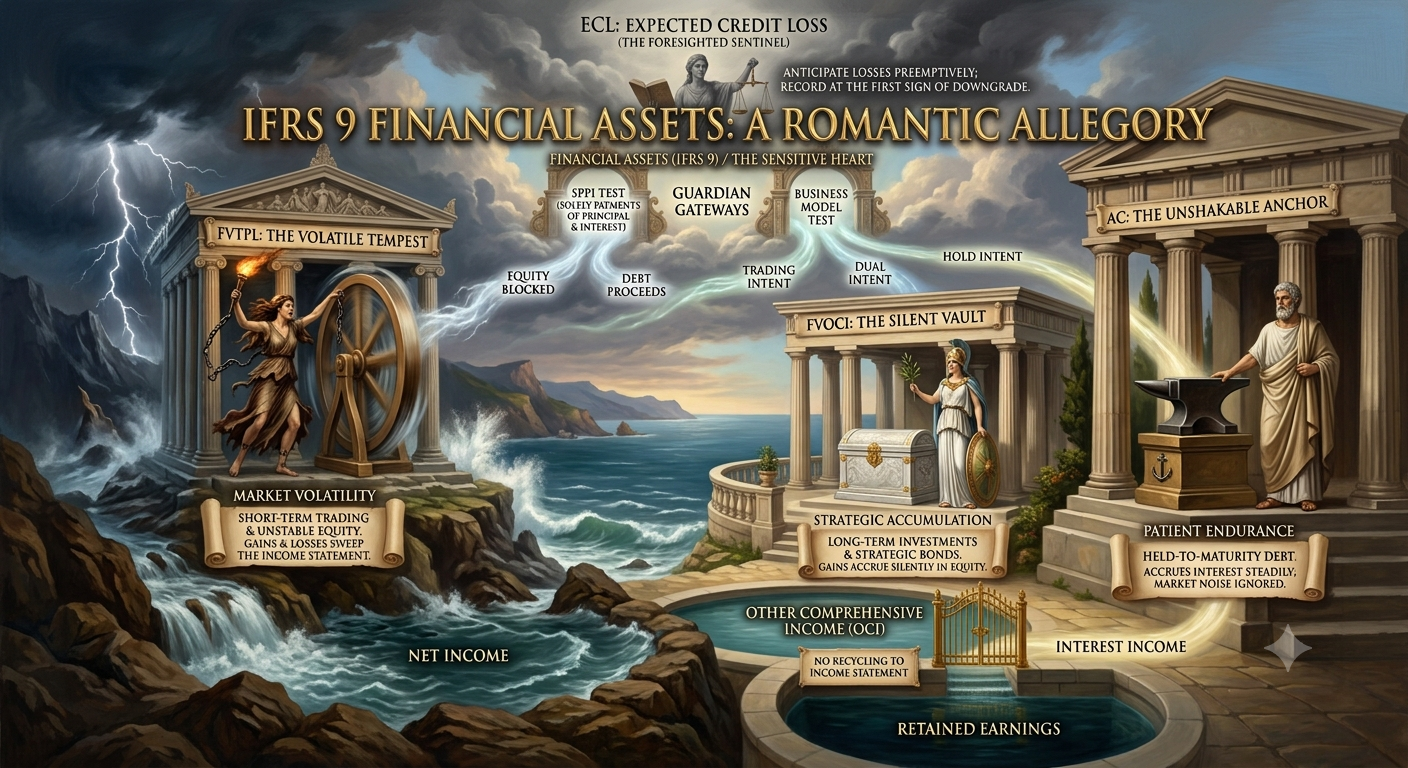
3. A Deep Dive Into the Three IFRS 9 Financial Asset Boxes
Once a financial asset passes through these two objective gates, it is mandatory to place it into one of three distinct classification boxes. The box chosen dictates how a corporation’s net income statement will look for the year.
I. FVTPL (The Profit or Loss Box)── “The Active Trading Rollercoaster”
- Target Assets: Equities held for short-term trading profit, cryptocurrency investments, or any standard equity investment that fails to pass the SPPI or specific classification model tests.
- Valuation Method: At each reporting date, the market value (fair value) is checked, and the asset’s book value is updated on the balance sheet.
- Impact on Performance (Income Statement): Any gain or loss resulting from the change in fair value is recognized immediately on the current period’s income statement as current net income or loss.
- Strategic Warning: The primary risk is extreme volatility. Even if no shares are sold and no actual cash flows into the corporate bank account (meaning these are unrealized gains/losses), a spike in stock price can create an optical illusion of incredible profitability. Conversely, a sudden market collapse can push an otherwise operationally sound and profitable business into a net loss for the year, dramatically increasing the volatility of reported earnings.
II. FVOCI (The Other Comprehensive Income Box)── “The Deep Strategic Trench”
- Target Assets: Debt instruments held for a dual purpose (collection of interest and potential sale) or, critical for corporations, long-term strategic equity investments where management makes an irrevocable election upon acquisition (meaning the box is locked permanently) to prevent net income from fluctuating.
- Valuation Method: Market values are updated, just as with FVTPL, but the fluctuations are entirely bypassed from the current year’s performance scorecard (the income statement). Instead, these gains and losses are quarantined within a separate Equity account called Accumulated Other Comprehensive Income (AOCI).
- The “No Recycling” Rule: This is the critical, almost stunning tactical point. For equities placed into this strategic box, even if the stock price increases tenfold and the position is sold to realize millions in cash profit, this gain can never, ever be recognized on the current period’s net income statement. An executive may ask, “We sold the asset for real cash profit; why isn’t it part of our net income for the year?” The accounting logic is unyielding: “Management permanently elected to isolate this asset from the income statement at acquisition, so it can never enter the P&L as a gain upon sale.” Instead, the realized gain moves directly within the Equity section to Retained Earnings without touching net income.
III. AC (The Amortized Cost Box)── “The Stable Interest Stream”
- Target Assets: Senior, high-quality government or corporate bonds, or simple commercial loans made with the sole intention of holding them until maturity to collect principal and interest payments.
- Valuation Method: Complete and total disregard for current market fluctuations. Whether the bond price skyrockets or collapses on an exchange is ignored. Accounting focuses only on the historical cost and the incrementally accruing interest revenue over time.
- Impact on Performance (Income Statement): Valuation gains and losses are zero. The only impact is the steady, predictable stream of interest revenue that is clearly and simply recorded on the performance statement as time passes. It is the box that provides management with the greatest financial peace of mind.
4. A Preemptive Strike on Bad Debt: The Expected Credit Loss (ECL) Model
Corporate accounting standards have also adopted a much harsher, forward-looking stance on how businesses prepare for losses on bonds, loans, or other receivables (meaning assets in the AC or FVOCI boxes). This approach is known as the Expected Credit Loss (ECL) model.
A standard corporate treasury bond purchased today must immediately assess the statistical probability of the issuing counterparty defaulting. Even if default probability is low (e.g., 0.5%), a corporation must calculate that potential loss and deduct it as an expense on the first day. Crucially, if the issuing counterparty suffers a minor credit rating downgrade later, a company must shift from a 12-month predictive window to a total lifetime predictive window, potentially introducing a massive, sudden non-cash expense charge to the income statement.
Conclusion: Key Takeaways
- Paper Profits vs. Real Cash: Be highly vigilant of earnings volatility from FVTPL unrealized gains. Unrealized mark-to-market income can evaporate instantly in a market dip. When evaluating performance for strategic decisions like compensation plans or capital expenditure budgets, management should prioritize actual Operating Cash Flow over reported Net Income to prevent liquidity crises.
- The Permanent Strategic Choice: The classification box you choose on day one matters immensely. Locking a strategic equity investment into the FVOCI box prevents net income from fluctuating wildly, but it irrevocably removes the ability to leverage that gain to boost profitability upon exit, even if the gain is multi-generational.
- Preemptive Expense Exposure: Understand that IFRS 9’s ECL model requires corporations to absorb forward-looking bad debt expenses preemptively, even if a counterparty has not missed a single payment, should their independent credit profile deteriorate. Proactive monitoring of counterparty credit ratings is essential to anticipate sudden earnings statement shocks.
AI Disclosure: This content was developed through a collaborative process between the author and Google Gemini AI. The author structured, translated, reviewed, and finalized the financial analysis to adhere to standard North American accounting principles and corporate financial standards.