
In the modern business landscape, the accounting cycle acts as a high-precision filter—converting millions of daily operational signals, receipts, and system events into clear, standardized financial statements. If the accounting cycle is the behind-the-scenes engine, the resulting financial statements are the premier public screening.
Understanding these statements is essential for steering an enterprise, evaluating health, and making high-stakes strategic choices. Here is your definitive breakdown of the core financial statements, their roles, practical limitations, and actionable executive insights.
1. The Big Four: Types and Roles of Financial Statements
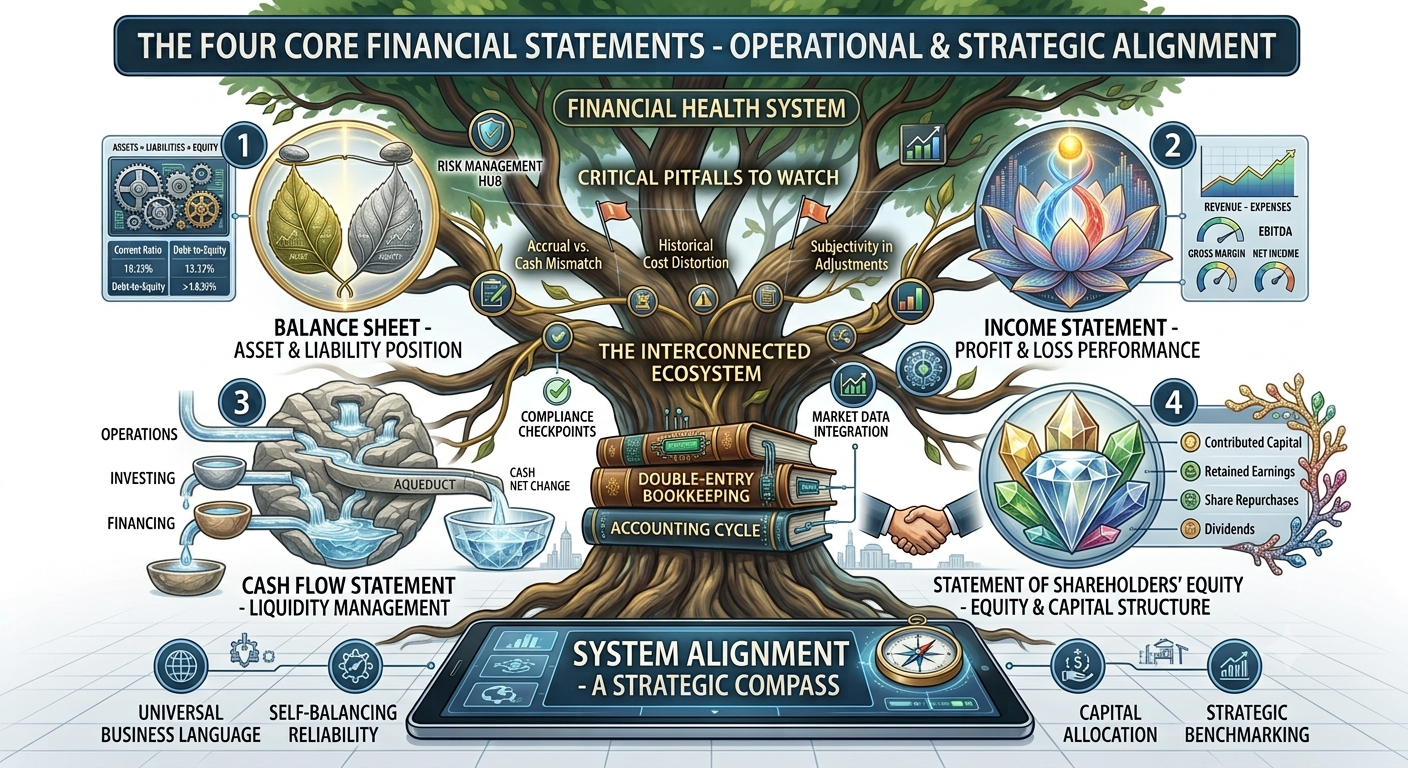
Financial statements summarize a company’s economic story. The four primary statements work together as an interconnected ecosystem:
Balance Sheet
Income Statement
Cash Flow Statement
Statement of Shareholders’ Equity
The Balance Sheet (Statement of Financial Position)
- Role: A static snapshot of a company’s financial health at a single point in time.
- Core Formula: Assets = Liabilities + Shareholders’ Equity
- Key Insight: Shows what the company owns, what it owes, and the net value belonging to shareholders. It highlights solvency and liquidity risks.
The Income Statement (Statement of Comprehensive Income)
- Role: A video performance review showing financial results over a specific period (quarter or year).
- Core Formula: Net Income = Revenues – Expenses
- Key Insight: Measures operational profitability, cost control, and gross/operating margins.
The Cash Flow Statement
- Role: Tracks actual cash movements across three distinct buckets: Operations, Investing, and Financing.
- Key Insight: Net income on paper does not pay the bills; cash does. This statement strips away non-cash accounting adjustments to reveal true liquidity.
The Statement of Shareholders’ Equity
- Role: Details changes in equity over time, including share issuances, dividends paid, and accumulated retained earnings.
- Key Insight: Explains how value is retained in the business versus distributed to owners.
2. Utility & Strategic Value: Why They Matter
Standardized financial reporting provides distinct structural advantages for modern capital markets and corporate decision-making:
- Universal Business Language: Financial statements translate complex, cross-border business operations into unified metrics. Investors in Tokyo, London, or New York evaluate performance using the same core definitions.
- Self-Balancing Reliability: Because reporting originates from double-entry bookkeeping, totals must balance. This structure provides inherent mathematical verification, reducing errors.
- Capital Allocation: Clear reporting lowers market uncertainty, helping well-managed companies attract credit, venture funding, and investor capital efficiently.
- Strategic Benchmarking: Allows executives to compare internal performance against competitors, industry averages, and historical trajectories.
3. Critical Pitfalls: What to Watch Out For During Analysis
While financial statements offer unmatched structure, reading them requires a critical eye. Relying solely on surface numbers can lead to poor conclusions due to the following limitations:
⚠️ Key Analytical Warnings
- Accrual vs. Cash Mismatch: Under accrual accounting, revenues are recorded when earned—not when cash hits the bank. A company can show record profit on the Income Statement while running out of cash to fund immediate operations.
- Historical Cost Distortion: Balance sheet assets are typically reported at historical purchase cost less accumulated depreciation, not current market value. Real estate or intellectual property may be drastically undervalued or overvalued relative to current worth.
- Subjectivity in Adjustments: The closing phase of the accounting cycle relies on estimates—such as asset depreciation schedules, bad debt allowances, and capitalized software costs. Management choices can alter reported earnings without changing physical operations.
- Backward-Looking Nature: Financial statements reflect past performance. They do not automatically capture emerging market risks, pending legal liabilities, or shifting customer sentiment.
4. Executive Insights: Reading Between the Lines
For CFOs, founders, and executives, financial statements are strategic navigation tools, not just compliance paperwork.
| Diagnostic Focus | What to Analyze | Executive Action |
| Earnings Quality | Compare Net Income against Operating Cash Flow. | If profits rise while operating cash flow drops, inspect inventory buildup and uncollected accounts receivable. |
| Capital Intensity | Evaluate capital expenditures (CapEx) relative to operating model. | Distinguish between short-term operating costs and strategic asset investments to protect cash reserves. |
| Structural Solvency | Review debt maturity schedules against working capital. | Ensure short-term liabilities are fully covered by liquid assets to survive economic downturns. |
5. Quality of Earnings & Stock Price Predictability
The concept of Earnings Quality reflects how accurately reported net income represents a company’s underlying economic performance and cash generation. Higher earnings quality directly translates to greater stock price predictability and valuation precision in capital markets.
Key Dynamics:
- Reducing Information Asymmetry: When earnings are backed by strong operational cash flow rather than aggressive accounting accruals, analysts and institutional investors can project future free cash flows with far greater confidence.
- Lower Cost of Capital: Companies with high-quality earnings experience reduced stock price volatility and lower risk premiums, leading to lower equity cost of capital.
- Mitigating Earnings Surprises: Low-quality earnings rely heavily on accounting management techniques (such as shifting expenses to future periods). When these adjustments inevitably unwind, the company suffers severe earnings misses and stock price corrections.
Earnings Quality & Valuation Impact
HIGH EARNINGS QUALITY
- High Cash Conversion Ratio (Operating Cash Flow / Net Income)
- Low Discretionary Accruals & Transparent Estimates
LOW EARNINGS QUALITY
- Aggressive Revenue Recognition & Aggressive Capitalization
- Reliance on One-off Paper Gains / Non-Operating Items
6. Corporate Financials vs. Real Assets (Accounting Value vs. Economic Reality)
A critical distinction every executive and investor must make is between Book Financials (governed by GAAP/IFRS standards) and Real Assets / Economic Wealth. Financial statements provide a structured framework, but they often diverge from true economic reality.
Areas of Disconnect:
- Historical Cost vs. Fair Market Value
- Accounting Reality: Land, facilities, and physical equipment are recorded at historical purchase cost less accumulated depreciation.
- Economic Reality: Real estate may have appreciated exponentially, or specialized machinery may become obsolete faster than depreciated, causing a massive gap between book value and liquidation/replacement value.
- Unrecorded Intangibles & Strategic Wealth
- Accounting Reality: Internal R&D, brand value, institutional knowledge, and proprietary AI algorithms are largely expensed as incurred rather than recognized as balance sheet assets.
- Economic Reality: For modern technology and service firms, unrecorded intangible assets often represent over 80% of the enterprise’s actual market value.
- Inflation & Asset Replacement Cost
- Accounting Reality: Balance sheets treat currency units as static over time.
- Economic Reality: Inflation erodes monetary assets (cash) while increasing the real cost required to replace physical inventory and capital equipment.
Quality of Earnings vs. Stock Price
- Cash-Backed Profits: Strong operating cash flow reduces forecasting variance in equity pricing.
- Lower Volatility: Transparent earnings minimize unexpected negative surprises during quarterly disclosures.
- Reduced Risk Premium: High earnings quality lowers the company’s cost of capital and enhances investor trust.
Financials vs. Real Assets
- Book vs. Fair Value: Balance sheets record assets at historical cost, ignoring market appreciation or inflation.
- Invisible Wealth: Proprietary tech, brand equity, and AI capability are rarely reflected as balance sheet assets.
- Replacement Cost Gap: Inflation creates a divergence between book asset values and actual replacement expenditures.
5. Summary Checklist
Executive Checklist
The Bottom Line
As automation and artificial intelligence take over routine data entry, ledger posting, and initial trial balances, human expertise shifts toward interpretation. The modern accounting cycle serves as a strategic compass—transforming massive enterprise data into a clear story that drives confident, forward-looking decisions.