
Hello! In our previous post, we explored the overall concept of ‘Capital Adjustment,’ the temporary waiting room in the Equity section of the balance sheet. Today, we are going to dive deep into the account boasting the most powerful presence in that room: Treasury Stock (also frequently referred to as Share Buybacks or Stock Repurchases in North America).
You have likely seen headlines like, “XYZ Corporation Announces $1 Billion Share Repurchase Program to Boost Stock Price!” Why on earth does a company spend its hard-earned cash to buy back its own shares? How is this recorded on the financial statements, and what critical messages does it signal to management and investors?
By the end of this post, you will perfectly master everything from the definition of treasury stock to its accounting treatment and strategic implications.
1. What Exactly is Treasury Stock?
💡 An Easy Analogy: The Family Vault
If we look at the origin of the term, it combines “Treasury” (a treasure chamber or vault) and “Stock.” It literally means “stock kept in the vault.”
Historically, this originates from sovereigns or nobles keeping precious treasures locked away in a secret vault (the Treasury) within the castle walls. Translated to finance, it means the company takes its ownership certificates that were once issued to the market, buys them back, and instead of giving them to someone else, stores them safely in “the company’s secret vault.” Consequently, in the North American corporate world, this state of holding repurchased shares is referred to as “holding treasury stock.”
Imagine a family community fund that had previously issued ownership certificates to members. Later, the fund uses its cash to buy those certificates back from some members and stores them in a desk drawer. That is essentially what treasury stock is.
- Share Buyback / Stock Repurchase: In North America, these terms are often used interchangeably with treasury stock, although technically, they refer to the act of acquiring the shares, while treasury stock is the result. It is the act of a corporation purchasing its own shares back.
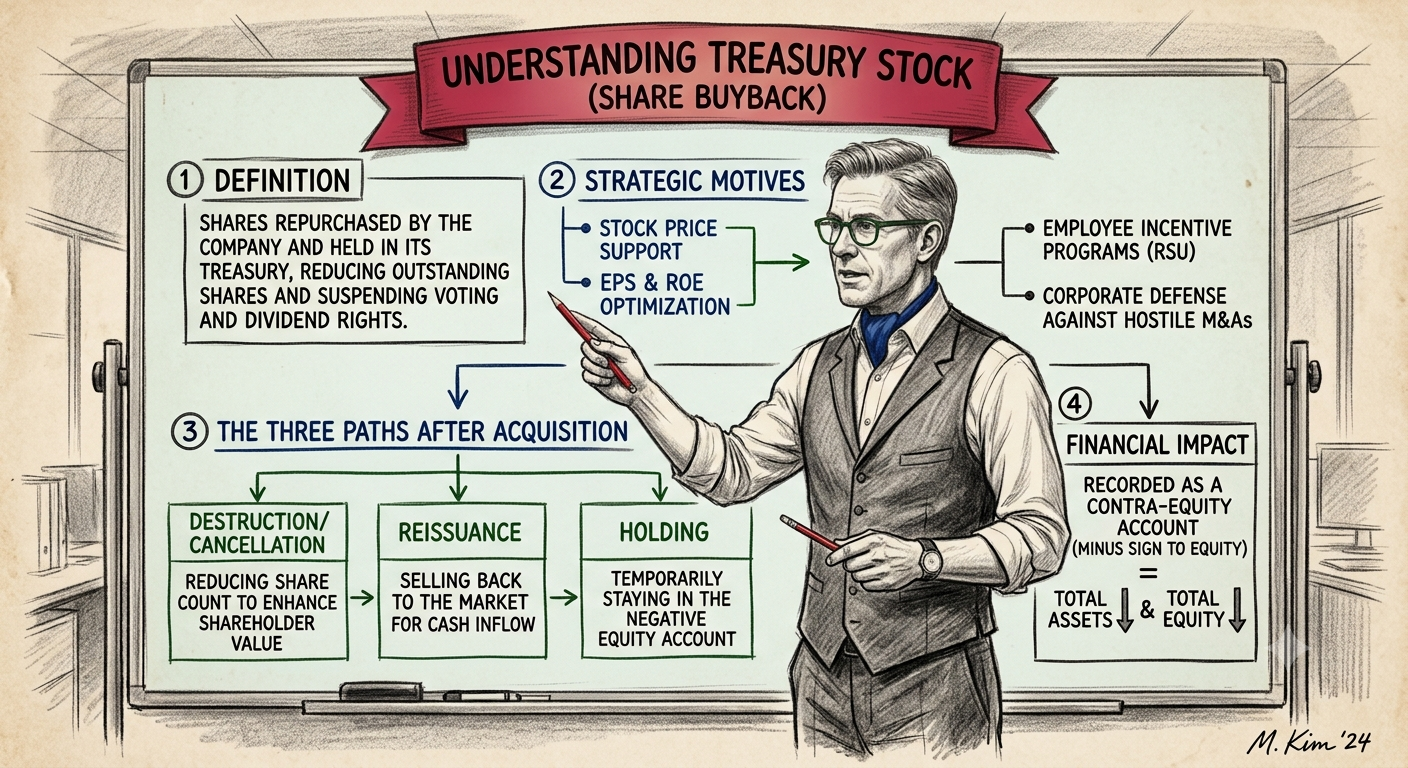
- Definition: It refers to the shares of a corporation that were once issued and outstanding but have been subsequently repurchased by the company from shareholders and held by the corporation.
- Characteristics: It is important to note that these shares are not retired (canceled). Instead, they are in a state of being “temporarily held in the vault.” Therefore, the rights associated with shareholder ownership (voting rights, the right to receive dividends, preemptive rights to subscribe to new shares, etc.) are suspended while the shares are held in treasury.
2. Why Do Corporations Repurchase Their Own Shares?
A company does not spend precious cash to buy back its own stock without a clear strategic purpose. There are several powerful managerial reasons.
- Boosting Stock Price and Enhancing Shareholder Value: By repurchasing shares, the company reduces the number of shares actively traded in the market (outstanding shares). Even if the company’s net income remains the same, this reduction increases Earnings Per Share ($EPS$), which often leads to a higher stock price. Furthermore, it sends a powerful signal to the market that “the company believes its own stock is currently undervalued.”
- Defending Against Hostile Takeovers: In the face of a hostile takeover threat, a company can repurchase its own shares to place them “in the vault.” Later, these shares can be sold or transferred to a friendly third party (often called a “White Knight”) to revive the voting rights and defend the existing management’s control.
- Employee Compensation Tool: Corporations need a supply of shares to fulfill employee stock option exercises or to grant shares as performance bonuses (such as Restricted Stock Units or $RSU$s). Acquiring treasury stock is a common way to secure the shares needed for these plans.
- Improving Financial Structure and Capital Efficiency: When a corporation has excess cash and lacks immediately attractive investment opportunities, repurchasing shares can be a way to optimize its capital structure and improve capital efficiency, rather than allowing cash to sit idle.
3. How Are the Repurchased Shares Managed?
Once repurchased, the fate of treasury stock generally follows one of three paths.
[ Acquire Treasury Stock ]
- Cancellation (Retirement) -> The shares are permanently destroyed. Capital Stock or Retained Earnings decrease. (Highest level of shareholder return)
- Reissuance (Resale) -> The shares are sold back into the market or transferred. Cash flows back into the company.
- Continued Holding -> The shares are kept in the vault. They remain a negative (-) item in the Equity section.
- ① Share Cancellation (Retirement): This involves permanently retiring the repurchased shares. Because the total number of issued shares is permanently reduced, the value of the remaining shares held by existing shareholders increases. This is considered the ultimate form of shareholder return.
- ② Reissuance (Resale): The corporation sells the shares held in the vault back to the market, or to a specific party, such as employees for bonuses. While cash flows back into the corporation, this increases the number of outstanding shares, which could put pressure on the stock price.
- ③ Continued Holding: Without a specific action, the shares remain a negative (-) “sticky note” in the Capital Adjustment account, safely stored in the corporation’s vault.
4. Accounting for Treasury Stock on Financial Statements
The absolute core of understanding treasury stock is realizing it is NOT an asset. Under North American GAAP (Generally Accepted Accounting Principles), it is a negative (-) account that reduces Total Equity!
| Category | Accounting Method | Impact on Balance Sheet |
| 1) Upon Acquisition | Cash flows out, and the purchase amount is recorded as ‘Treasury Stock (negative Capital Adjustment)’. | Assets decrease, Total Equity decreases. |
| 2) Upon Reissuance (at a Gain) | If sold for more than the purchase price, the difference is recorded as ‘Gain on Reissuance of Treasury Stock (Additional Paid-in Capital)’. | Total Equity increases. |
| 3) Upon Reissuance (at a Loss) | If sold for less than the purchase price, the difference is recorded as ‘Loss on Reissuance of Treasury Stock (negative Capital Adjustment)’. | Total Equity decreases (but must be first offset against any existing gains). |
| 4) Upon Cancellation | The shares are completely retired and offset against Capital Stock or Retained Earnings. | Capital Stock/Earnings decrease (Since Equity already decreased upon acquisition, there is no change to Total Equity). |
📌 The Principle of Prior Offsetting!
In North American accounting, we generally offset related Equity items. If a company has a history of selling treasury stock at a gain (Gain on Reissuance), and later sells treasury stock at a loss (Loss on Reissuance), it cannot immediately record the entire loss in Capital Adjustment. Instead, it must first reduce the existing Gain account to zero, and only the remaining loss is recorded in the Capital Adjustment account.
5. Key Strategies for C-Level Executives and Investors
This distinction is crucial for financial analysis and strategic decision-making.
1) The Investor’s Perspective: “Verify if ‘Cancellation’ is the Next Step”
- Check for Overhang Risk: You should not automatically cheer just because a company announces a share buyback. Treasury shares held for a long time without a clear plan to cancel them can become a time bomb, potentially flooding back onto the market and crashing the stock price. This is a classic “overhang” risk that North American analysts scrutinize.
- Beware of the EPS Illusion: While EPS can rise when shares are repurchased, it is essential to check if the underlying business performance is actually improving. A buyback can artificially inflate metrics like EPS and Return on Equity ($ROE$) even if net income is flat or declining, because the denominator (shares or equity) has decreased. Investors must look at the cash flow from operations and revenue growth to ensure the core business is healthy.
2) The Executive’s Perspective: “Managing the Message to Create Trust”
- Present a Clear Capital Allocation Roadmap: Markets value predictability. Executives should clearly disclose the purpose of the buyback—whether the shares are for cancellation (returning capital), employee compensation (incentivizing talent), or strategic acquisition. Transparency from the initial regulatory filing is vital. A vaguely defined repurchase program can be perceived as a lack of better investment opportunities or an attempt to manipulate the stock price, potentially eroding trust with long-term investors.
- Optimizing the Cost of Capital ($WACC$): Beyond defensive strategies or talent management, a well-executed share repurchase program should be part of a sophisticated capital allocation strategy. It can be used to optimize the corporation’s capital structure, manage the Weighted Average Cost of Capital, and maximize shareholder value in the long run. The decision should be evaluated against other uses of cash, such as increasing the dividend or making organic investments.
Summary
Treasury stock is like a temporary ‘negative sticky note (-)’ that temporarily reduces total equity. Genuine enhancement of shareholder value is only fully completed when this sticky note is permanently removed through ‘Share Cancellation’!
We hope this post has helped you master the complex world of treasury stock, enabling you to better decipher financial signals and develop stronger investment or management strategies. If you have any remaining questions, please feel free to leave a comment below!
AI Disclosure: This article was developed through a collaborative effort using advanced Google AI models for analytical structuring, translation, and content refinement, alongside professional human editorial review to ensure technical precision and clarity.