
In the past, the accounting cycle was viewed as a purely mechanical routine of collecting paper receipts and copying transactions into ledgers. Today, financial reporting transforms this cycle into a dynamic visualization process that filters valuable signals from operational noise to deliver transparent financial statements. Facing a daily tide of costs and invoices, leaders must choose between drifting in administrative chaos or steering as a captain with a precise financial compass. Whether managing a complex hospital or a enterprise, mastering this cycle is essential to building an accurate reporting framework. Understanding how financial, managerial, cost, tax, audit, and governmental accounting interconnect provides the ultimate perspective for modern management. Through this clear framework, businesses can transform raw daily transactions into strategic intelligence that guides future growth.
Breaking Down the 6 Core Branches of Accounting
To navigate the financial ecosystem effectively, business leaders must understand how different branches of accounting serve distinct internal and external purposes:
1) Financial Accounting
Focuses on tracking all economic activities through standard accounting principles to officially report a firm’s health to external stakeholders, including shareholders, investors, banks, and regulatory authorities.
2) Managerial Accounting
Serves as an internal compass for executives and directors. It provides forward-looking insights, budget forecasts, and operational analyses to guide strategic decision-making and resource allocation.
3) Cost Accounting
Acts as the foundational engine for managerial accounting by accurately tracking and calculating the real underlying costs of producing goods or delivering services.
4) Tax Accounting
Calculates a firm’s tax obligations based on statutory tax codes and regulatory standards, ensuring compliance while optimizing corporate tax structures.
5) Auditing
Functions like a financial microscope. Independent Certified Public Accountants (CPAs) verify whether a company’s financial statements adhere strictly to governing principles, providing crucial credibility to capital markets.
6) Government Accounting
Governs non-profit public entities and governmental institutions (such as state agencies or municipal bodies). It ensures that taxpayer dollars and public budgets are executed and reported strictly according to statutory mandates.
Core Concepts: Financial Accounting vs. Managerial Accounting
Financial Accounting is often the first concept that comes to mind when people hear the word “accounting.” It translates complex business operations into a unified financial language, giving outside stakeholders a clear view of an organization’s fiscal health.
| Comparison Point | Financial Accounting | Managerial Accounting |
|---|---|---|
| In Simple Terms | An official public report for external stakeholders. | A confidential internal blueprint for corporate strategy. |
| Primary Role | Prepares financial statements compliant with GAAP or IFRS. | Conducts product cost analysis, budgeting, and future decision support. |
| Primary Audience | External stakeholders (investors, banks, creditors, regulators). | Internal leaders (CEOs, executives, department managers). |
| Core Objective | Delivers trustworthy financial disclosures to capital markets. | Optimizes internal resource allocation and operational strategy. |
| Reporting Cycle | Fixed legal cycles (quarterly, annually). | On-demand and real-time reporting based on executive needs. |
| Real-World Analogy | A verified logbook proving safe navigation to external investors. | A real-time map used by the captain to steer the ship forward. |
| Role in the AI Era | Rule-based transaction logs and reporting are automated. | Analyzes AI-refined data to generate high-level strategic value. |
Cost Accounting vs. Managerial Accounting: Distinct Roles
While often conflated, cost accounting and managerial accounting play distinct roles in corporate finance.
Cost Accounting: The Precise Artisan Measuring Facts
- Nature: Tracks direct materials, direct labor, and manufacturing overhead to calculate the exact unit cost of a product or service.
- Focus: Examines historical expenditure data and supplies the exact numbers needed for inventory valuation and cost of goods sold (COGS) on official financial statements.
Managerial Accounting: The Strategic Captain Interpreting Data
- Nature: Takes the raw cost data provided by cost accounting and evaluates strategic questions: What price should we set to maximize margins? Should we discontinue an unprofitable product line?
- Focus: Blends historical facts with future projections and opportunity costs to craft overall competitive strategy.
Analogy: If cost accounting is the process of precisely weighing and pricing fresh ingredients in a kitchen, managerial accounting is designing the menu, setting retail prices, and shaping the restaurant’s culinary strategy.
Non-Profit Accounting vs. Government Accounting
The primary distinction between non-profit and government accounting comes down to revenue structure: forced revenue via taxation versus voluntary funding through contributions.
| Feature | Government Accounting | Non-Profit Accounting |
|---|---|---|
| In Simple Terms | Financial records for public entities funded by taxpayers. | Financial records for charities and foundations funded by donations. |
| Primary Income | Mandatory taxation (public funds). | Voluntary donations, grants, and program fees. |
| Governing Framework | Legislative budget control and statutory oversight. | Non-profit accounting standards and donor restriction agreements. |
| Primary Focus | Verifying funds were spent strictly within approved budget limits. | Verifying funds were spent according to donor-designated missions. |
| Key Examples | U.S. Department of the Treasury, City of New York, state universities. | Red Cross, Bill & Melinda Gates Foundation, charitable trusts. |
Navigating Specialized Non-Profit Accounting Frameworks
Non-profit organizations are not one-size-fits-all. While they all refrain from distributing profits to equity owners, operational models vary significantly between charitable foundations, healthcare systems, and educational institutions.
1. The 3 Specialized Domains
- Standard Non-Profit Accounting (Donation-Driven): A transparent ledger proving that voluntary donations are spent strictly on public welfare missions.
- Healthcare & Hospital Accounting (Revenue-Driven): A cost-intensive accounting framework dominated by medical billing, clinical procedures, and insurance reimbursements.
- University & Academic Accounting (Tuition & Endowment-Driven): A compartmentalized framework balancing student tuition, research grants, and restricted endowments.
2. Industry Comparison Matrix
| Feature | Standard Non-Profit (NGOs/Foundations) | Healthcare Institutions | Higher Education (Universities) |
|---|---|---|---|
| Primary Revenue | Voluntary donor contributions and grants. | Patient services, insurance, and medical billing. | Student tuition, state funds, and endowments. |
| Applicable Standard | Non-Profit Financial Reporting Standards. | Healthcare Financial Management Standards. | Higher Education Fund Accounting Rules. |
| Core Accounting Goal | Tracking donor-restricted vs. unrestricted funds. | Detailed unit-cost tracking for medical procedures. | Managing fund separation between operating and capital budgets. |
| Key Characteristics | High emphasis on donor intent compliance. | Complex depreciation for high-tech capital equipment. | Strict separation of restricted endowments and general tuition. |
| Real-World Examples | Habitat for Humanity, UNICEF. | Mayo Clinic, Johns Hopkins Hospital. | Harvard University, Stanford University. |
The Hierarchy of Accounting: Building a Control System
Rather than existing in isolation, these financial disciplines form a structured hierarchy centered around Financial Accounting as the primary infrastructure.
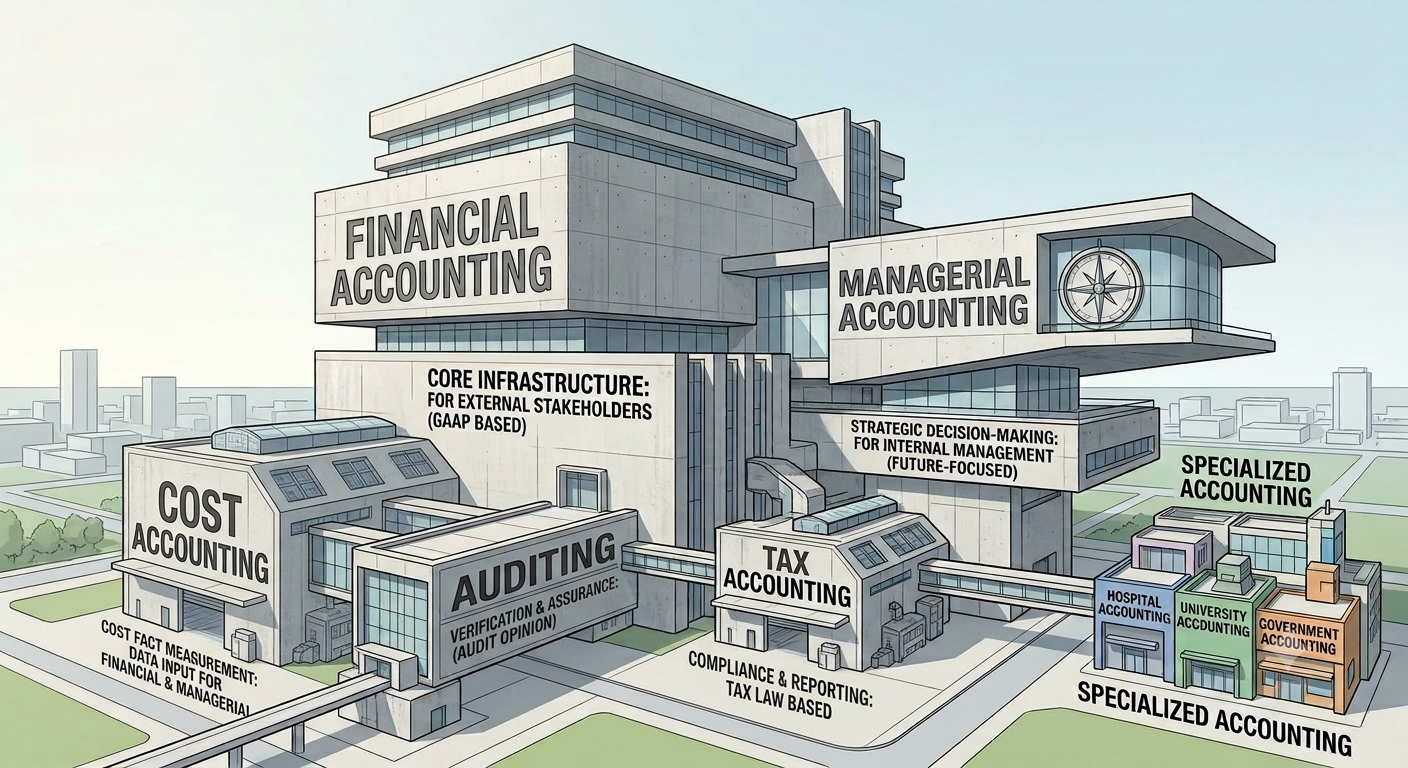
Level 1: Core Base & Infrastructure
- Financial Accounting (The Foundation): The central pillar of all accounting. Double-entry bookkeeping creates an auto-balancing framework to record all organizational transactions.
- Cost Accounting (The Fact Engine): Measures true operational costs, feeding critical inventory and COGS data directly into the financial accounting core.
Level 2: Derived Domain Extensions
- Tax Accounting: Uses financial accounting data to adjust for tax rules and calculate statutory obligations.
- Specialized Accounting: Adapts core financial rules to industry-specific operational models, such as healthcare billing, university fund management, or municipal fund controls.
Level 3: Strategy & External Audit
- Managerial Accounting (The Compass): Positioned at the top of the hierarchy, it converts historical data from Levels 1 and 2 into forward-looking insights for executive decisions.
- Auditing (The Shield): Provides external validation, verifying that the entire hierarchy produces accurate, transparent reporting.
Key Managerial Implications
- Without strong Financial Accounting, Managerial Accounting fails: Focusing solely on executive dashboards while neglecting underlying transaction logs leads to poor data quality (Garbage In, Garbage Out). Invest in baseline record-keeping infrastructure first.
- Understand Costs before setting Prices: In service-heavy industries like healthcare, higher education, or enterprise IT, failing to capture indirect overhead leads to hidden margin erosion. Accurate cost accounting is essential for maintaining pricing power.
- View Audits as Strategic Assets, not Expenses: Independent verification strengthens internal controls and lowers capital costs by building long-term credibility with lenders, rating agencies, and investors.
Conclusion: Key Takeaways
- The Centrality of Financial Accounting: Financial accounting serves as the foundational core, converting everyday operational transactions into structured, credible information for all stakeholders.
- Built-in System Integrity: Double-entry accounting acts as a self-balancing mechanism, helping identify errors before reporting periods close.
- Strategic Evolution in the AI Era: While automated systems handle routine entry and reconciliation, finance leaders must focus on Level 3 capabilities—interpreting insights, navigating risks, and shaping corporate strategy.
“Accounting is not a chain that restricts enterprise growth. Solid financial accounting provides the structural backbone, while sharp managerial accounting gives the business wings to scale.”
AI Disclosure: Created in collaboration with Google Gemini. All core content was authored, reviewed, and edited by the author.