
Have you ever noticed how everyday English words suddenly take on a completely different, almost cryptic meaning the moment they enter the world of Artificial Intelligence and information technology? If you have ever felt confused by this phenomenon, you are definitely not alone.
One of the most frequently used—and misunderstood—terms in this new era is the word “Cloud.” Why does this word change its shape and definition when we talk about enterprise infrastructure, web application deployments, and complex AI systems? Today, we are going to dive deep into the world of technology architecture to uncover exactly what the cloud is, where the term historically comes from, and why it matters to you.
1. In Everyday Life: The Fluffy Structures in the Sky
Before it became tech jargon, a cloud was simply something floating in the atmosphere. For everyone, the word triggers an immediate, universal image. You look up on a sunny day and see white, fluffy masses of condensed water vapor drifting across the sky. In our physical world, a cloud represents nature, weather patterns, and sometimes a signal that a storm is coming. It is accessible to everyone’s vision, yet completely untouchable and unanchored to any single spot on earth.
2. In the IT World: The Massive Digital Warehouse
When we transition into the digital landscape of computer science and Artificial Intelligence, the physical water vapor disappears, but the concepts of vastness and being “untethered” remain entirely intact.
To put it simply: In the IT world, the Cloud does not refer to the sky, but rather to a massive pool of decentralized computing resources accessible over the internet.
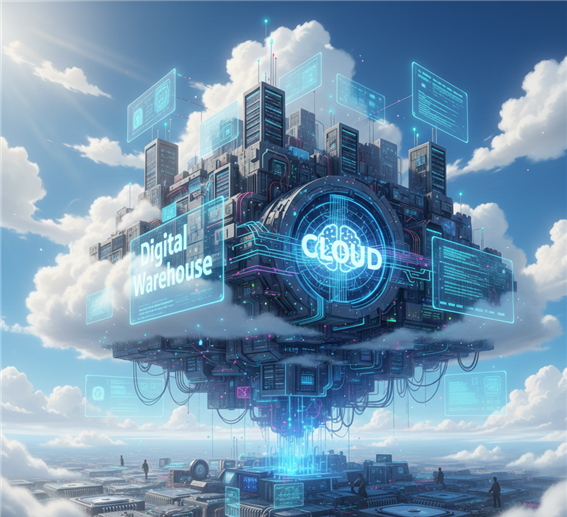
Think of it as a giant, global network of high-powered digital warehouses. In the old days, if your personal computer or local company server ran out of hard drive space or processing power, you had to physically go out, buy expensive hardware upgrades, and install them yourself. Today, as long as you have a stable internet connection, you can instantly lease raw computing power, database storage, and advanced AI models from a massive data center located thousands of miles away—handling your workloads seamlessly as if that giant supercomputer were sitting right underneath your desk.
3. The Origin Story: The “Magic Diagram” of Early Engineers
How did network architects and software engineers land on this specific meteorological term? The origin lies in the early days of network mapping and telecommunications layout design.
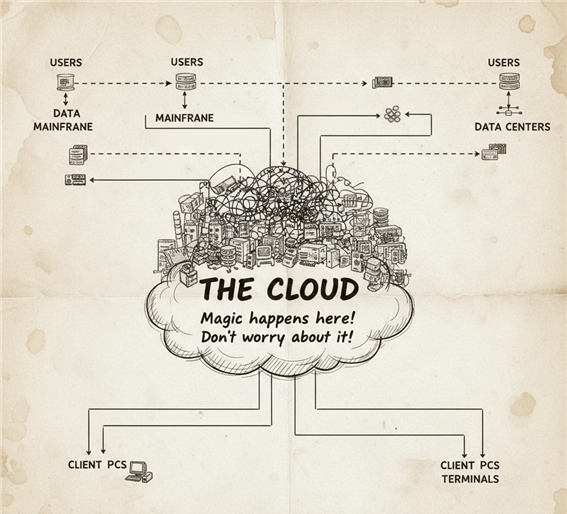
Decades ago, when systems engineers drew architectural diagrams to plan how data traveled from one point to another, they faced a complex dilemma. They had to map out an intricate web of local office computers, routers, switches, and long-distance telephone lines. However, once the data left the building and entered the massive, complex world of the global internet, drawing every single switch, wire, and fiber-optic cable became completely overwhelming and counterproductive.
To save time and preserve sanity, engineers made a deliberate choice: “Look, we don’t need to stress out over drawing every single piece of external infrastructure. Let’s handle all the complicated backend routing on our end, and for our diagrams, we will just draw a simple, fluffy ‘cloud’ shape to represent the entire external internet network!”
Inside that hand-drawn cloud diagram, engineers would often write phrases like “Magic happens here.” It was a friendly, practical promise to the end-user: you do not need to worry about the millions of miles of electrical cables or complex server configurations. You just connect to the cloud shape, and the technology takes care of the rest.
- Cloud Computing: The practice of utilizing a network of remote servers hosted on the internet to store, manage, and process data, rather than using a local personal computer or a localized on-premise server.
- On-Demand Resources: The architectural capability to scale data storage and computation power up or down instantly based on real-time operational demands.
4. Cleared Up: Local Server vs. Dedicated Server vs. The Cloud
In the tech industry, people often get confused trying to differentiate between where their data actually lives. Let’s break down these infrastructure models so you can navigate tech architecture like an industry expert:
| Category | Technical Definition | Practical Analogy |
| Local Server | An on-premise physical computer or hardware drive directly connected to your local network. | A small physical safe inside your home. Only you have direct access, and you are entirely responsible for its security and maintenance. |
| Dedicated Server | A standalone, independent physical server hardware unit located in a remote data center facility. | A dedicated individual warehouse building. It provides excellent, isolated space, but scaling up requires building a whole new structure. |
| The Cloud | A vast, virtualized network where thousands of individual servers are pooled together to behave as a single fluid system. | A massive, interconnected global logistics hub. Resources are shared dynamically, expanding and contracting like a cloud of water vapor. |
5. Common Concepts in Cloud Architecture
As you deploy enterprise applications or store personal data, you will frequently encounter terms built around cloud environments:
- Cloud Storage: Remote digital space dedicated purely to holding files and media assets securely. Everyday examples include consumer services like Google Photos or enterprise tools that back up critical databases.
- Cloud Computing: Utilizing remote processors to run heavy calculations, train massive Artificial Neural Networks, or run complex software applications without draining your local device’s battery.
- Multi-Cloud Strategy: An advanced corporate infrastructure design where an enterprise distributes its digital workloads across multiple different global cloud provider networks to avoid relying on a single point of failure and to boost security optimization.
6. The Global Powerhouses: Who Owns the Cloud?
The modern cloud landscape is managed by massive global infrastructure conglomerates that serve as the hidden backbone for the modern digital economy:
- Amazon Web Services (AWS): The undisputed global market pioneer. AWS holds the largest market share in cloud infrastructure, famously hosting the massive streaming workloads of platforms like Netflix to deliver high-definition video feeds seamlessly to millions of homes simultaneously.
- Microsoft Azure: The enterprise leader of choice for modern corporate environments. Because it integrates flawlessly with ubiquitous office productivity suites like Windows, Word, and Excel, Azure has become the standard cloud foundation for Fortune 500 companies.
- Google Cloud Platform (GCP): Renowned worldwide for building the hyper-scale data infrastructure that powers YouTube. Google leverages this incredible data-processing pipeline to position itself as a dominant force in high-performance AI model training and machine learning analytics.
- Regional Providers: Specialized local tech firms (such as Naver Cloud or KT Cloud in South Korea) that cater heavily to regional compliance, localized security standards, and optimize data processing specifically for local language models.
Conclusion: Key Takeaways for Today’s Tech-Driven Landscape
Understanding the mechanics of decentralized cloud architecture gives you a much sharper perspective on how global modern businesses scale operations.
- Break Free from Local Constraints: The cloud eliminates the physical limitations of your local hardware, allowing small startups to leverage the exact same massive computation power as multi-billion-dollar corporations.
- Focus on Core Value: Just as early engineers designed the cloud diagram to hide background complexity, cloud architecture allows modern developers to ignore server maintenance entirely and focus 100% on building innovative features.
- The Infrastructure of AI: Without the rapid development of the cloud, hosting large language models and computing millions of semantic tokens would be financially impossible for the public. The cloud is the invisible machinery making the AI revolution a reality.
AI Disclosure: Created in collaboration with Google Gemini. All core content was authored, reviewed, and edited by the author