
Have you ever noticed how everyday English words suddenly take on a completely different, almost cryptic meaning the moment they enter the world of Artificial Intelligence and information technology? If you have ever felt confused by this phenomenon, you are definitely not alone.
One of the most frequently used—and misunderstood—foundational terms in this digital era is the word “Server.” Why does this word change its shape and definition when we talk about network infrastructure, cloud engineering, and high-performance computation? Today, we are going to dive deep into the world of tech architecture to uncover exactly what a server is, where the term historically comes from, and how these digital powerhouses keep the modern web running.
1. In Everyday Life: The Helpful Host at Your Table
Before it became tech jargon, a server was a person you encountered at a local restaurant. For anyone living in North America, the word triggers an immediate, highly familiar customer service image. You sit down at a table, a server approaches with a smile, takes your order, handles your specific requests, and brings out your food from the kitchen. In our physical world, a server is the crucial link connecting the customer in the dining room to the chefs preparing the meals behind closed doors. They are defined by their role: they take an order, deliver a service, and fulfill a request.
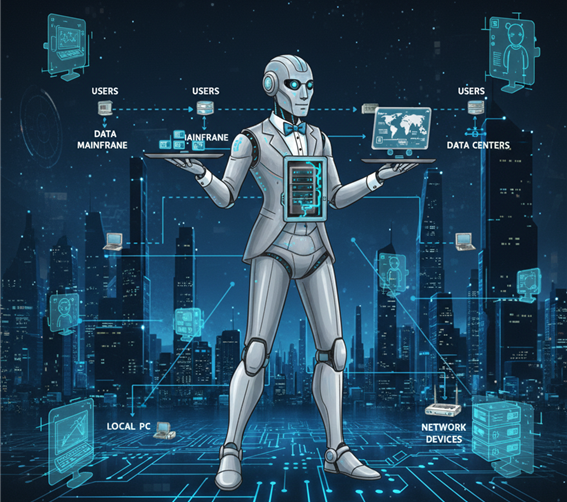
2. In the IT World: The 24/7 Digital Butler
When we transition into the digital landscape of computer science and Artificial Intelligence, the physical restaurant worker disappears, but the core concept of delivering a service remains entirely intact.
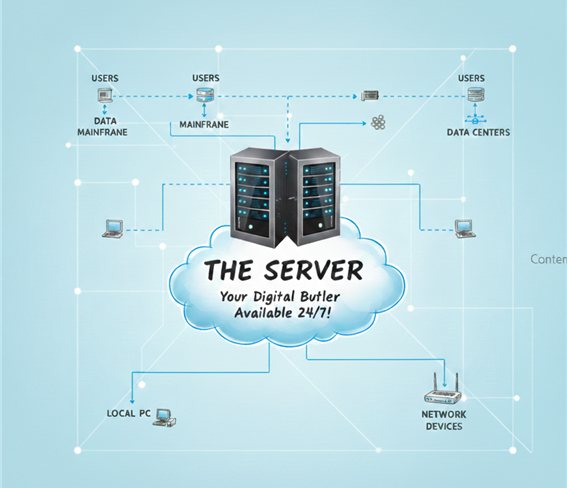
To put it simply: In the IT world, a server is a specialized, high-performance computer designed to process requests and deliver data to other computers over a local network or the internet.
Just as the sky’s clouds are made up of countless water droplets, the vast internet landscape is populated by millions of these dedicated digital workers. A server is not just a standard laptop; it is an industrial-grade machine operating inside massive data centers, built to run continuously without a single second of downtime. Every single time you click a link, stream a video, or ask an AI to process a prompt, you are sending a digital order to a remote server. It receives your request, processes the calculation at the speed of light, and serves the data right back to your screen.
3. The Origin Story: The Birth of Client-Server Architecture
How did computer network architects land on this specific service-oriented term? The origin dates back to the early developmental phases of distributed computing networks.
In the earliest days of computing, a single, massive mainframe computer had to handle every single task by itself. However, as the number of users grew exponentially, individual machines became completely overwhelmed by the sheer volume of simultaneous operational demands. To prevent system collapses, software engineers decided to implement a tactical division of labor.
They established a revolutionary protocol: “Let’s build a network where roles are explicitly split. We will design one high-powered machine whose sole job is to professionally serve data and manage resources. The other individual computers will simply request and receive those services.”
This strategy birthed Client-Server Architecture. The requesting machine became the “Client,” and the delivering machine became the “Server.” Engineers gave these machines a strict directive: “No matter what the client asks for, stay awake 24 hours a day, 7 days a week, and be ready to respond. Even if millions of orders flood in simultaneously from around the globe, fetch and deliver that information within a fraction of a second.”
- The Internal Engine: Inside the server, advanced data engines and enterprise processors spin continuously to manage thousands of complex user calculations simultaneously.
- The External Interface: Outside the server, users simply browse a clean menu—such as a mobile app or website interface—select what they want, and let the server handle the heavy lifting behind the scenes.
4. Cleared Up: Local Device vs. Network Server
In technology discussions, it is incredibly easy to confuse your personal computing environment with true server infrastructure. Let’s break down the technical differences so you can classify network assets like an IT professional:
| Category | Technical Definition | Practical Analogy |
|---|---|---|
| Local Device | Your personal laptop, desktop, or smartphone directly in front of you. | Your personal home kitchen. It is an isolated, private space where you prepare things for yourself; when you turn off the lights, nobody else can access it. |
| Network Server | A high-performance computing system built to share resources globally over the internet. | A commercial restaurant kitchen. It is a shared, public space optimized for high-volume production, open 24/7 to take orders from anyone in the world. |
5. Common Variations of Server Environments
As you navigate web development platforms or deploy cloud applications, you will encounter the term attached to various specific functions:
- Web Server: The specialized server environment tasked explicitly with hosting, managing, and delivering website data (like HTML pages, images, and text) to your web browser when you type in a URL.
- Server Crash: A critical scenario where an overwhelming flood of user traffic hits a network at once—similar to a massive crowd bottlenecking the entrance of a popular venue—causing the server’s processing capacity to overload and shut down temporarily.
- Game Server: A hyper-fast, synchronized server infrastructure designed to bring thousands of multiplayer gamers together into a single, real-time virtual arena, ensuring low latency and smooth data tracking.
6. The Infrastructure Giants: Who Power the Servers?
The global server ecosystem is divided into two major commercial categories: the physical hardware manufacturers and the cloud infrastructure providers.
- Dell Technologies & HP Enterprise (HPE): The global hardware heavyweights. These companies specialize in engineering the actual physical server units—the hyper-durable metal chassis, enterprise motherboards, and cooling systems that line the rows of data centers worldwide.
- Amazon Web Services (AWS) & Microsoft Azure: The dominant cloud ecosystems. Instead of forcing modern businesses to spend thousands of dollars purchasing physical Dell or HP servers upfront, these cloud platforms lease out massive virtual server slices over the internet, allowing startups to scale up instantly.
Conclusion: Key Takeaways for Today’s Digital Ecosystem
Understanding the underlying framework of client-server architecture gives you a much clearer perspective on how modern digital platforms maintain global scale.
- The Ultimate Service Machine: Every digital action is an unspoken contract between a client and a server. Your device asks, and a server delivers.
- Scalability is Critical: In the modern enterprise landscape, preventing a server crash during peak traffic spikes is the difference between retaining millions in revenue or suffering major operational losses.
- The Invisible Foundation: Without the relentless, 24/7 performance of global server networks, cloud storage, web navigation, and rapid AI token processing would simply not exist. They truly are the invisible, tireless digital butlers of our modern era.
AI Disclosure: Created in collaboration with Google Gemini. All core content was authored, reviewed, and edited by the author.