
Artificial intelligence has officially broken through the digital screen. It is no longer confined to the virtual world; AI is now walking among us, working on our factory floors, and performing intricate surgeries in our hospitals. We have entered the era of “Physical AI”—a paradigm shift where intelligent systems interact directly with the material world. This is no longer a matter of mere technological curiosity. Physical AI has evolved into a core strategic weapon that will dictate the geopolitical power of nations and the ultimate survival of corporations.
While the historic Industrial Revolution was defined by human beings leveraging the raw physical power of machines, the current Physical AI revolution is fundamentally different. It is about imbuing those machines with “autonomous judgment,” allowing them to perceive, reason, and act independently. In doing so, we are completely redefining the physical limits of human capability.
As we navigate 2026, global superpowers and tech giants find themselves locked in a silent, cutthroat war to claim dominance over this massive new territory. Much like the intense Space Race during the Cold War era, the ultimate metric of national competitiveness today is determined by a single question: Who can deploy the smartest, most sophisticated “iron workers” into the real world first?
1. Understanding the Concept Through Everyday Analogies
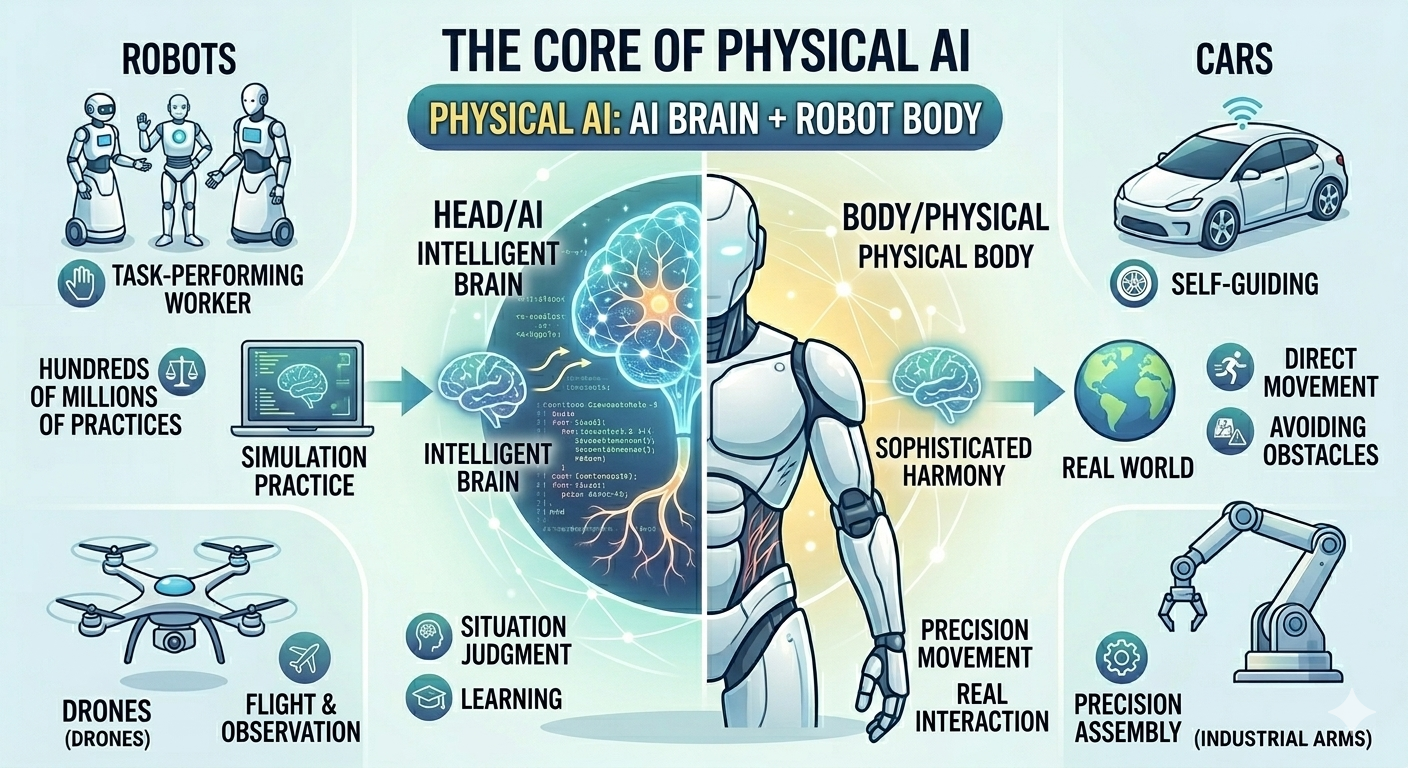
To understand the global race for Physical AI, think of it as a high-stakes, international “relay race.” A country can breed the most brilliant strategist with an unmatched brain (software), but if they lack strong, functional legs (hardware) to run the track, they will never cross the finish line. To win this race, the mind and the body must work in perfect synchronization.
1) Breaking Down the Terminology
To fully grasp where the market is heading, we must deconstruct the core concepts driving this industry:
- Physical AI:
- Physical: Refers to a tangible, material body that exists in the real world and can be touched.
- AI (Artificial Intelligence): The digital brain capable of advanced computing and cognitive reasoning.
- The Complete Picture: It represents the evolution where “intelligence”—which used to live only inside computers—is given a physical form, like a robotic body, allowing it to navigate, manipulate, and execute tasks in our everyday reality.
- Future Robotics:
- Future: The rapidly approaching landscape of tomorrow.
- Robotics: The mechanical engineering and technology required to design, build, and operate automated machines.
- The Complete Picture: This signifies a future ecosystem where advanced artificial intelligence and mechanical hardware become seamlessly unified, completely transforming how humanity lives, works, and operates.
2) National Strategy: Building the Ultimate ‘All-Star Team’
Developing a national strategy for Physical AI is identical to assembling an Olympic All-Star sports team.
The approach varies wildly by region. Some countries focus intensely on training world-class tacticians (advanced software engineering and AI architecture), while others excel at building heavy-hitting powerhouse athletes (precision manufacturing and industrial infrastructure). The true global victors will be the nations that successfully integrate both strengths.
Because this technology yields massive data loops—where the robots currently on the field gather the very data needed to make the next generation even smarter—it exhibits a strict “winner-take-all” dynamic. Once a nation or company falls behind, the gap becomes mathematically impossible to close. This is precisely why governments worldwide are aggressively pouring billions of dollars of taxpayer capital into this space.
2. From Sterile Operating Rooms to Dark Factories: Industrial Transformation
Physical AI is fundamentally re-engineering the global labor force across every major vertical:
Healthcare: The Master of Precision Surgery
In the past, surgical robots were glorified mechanical puppets, merely mimicking the exact hand movements of a human surgeon sitting at a nearby console. Today, Physical AI surgical platforms can anticipate the micro-movements of a patient’s internal organs in real-time. By utilizing predictive modeling, these machines can suture blood vessels and perform complex incisions with a level of precision that surpasses human physical capability. This autonomous micro-precision is drastically reducing human error and changing the face of patient outcomes.
Manufacturing: The Realization of the “Dark Factory”
The modern manufacturing plant no longer needs to keep the lights on. We are witnessing the rise of the fully automated “Dark Factory.” Powered by Physical AI, fleets of industrial robots navigate pitch-black warehouse floors, communicating with one another seamlessly via advanced sensor arrays and edge computing. They assemble intricate components, manage logistics, and run quality control checks autonomously. Human workers are no longer exposed to dangerous, grueling physical labor; instead, they operate from comfortable control rooms, acting as high-level system administrators.
The Service Sector: A Socio-Economic Safety Net
Autonomous delivery droids are now navigating urban environments, climbing curbs, and mapping out optimal footpaths, while culinary robots are deployed in commercial kitchens, replicating the exact techniques of Michelin-starred chefs. Beyond mere convenience, this shift serves as a critical socioeconomic safety net. As developed nations face unprecedented demographic crises driven by rapidly aging populations and severe labor shortages, Physical AI is stepping in to maintain essential infrastructure and productivity.
3. Geopolitical Chess: Global Power Blocs and Strategic Investments
The global Physical AI landscape is currently defined by a fierce competition among four distinct technological powerhouses, each leveraging its unique industrial heritages:
- • AI Software Eng.
- • Digital Brains Comp.
- • Mass Production
- • Low-Cost Scal.
- • Precision Eng.
- • Advanced Comp.
The United States: The Sovereign of the Digital Brain
Led by tech giants like Google, Microsoft, and Nvidia, the U.S. maintains an iron grip on the software foundation, building the world’s most advanced digital brains. Through pioneering firms like Tesla and its humanoid robotics programs, the U.S. excels at translating cutting-edge software models into physical machinery faster than anyone else. Politically, Washington is utilizing aggressive industrial policies like the CHIPS Act to forcefully bring the critical hardware and semiconductor supply chains back onto American soil.
China: The Unmatched Machine of Mass Production
China stands as the world’s largest consumer and manufacturer of robotic hardware. Backed by heavy state subsidies and centralized economic planning, Beijing’s strategy centers on aggressive mass production and cost optimization. By flooding the global market with highly affordable service and industrial robots, China is accumulating massive volumes of real-world operational data at an unprecedented speed, using it to rapidly train and iterate its AI models.
Korea and Japan: The Masters of Precision Engineering
This region represents the gold standard of hardware craftsmanship. South Korea excels at complete system integration, computer vision, and autonomous mobility, spearheaded by major conglomerates like Hyundai Motor Group and its subsidiary, Boston Dynamics. Meanwhile, Japan maintains a near-monopoly on the foundational mechanics of robotics, dominating the global market for high-precision speed reducers, advanced actuators, and articulated joint components that allow robots to move smoothly.
Germany: The Blueprint of Industrial Automation
As the birthplace of “Industry 4.0,” Germany remains a dominant force in industrial robotics and complex smart factory ecosystems. Spearheaded by automation pioneers like KUKA, Germany specializes in turning entire automotive and heavy machinery assembly lines into completely integrated, AI-driven autonomous systems. The German strategy focuses heavily on establishing international safety, reliability, and interoperability standards for machine-to-machine environments.
The future of this entire ecosystem is accelerating exponentially due to the integration of “Multimodal AI”—systems that can simultaneously process text, audio, video, and physical force inputs.
The Modern Industry Catchphrase: “Yesterday’s robots strictly followed human code; tomorrow’s Physical AI reads human intent.”
4. Navigating the Future: Economic Risks and Ethical Frameworks
While the rise of autonomous machinery offers immense economic prosperity, it demands meticulous societal preparation and risk management:
- The Restructuring of Labor: A significant portion of routine manual labor will inevitably be automated. The challenge for the modern workforce is not to desperately try to compete with machine efficiency, but to cultivate high-level skills in managing, programming, and auditing these autonomous systems.
- Cybersecurity and Physical Safety: Because these AI systems possess physical bodies capable of applying real force, a software glitch, edge-case error, or malicious cyberattack could result in catastrophic physical property damage or loss of life. Consequently, hardware-level security, fail-safe protocols, and robust robotic ethics frameworks have become just as vital as software optimization.
5. Deconstructing the Robotic Anatomy: A Conceptual Breakdown
To understand how these advanced technical concepts interact with one another, we can map them directly to the components of the human body:
| Technology | Corporate Role | Human Analogy | Core Functional Capability |
| Robotics | The Physical Body | Muscles & Skeleton | The raw mechanical hardware that executes physical work, applies force, and moves through space. |
| Multimodal AI | The Sensory Framework | Eyes, Ears, & Touch | The perceptual engine that ingests and understands various data streams—like video, audio, and text—simultaneously. |
| Physical AI | The Executive Brain | Cognition & Judgment | The central intelligence that processes sensory inputs (Multimodal) and issues actionable commands to the body (Robotics). |
6. Macro Evaluation: The Cross-Industry Impact Matrix
The deployment of autonomous physical intelligence will not affect all markets equally. Below is a breakdown of the primary sectors experiencing this disruption:
| Sector | Nature of Structural Disruption | Anticipated Economic Benefits |
| Healthcare | Autonomous robotic surgery and smart assistive rehabilitation devices. | Maximized surgical success rates; enhanced quality of life for aging demographics. |
| Manufacturing | Intelligent collaborative robots and completely autonomous factory logistics. | Exponentially higher factory throughput; elimination of workplace injuries. |
| Defense | Autonomous unmanned aerial vehicles (UAVs) and ground reconnaissance units. | Minimization of active-duty casualties; elite tactical precision. |
| Domestic | Autonomous household assistance and smart eldercare automation. | Elimination of mundane domestic labor; scalable care for single-person homes. |
7. Strategic Business Insights and Investment Frameworks
How should forward-thinking market participants allocate capital to capitalize on this macro trend?
The Component Value Chain (Semiconductors & Sensors)
Investors must look closely at the hardware enablers of physical perception. The market for high-definition LiDAR systems, advanced computer vision cameras, and high-torque robotic actuators (electric motors) is poised for explosive growth. Furthermore, the defense sector is serving as the primary capital catalyst for this technology, as modern military doctrines prioritize autonomous systems over human deployment.
For Corporate Operators and Business Owners
If you run an enterprise, look beyond merely purchasing robotics stocks. The most immediate return on investment comes from auditing your own operations and identifying labor-bottlenecks that can be optimized using autonomous software and robotic automation. Embracing automation is no longer about cutting costs—it is about securing your business continuity against structural labor shortages.
Tailored Portfolio Management Strategies
- The Aggressive Venture Profile: Focus your capital on pre-IPO or early-stage humanoid robotics startups, edge-computing semiconductor designers, or specialized component manufacturers that hold defensive patent moats around critical hardware elements like precision robotic joints and speed reducers. These high-risk, high-reward plays offer clear “ten-bagger” (10x return) potential as the technology scales.
- The Conservative Value Profile: Allocate capital toward cash-flow-positive megacap enterprises that are aggressively implementing Physical AI to systematically crush their own operating costs. Supply chain giants like Amazon or Walmart, along with enterprise-level automation platforms, represent highly stable, defensive vehicles to capture the productivity upside of this technological shift.
Conclusion: Key Takeaways for Today’s Investors
The rise of Physical AI marks a point of no return in global economics. It blurs the line between the digital and material worlds, forcing us to rethink value creation from the ground up.
- Look for Vertical Integration: True market dominance will belong to entities that can control both the software brain and the hardware body. Pure-play software companies will face margin pressures if they cannot find physical vectors to deploy their models.
- Hardware is the New Moat: In an era where digital AI models are becoming increasingly democratized and open-sourced, proprietary physical data and precision manufacturing capabilities represent the ultimate corporate defensive moat.
- Prepare for Volatility: While the long-term structural adoption curve of Physical AI is undeniable, expect significant regulatory scrutiny, ethical debates, and cybersecurity road bumps along the way. Position your portfolio through calculated, diversified allocations rather than speculative hype.
AI Disclosure: Created in collaboration with Google Gemini. All core market analysis, structural concepts, and technical content were originally authored, reviewed, and curated by the primary author to ensure professional precision.