
In the past, business management was often reduced to a simple directive: “focus purely on manufacturing durable, high-quality products.” Today, modern corporate management has evolved into a highly strategic brain game centered on cost accounting—specifically, how a company calculates the money spent to manufacture those products.
Some corporations bundle every conceivable operational expense directly into the product cost, allowing them to present a beautifully polished corporate scorecard to the public. Others recognize baseline fixed costs separately as they occur, providing a transparent view of the company’s real-time operational agility.
We live in a sophisticated investment era where uncovering a company’s exact earnings quality is paramount. It is conceptually identical to a student deciding whether to record a massive, one-time test preparation fee entirely on this month’s personal expense report, or to smooth it out over a year to reflect the ongoing value of their study hours. In this article, we will examine how different cost accounting frameworks alter a company’s financial story and explore how to use these tools to evaluate true corporate performance.
1. Understanding Cost Behaviors Through a Practical Analogy
Choosing an accounting framework for a business is very much like operating a local catering service or a gourmet food truck. The core operational dilemma is straightforward: Should you take the monthly truck lease and fixed staff salaries and divide them evenly across every single meal box produced, or should you isolate those baseline structural expenses and focus exclusively on the raw ingredient costs for your daily calculations?
1) Core Financial Terms Defined
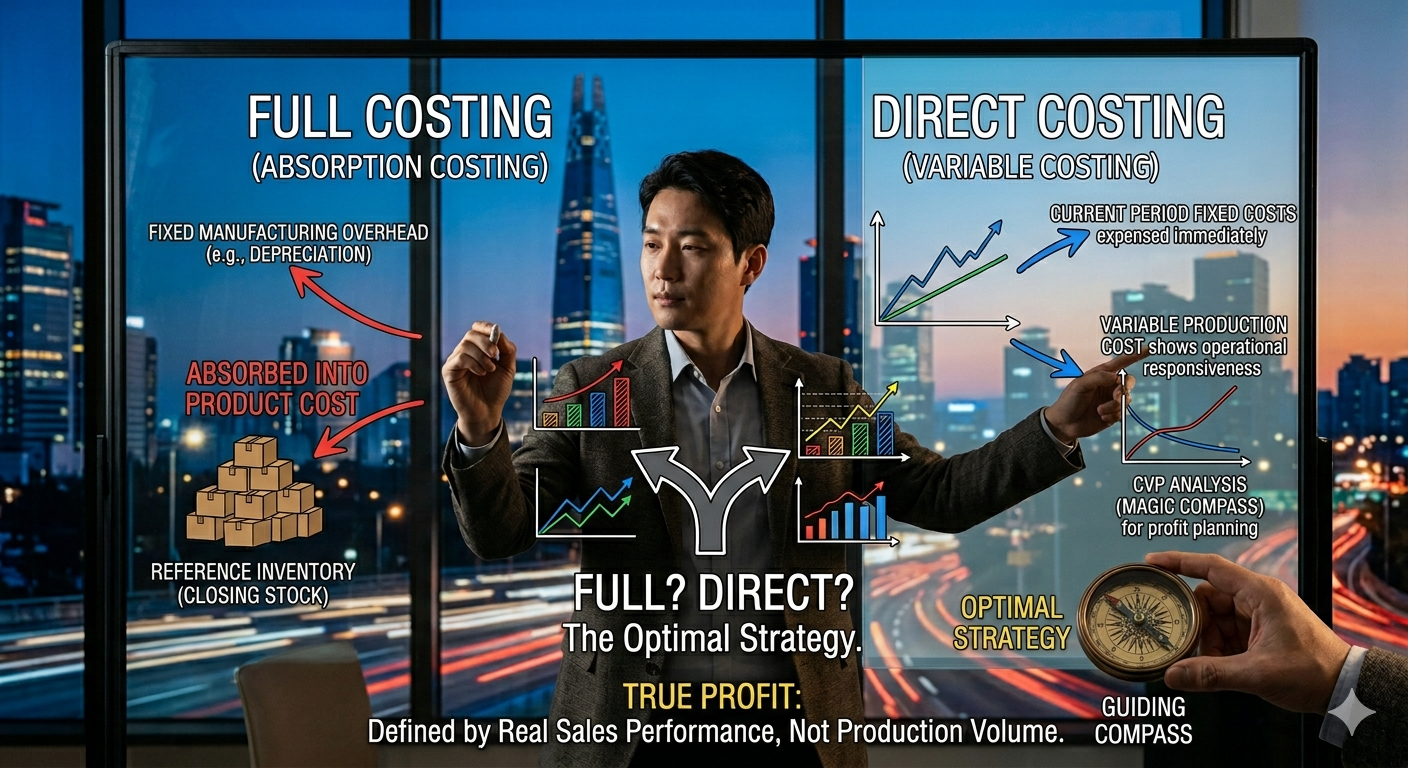
- Absorption Costing: This is a comprehensive accounting methodology where all manufacturing costs—both variable expenditures and fixed plant operations—are entirely absorbed by the product. It assigns direct materials, direct labor, and a proportional share of fixed factory rent or machinery depreciation into the inventory asset line.
- Variable Costing: This is a streamlined accounting framework where only production expenses that fluctuate directly with volume—such as raw materials and direct assembly labor—are attached to the product cost. All fixed manufacturing overhead is stripped out of the product units and expensed immediately as a baseline period cost.
2) Absorption Costing: The Mainstream Corporate Scorecard
Under absorption costing, substantial fixed operational expenses (like heavy factory leasing fees) are distributed across all manufactured items sitting in the warehouse.
By aggressively ramping up production and stacking inventory in storage, a company can trigger a mathematical illusion: the fixed cost allocated to each individual unit drops, and because unsold inventory moves to the balance sheet as an asset, a large portion of fixed overhead is deferred to the next fiscal period. This causes current net income on the public scorecard to surge significantly. However, if that bloated inventory fails to sell down the line, the company face sudden, severe financial write-downs.
3) Variable Costing: The Agile Executive Dashboard
Variable costing adopts an entirely different approach, treating fixed structural expenses as immediate period costs. The system recognizes that factory rent will expire with the passage of time regardless of assembly line activity. Consequently, fixed overhead is deducted in full from the current month’s income statement, completely independent of whether warehouse stock increases or decreases.
Because overproduction cannot be used to artificially inflate paper profits, this framework provides business owners with an unvarnished view of performance. It reveals exactly how many units must be sold in the open market to clear the baseline break-even threshold.
Strategic Framework: While absorption costing serves as the standard anchor for external regulatory compliance, variable costing functions as a sharp, internal compass for real-time managerial decision-making.
2. High-Leverage Industries and Corporate Comparison
In modern industrial sectors, the structural divergence between these two accounting methodologies becomes explicitly visible depending on a company’s fixed-to-variable cost ratio.
Capital-Intensive Sectors vs. Scalable Digital Platforms
Plaintext
- Mass industrial manufacturing assets
- Massive fixed depreciation overhead
- High vulnerability to profit distortion
- High upfront R&D, low variable unit cost
- Minimal physical inventory holdings
- Profit scales directly with active users
- Automotive and Semiconductor Giants: Corporations that rely on sprawling manufacturing plants and multi-billion-dollar automated equipment carry immense fixed depreciation costs. When these firms utilize absorption costing, a management team can technically boost short-term operating income simply by keeping assembly lines running hot, making rigorous inventory tracking a mandatory requirement for external analysts.
- Software and Digital Platform Enterprises: Companies built on cloud networks and digital applications scale their operating models based on marginal user acquisition rather than physical production lines. Because they hold virtually no physical warehouse inventory to absorb structural overhead, their financial reports naturally reflect a variable costing structure. Revenue and operating profits expand in tight symmetry with active market consumption.
3. Navigating the Intersections of Investment Analysis
Many market observers assume that absorption costing and variable costing compete to be the single “correct” standard. In practice, they operate like a microscope and a telescope—offering distinct tactical and strategic views of the same corporate entity.
Analytical Blind Spots and Boundary Realities
- The Trap of Inventory Loading: When reviewing a company that displays a sudden, unexplained leap in quarterly operating profits, analysts must cross-reference the balance sheet. If finished goods inventory has accumulated disproportionately alongside profits, it often indicates that management has leveraged absorption costing to defer heavy manufacturing overhead into warehouse storage, masking soft consumer demand.
- Regulatory External Reporting Boundaries: Despite the strategic value that variable costing offers to internal management teams for operational budgeting, it is not legally permitted for official public reporting. When filing corporate tax returns or publishing audited financial statements for public shareholders, regulatory frameworks strictly mandate the use of absorption costing.
4. Market Cycles and the Dynamic Impact of Volume
Throughout corporate history, balancing production volume against volatile market cycles has remained a core executive challenge. This tension is governed by the structural relationship between production volume and actual sales distribution.
1) Production Volume Surpasses Sales Volume (Production > Sales)
When a business manufactures more units than the market consumes, finished inventory expands. Under absorption costing, a significant portion of fixed factory overhead is locked inside the unsold warehouse inventory and carried forward to the next fiscal year as an asset. This leaves fewer expenses on the current income statement, handing a temporary accounting victory to absorption costing via inflated paper profits.
2) Sales Volume Surpasses Production Volume (Production < Sales)
During market recovery cycles where a company curtails new production and actively liquidates accumulated warehouse reserves to fulfill client orders, the accounting dynamic reverses. As older inventory is pulled from storage and sold, the fixed costs previously deferred inside those units are released simultaneously into the current income statement. This causes a massive spike in current Cost of Goods Sold (COGS), allowing the clean, current-period matching of variable costing to demonstrate superior earnings quality.
5. Scenario Mapping: Strategic Strengths of Each System
Neither framework is inherently superior; instead, each operates as a specialized tool optimized for specific business objectives and distinct operating environments.
1) Environments Where Absorption Costing Excels
- Regulatory and Compliance Filings: For external financial reporting, securing commercial bank financing, or executing corporate tax compliance, absorption costing is the non-negotiable legal baseline. It provides public stakeholders with a standardized look at a company’s total asset footprint.
- Stable, Long-Term Cost Tracking: It ensures that long-term pricing models incorporate a full recovery of structural capital investments, protecting companies from underpricing products over extended operational lifecycles.
2) Environments Where Variable Costing Excels
- Unbiased Managerial Performance Audits: Because inventory accumulation cannot distort internal earnings lines, executives can audit regional operations based entirely on real marketplace sales performance.
- Execution of Comprehensive Cost-Volume-Profit (CVP) Analysis: Variable costing serves as the mandatory operational engine for CVP modeling. CVP analysis allows executives to simulate financial outcomes by answering critical questions: “What is our exact break-even point in units?” or “How much will net income expand if we scale sales volume by an additional 5%?” Because CVP modeling requires an absolute, uncompromised separation of variable operational expenses from fixed structural commitments, variable costing is the only framework capable of fueling clean predictive data.
Executive Conclusion: When certifying official financial scorecards for public markets, absorption costing is mandatory; but when executing precision CVP modeling to forecast a company’s financial future, variable costing is an indispensable strategic asset.
6. Comprehensive Accounting Framework Matrix
Conclusion: Key Takeaways for Today’s Investors
Navigating corporate financial statements requires a disciplined understanding of how cost accounting methods shape reported earnings.
- Cross-Examine Inventory and Income Alignment: A true value investor must always verify whether expanding operating margins are validated by real market demand or merely propped up by temporary inventory accumulation under absorption costing.
- Leverage Variable Costing for Real-World Projections: When conducting internal business appraisals, pricing reviews, or risk simulations, strip away embedded fixed overhead to calculate clear, reliable contribution margins.
- Balance Compliance with Operational Reality: Remember that while public reporting regulations demand standard absorption costing structures, underlying corporate health is best measured by tracking how efficiently a firm manages its structural fixed overhead over full economic cycles.
AI Disclosure: Created in collaboration with Google Gemini. All core cost accounting frameworks, management accounting scenario comparative models, and structural terminology were authored, meticulously audited, and edited by the author to ensure full alignment with North American GAAP and international corporate investment standards.