
In the early days of personal computing, the operational dynamic resembled a strict classroom hierarchy: legacy terminals forwarded every problem to a central main server or a “school teacher” to receive a definitive answer. Today, technology has advanced into a decentralized era where the “smart notepad” inside your personal briefcase solves complex equations independently. Previously, engaging with highly sophisticated artificial intelligence required taking a digital highway via internet connections straight to a remote, hyper-scale data center headquarters.
As we navigate 2026, the technology landscape has shifted past the era of total centralization. We are living in a structural transition defined by Edge Computing and On-Device AI, where localized units think, analyze, and make decisions right at your fingertips. This change is very much like an entry-level retail clerk who initially needs to call corporate headquarters for every minor transaction, but eventually matures into a seasoned store manager capable of reading a customer’s subtle body language to fulfill their exact needs instantly.
1. Grounding the Technology: Everyday Analogies and Definitions
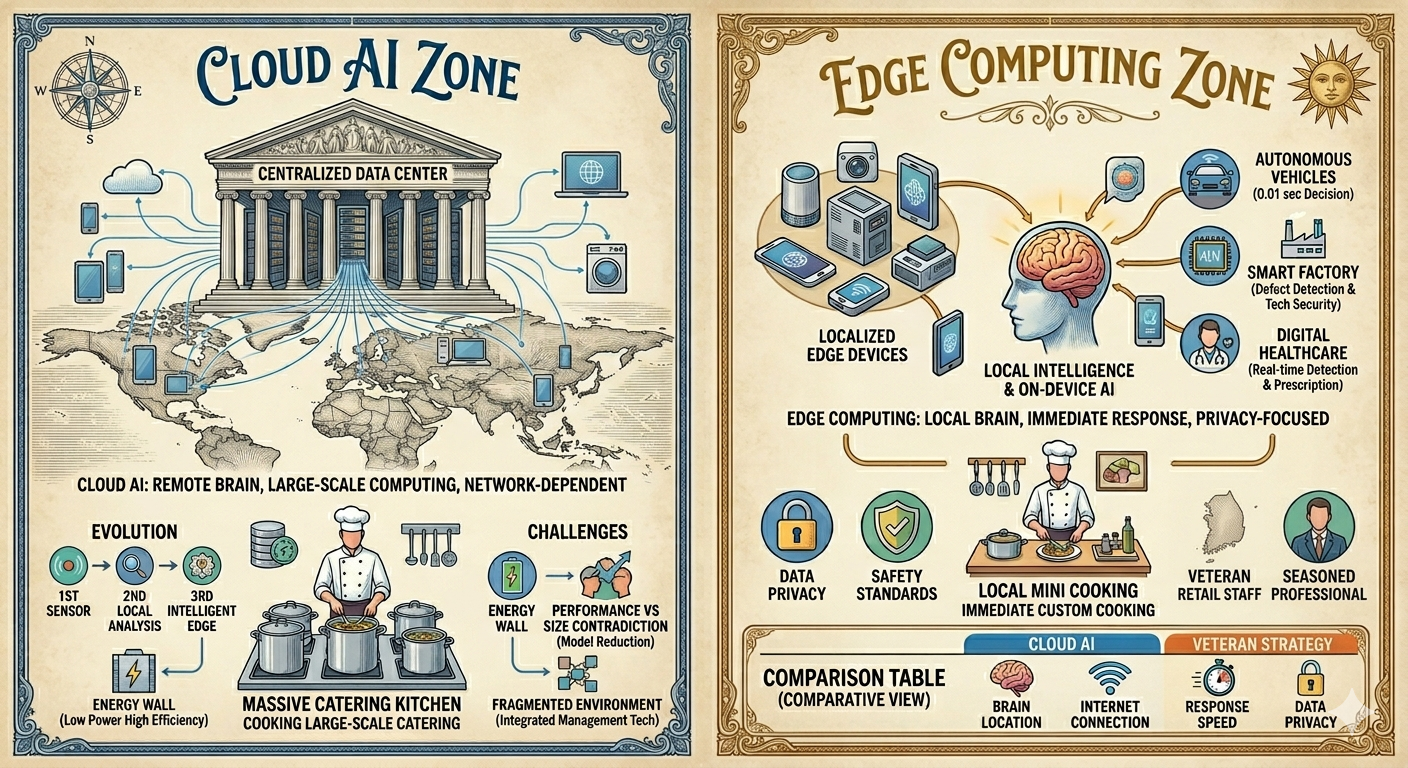
Understanding the operational differences between these tech paradigms is best achieved through familiar, real-world scenarios. Think of using artificial intelligence as preparing a meal. You can either take raw ingredients and travel miles to a large regional restaurant kitchen to cook them, or you can use a high-tech smart appliance right on your kitchen counter for an instant, personal meal.
① Defining Edge Computing and On-Device AI
- Edge Computing: “Edge” refers to the outermost boundary of a network architecture—the literal endpoint where data is generated by an end-user or physical machine. “Computing” is the processing and analysis of that data. Together, this technology processes information at lightning speed close to the source, rather than routing it through a distant cloud server.
- On-Device AI: “On-Device” signifies that an application runs entirely within the physical circuitry of an isolated hardware device without requiring external cloud connectivity. “AI” denotes software capable of human-like reasoning and pattern recognition. This technology allows a smartphone or laptop to act as a responsive personal assistant even when completely offline.
② Edge Computing: The Local Convenience Store Model
Instead of driving a long distance to a massive wholesale hypermarket (the centralized cloud server) just to buy a single item, you walk over to a neighborhood convenience store right at your doorstep. This framework minimizes latency, making it vital for critical, split-second applications like autonomous driving systems.
③ On-Device AI: Your Mental Math Capabilities
Instead of making a phone call to ask a colleague for help with a math problem, you compute the answer entirely within your own head using mental math. This completely eliminates data transmission risks, meaning your private information never leaves your personal device. It keeps your data highly secure and allows the system to function perfectly during a flight with no internet access.
2. The Three Evolution Milestones of Edge Technology
Decentralized networks are steadily advancing through clear, incremental phases of structural maturity:
- Phase 1: Basic Data Transmission (The Past): Simple IoT sensors collected raw data and passed it along directly to the centralized cloud. The local devices lacked processing power and served merely as digital pipes.
- Phase 2: Localized Analysis (The Present): Modern endpoints analyze raw data inputs locally to filter out noise or trigger basic automated alerts. For example, a contemporary smartwatch monitors heart rate data and instantly flags an irregular pulse pattern without needing constant cloud interaction.
- Phase 3: Fully Intelligent Edge (The Future): Every surrounding consumer asset will learn and optimize its performance autonomously. Household appliances will understand user habits deeply without relying on external servers, introducing a true era of ambient intelligence and offline reasoning.
3. High-Impact Industry Verticals and Use Cases
Decentralized intelligence has become a non-negotiable requirement across several high-stakes commercial sectors:
- Autonomous Transportation: For a vehicle to avoid a collision, response times must be kept under a hundredth of a second. The system simply cannot afford the latency of waiting for a cloud confirmation, making local edge computing a life-saving necessity.
- Industrial Smart Factories: On-site manufacturing robots detect minor component defects instantly on the assembly line and halt production to prevent systemic quality failures. Keeping this data local also protects sensitive manufacturing trade secrets from leaking.
- Digital Healthcare Innovation: Advanced pacemakers or automated insulin pumps track a patient’s vital signs in real time to deliver life-saving therapies instantly. Immediate local processing is critical when dealing with sudden, life-threatening changes.
4. Engineering Bottlenecks and Structural Hurdles
Building an efficient decentralized ecosystem requires overcoming three major hardware and software challenges:
- The Thermal and Energy Efficiency Wall: Running complex AI algorithms locally increases power consumption and generates significant heat. Developing ultra-low-power, high-efficiency semiconductors remains a top priority for hardware engineers.
- The Compact Performance Paradox: Fitting a massive, highly capable AI engine into a thin, lightweight consumer device requires extreme optimization. The tech industry relies heavily on advanced “model quantization” and network pruning techniques to make these AI models smaller and more efficient.
- Systemic Ecosystem Fragmentation: Managing firmware updates across hundreds of millions of diverse devices running completely different operating systems is a logistical challenge. Building unified, secure device-management software platforms is a highly complex task.
5. Strategic Investment Frameworks: Evaluating the Market
From an investment standpoint, identifying long-term winners requires looking past marketing buzzwords and evaluating the actual maturity of a company’s underlying technology.
① From Cloud Dependency to On-Site Autonomy
Relying entirely on cloud-based AI is like managing an entry-level employee who has to check with corporate headquarters for every decision. The response may be highly accurate, but the process introduces significant latency. Conversely, Edge and On-Device AI models act like experienced on-site managers who read a situation instantly and make immediate, localized decisions.
② Linking Technology to Market Value
- Low Latency: Immediate processing allows autonomous vehicles and industrial robots to react instantly to changing conditions without dangerous communication delays.
- Hyper-Personalization: On-device models learn your unique personal habits and preferences locally. This delivers a tailored user experience without ever exposing your private data to external corporate databases.
- System Independence: The hardware retains its intelligence even when entirely cut off from the network, making it resilient against widespread cloud data center outages.
③ The Labor and Automation Shift
As edge computing scales, standard repetitive tasks will be handled entirely by localized AI machinery. Capital and human labor will shift toward managing these complex systems and designing more intelligent local hardware nodes.
6. Tailoring Your Investment Strategy to Your Risk Profile
Investors can position their portfolios across three distinct risk and reward strategies:
- Aggressive Growth Strategy: Focus capital on pure-play fabless chip design firms developing next-generation Neural Processing Units (NPUs), or target innovative software startups specializing in AI model compression and edge security.
- Defensive Value Strategy: Invest in established consumer electronics giants that already control massive global device ecosystems. As On-Device AI features become standard consumer requirements, these scale manufacturers stand to benefit from a major hardware replacement cycle.
- Income-Focused Strategy: Allocate capital to telecommunications infrastructure providers rolling out 5G/6G networks, or invest in real estate investment trusts (REITs) that specialize in localized, regional edge data centers to secure reliable dividend yields.
7. Side-by-Side Comparison: Centralized Cloud vs. On-Device AI
| Core Category | Centralized Cloud AI | On-Device AI |
| Primary Location of Intelligence | Massive, distant data centers | Localized hardware silicon and NPUs |
| Network Connectivity Requirements | Requires constant, high-speed bandwidth | Functions completely offline |
| Latency and Response Metrics | Variable delays from data round-trips | Instantaneous, real-time responses |
| Core Strategic Advantage | Virtually limitless computing scale | Data privacy, speed, and reliability |
| Primary Engineering Constraint | Higher security risks, bandwidth costs | Limited onboard battery and power |
Conclusion: Key Takeaways for Today’s Tech Investors
Navigating the decentralized technology boom requires keeping your portfolio grounded in actual hardware economics.
- Look Beyond the Hype: Avoid companies that simply append “On-Device AI” to their marketing materials. Focus your analysis on businesses that possess proprietary chip designs, specialized software optimization tools, or massive distribution scale.
- Diversify Across the Value Chain: Do not place all your capital into chip designers alone. A truly resilient investment strategy balances high-exposure semiconductor stocks with steady infrastructure providers and dominant device manufacturers.
- Monitor Hardware Limits: Keep a close eye on power efficiency milestones. The companies that solve the core challenges of battery life and heat management will ultimately lead the next major technological expansion.
AI Disclosure: Created in collaboration with Google Gemini. All engineering concepts, edge network paradigms, NPU hardware architectures, and technology sector investment strategies were co-authored, technically audited, and verified by the author to ensure complete structural alignment with modern corporate market research and advanced financial analysis standards.