
Have you ever wished you could lock in today’s price for a purchase you need to make months from now? In a world of volatile markets, Futures are the “firm promises” that keep our global economy standing. They are the invisible gears that ensure fuel prices don’t fluctuate by the hour and that businesses can plan for the future with certainty. Let’s explore how these powerful derivatives work and how you can use them to protect and grow your assets.
1. Understanding Derivatives and Futures Through Metaphor
Financial “Derivatives” are contracts that derive their value from an underlying asset—the “Spot” or physical item.
- Derivatives (The ‘Processed’ Asset): Think of a fresh fish as the underlying asset. A derivative is like a fish cake or a fish voucher. Its value changes based on the price of the fish, but it offers a more versatile and safe way to trade than carrying around a raw, slippery fish.
- Futures (The ‘Firm Promise’): A Future is a contract to buy or sell an asset on a specific date at a price agreed upon today. It is a “strong commitment”—come rain or shine, both parties must fulfill the deal.
2. Futures in the Real World: Why the Economy Needs Them
Futures aren’t just numbers on a Wall Street screen; they are essential for the “Real Economy.”
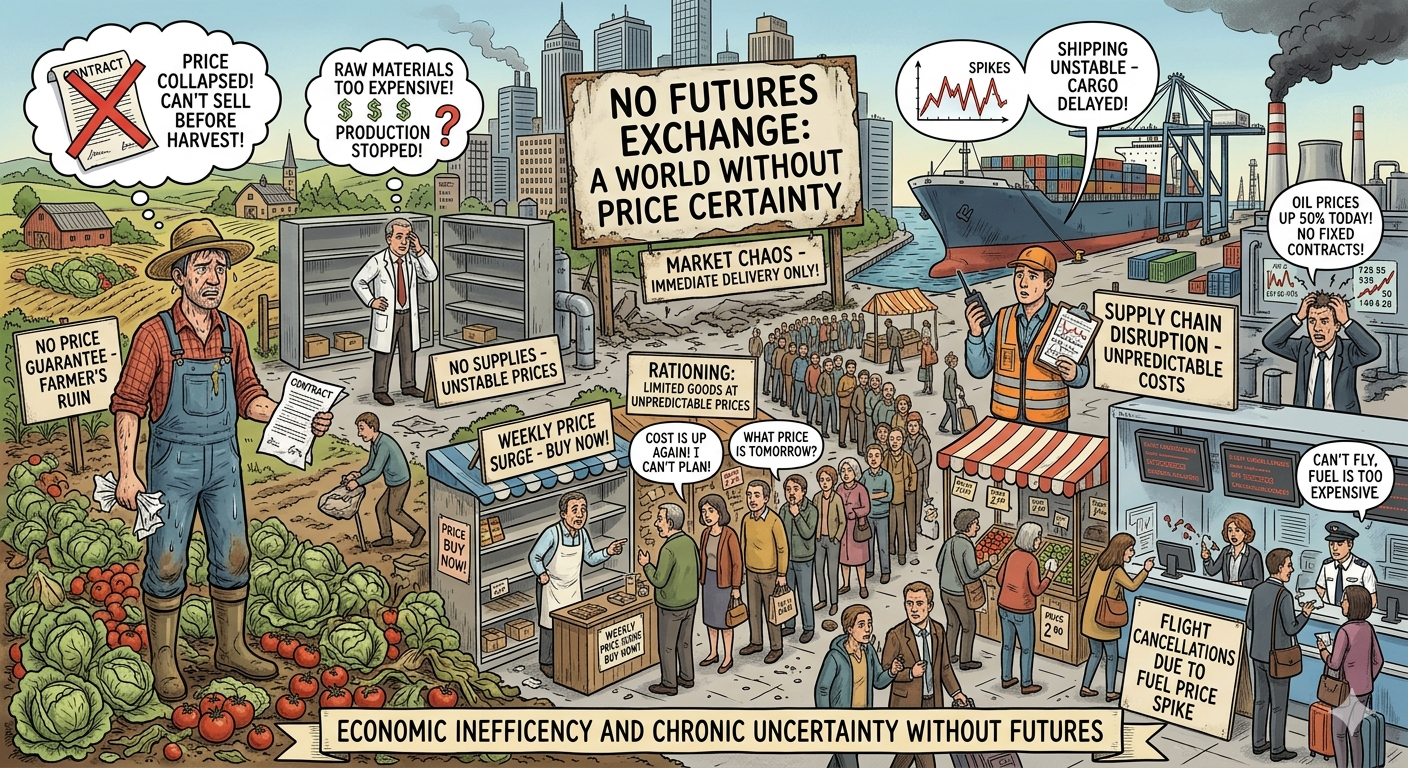
- Agricultural Stability: A farmer fears wheat prices will crash at harvest, while a bakery chain (like Panera or Starbucks) fears prices will skyrocket. By entering a Wheat Future, both lock in a price today. The farmer can farm in peace, and the bakery can keep bread prices stable for customers.
- Energy and Industry: Airlines like Delta or United are highly sensitive to oil prices. They use Oil Futures to prepay for their fuel. This is why your plane ticket price doesn’t change every time there’s a headline about the Middle East—the airline has already “locked in” its costs.
- Global Corporations: Tech giants like Apple or Microsoft receive revenue in many currencies. They use Currency Futures to hedge against a falling Dollar or Euro, ensuring their quarterly earnings remain predictable regardless of exchange rate swings.
3. Financial Futures: Trading the Value of Money
In financial markets, futures are used to manage the “value of money” rather than physical goods.
- Index Futures: Trading the performance of the entire market, such as the S&P 500 or Nasdaq.
- Interest Rate Futures: Betting on or hedging against the moves of the Federal Reserve.
- The Role of the Market: The futures market provides Price Discovery—it acts as a lighthouse, showing the world what the expected future price of an asset is based on the collective wisdom of thousands of traders.
4. The Mechanics: Margin, Leverage, and Daily Settlement
Futures operate on a completely different engine than “Spot” (standard stock) trading.
Leverage: The Power of the Deposit
In spot trading, if you want $100,000 worth of stock, you must pay $100,000. In futures, you only need a “Good Faith Deposit” (Initial Margin), typically around 10%. This Leverage allows you to control a large amount of assets with a small amount of capital. However, a long lever works both ways—a small price drop can snap your “wrist” (your initial capital) if you aren’t careful.
Mark-to-Market: Daily Settlement
Unlike stocks, where gains are “on paper” until you sell, futures are settled every single day. At the end of the trading session, the exchange calculates the price move. If you won, cash is deposited into your account immediately. If you lost, it is withdrawn. Every day is a fresh start.
The Margin Call: The Ultimate Warning
If your account balance falls below the Maintenance Margin due to daily losses, you receive a Margin Call. You must deposit more funds immediately, or the exchange will forcibly close your position (liquidation), locking in your losses.
5. Comparison Table: Spot vs. Futures
| Feature | Spot Trading (Cash) | Futures Trading |
| Payment | 100% of Asset Value | Initial Margin (approx. 10%) |
| Profit Realization | Realized only upon sale | Realized daily (Daily Settlement) |
| Additional Deposits | None required | Mandatory if ‘Margin Call’ occurs |
| Loss Limit | Limited to initial investment | Can exceed initial investment |
| Holding Period | Indefinite | Fixed Expiry Date |
| Analogy | Buying a house in full cash | A binding pre-construction contract |

6. Strategic Pairs: Combining Spot and Futures
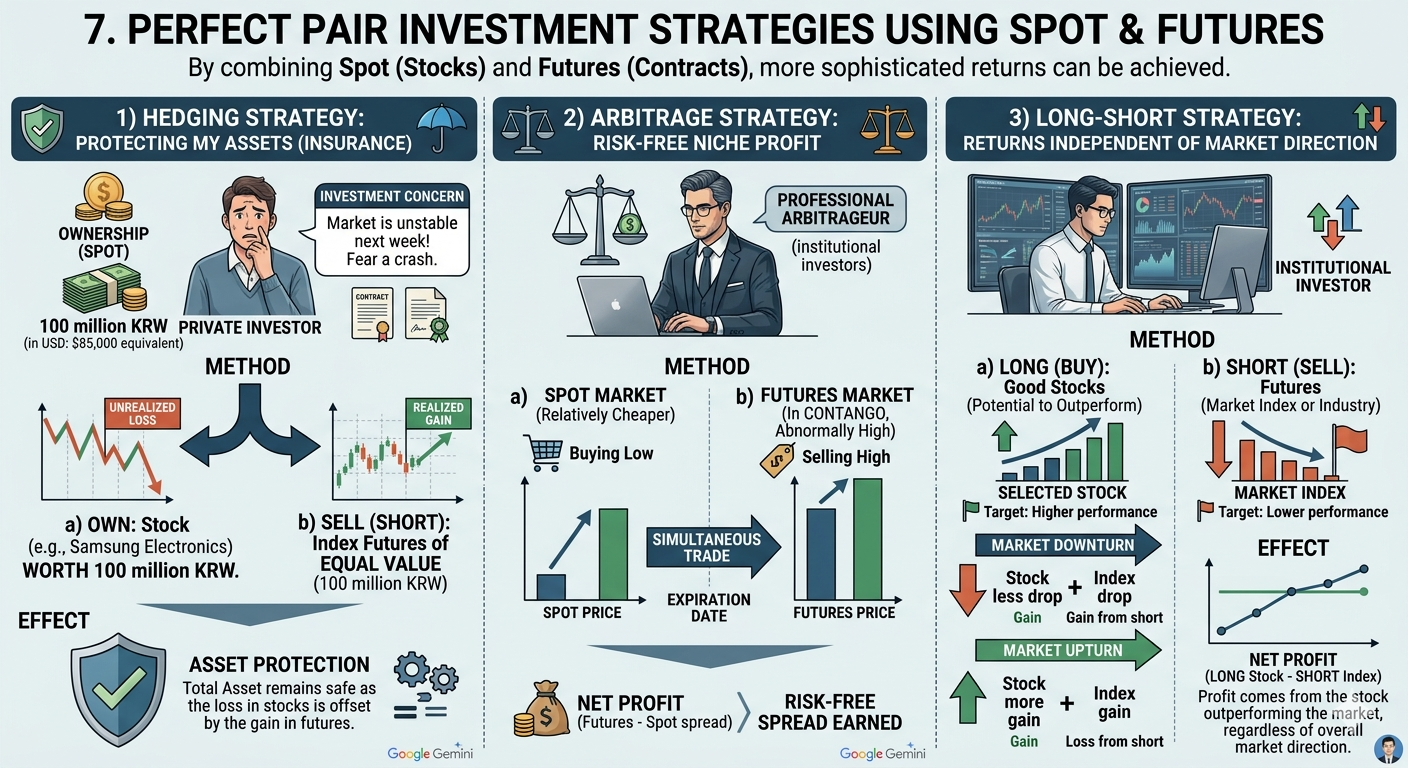
Pro investors combine these two to create sophisticated “Market-Neutral” strategies.
- Hedging (Asset Insurance): If you own $100,000 in stocks but fear a crash, you can “Short” (sell) an equal amount of Index Futures. If the market drops, the profit from your futures trade covers the loss in your stocks.
- Arbitrage (Risk-Free Spread): When the future price is irrationally higher than the spot price, pros buy the cheap spot and sell the expensive future to capture the guaranteed difference as they converge at expiry.
- Long-Short Strategy: Buy a specific stock you love (Long) and sell a future of a market you dislike (Short). You profit if your stock simply performs better than the market, regardless of whether the whole market goes up or down.
7. The Golden Rules of Futures Investing
- Acknowledge Unlimited Risk: Unlike stocks, futures can lead to debt if leverage is used recklessly.
- Manage Your Margin: Never keep just the “minimum” in your account. Always have a buffer to survive market volatility.
- Respect the Expiry: Futures have an expiration date. If you want to hold long-term, you must “Roll-over” to the next contract, which incurs costs.
- Use Stop-Losses: In the futures market, “hoping” is a strategy for failure. 기계적 (Mechanical) discipline is the only way to survive.
Conclusion: Key Takeaways
- Tool for Certainty: Futures allow businesses to fix future costs, stabilizing the global supply chain.
- Efficiency: High leverage offers great opportunities for capital efficiency but requires extreme risk management.
- Directional Freedom: Futures allow you to profit from falling markets just as easily as rising ones.
- Active Management: Because of daily settlement and margin requirements, futures are not a “buy and forget” investment.
AI Disclosure: Created in collaboration with Google Gemini. All core content was authored, reviewed, and edited by the author.