
In the past, investing was often seen as simply picking a “solid company” and burying it in the backyard for a decade. Today, however, investing is more akin to choosing the right “mode of transportation.” Some investors want to grab the steering wheel themselves, navigating rough terrains to hunt for massive gains. Others prefer to board a large, professional bus, prioritizing a safe and steady journey to their destination.
As of 2026, we find ourselves choosing between the “sports car” of individual stocks, the “efficient commuter bus” of ETFs, and the “custom-built tactical vehicle” of ETNs. Which of these partners will carry your assets to the finish line most safely and swiftly?
1. Understanding the Market Through Everyday Analogies
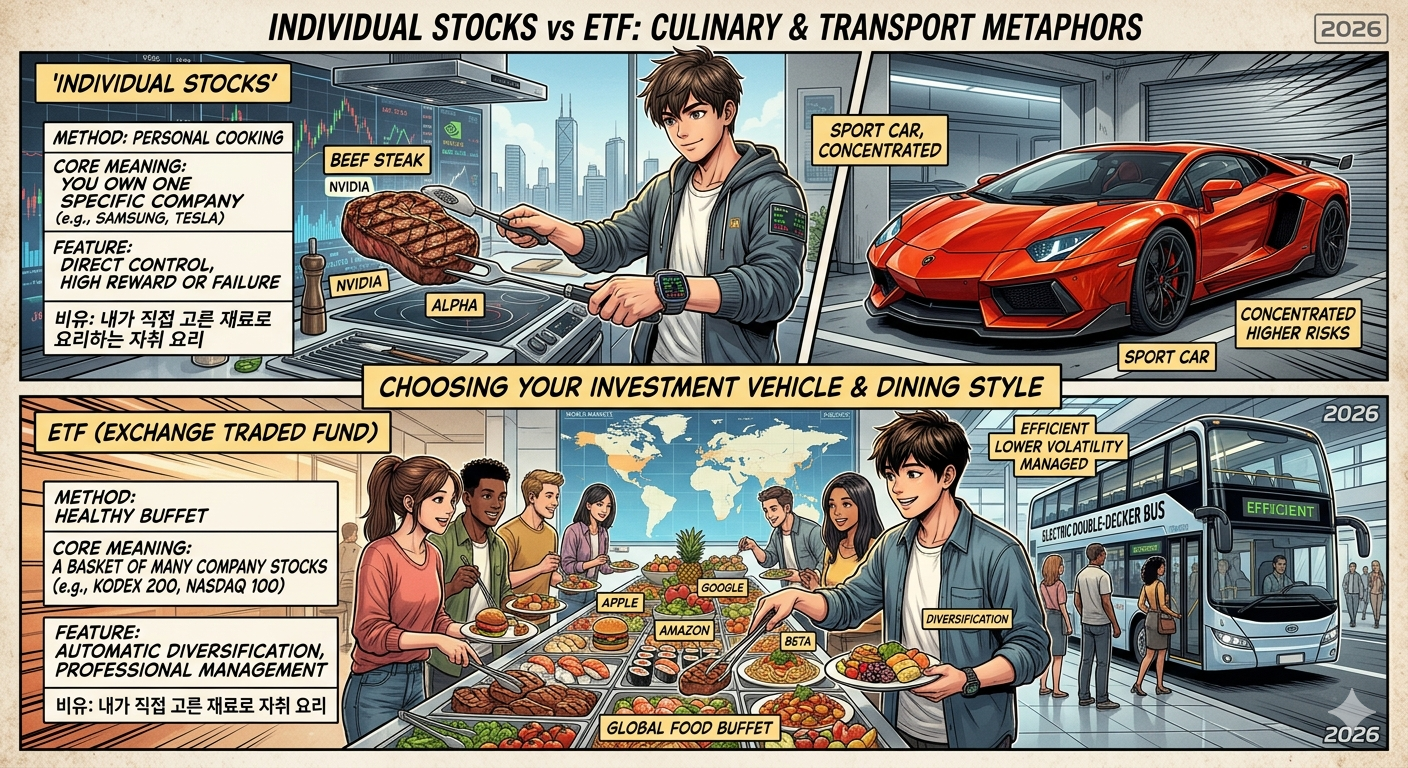
Think of investing as preparing a meal. The core question is: Do you want to go grocery shopping yourself, or would you prefer a professional chef to lay out a buffet for you?
1) Decoding the Terms:
- Individual Stocks:
- Individual: A single, standalone entity.
- Stocks: The right to prove you are a partial owner of a company.
- The Concept: You hand-pick one specific company you like—such as NVIDIA or Tesla—and become its shareholder.
- ETF (Exchange Traded Fund):
- Exchange Traded: Can be bought and sold instantly on the stock market.
- Fund: A basket where money from many people is pooled and managed by experts.
- The Concept: A “gift set” containing a diverse mix of stocks from various companies (e.g., VOO, QQQ).
- ETN (Exchange Traded Note):
- Note: A certificate where the issuer promises a specific return.
- The Concept: It looks like an ETF, but it is actually a “promise of return” backed by the credit of a financial institution.
2) The Comparison:
- Individual Stocks = “Home Cooking”: You pick the freshest meat (NVIDIA) or vegetables (Apple) from the market and cook it yourself. If the dish is a success, you enjoy a masterpiece. If the ingredients spoil, you go hungry. This is the essence of Concentrated Investing.
- ETF = “Healthy Buffet”: A professional nutritionist prepares a wide variety of small dishes. Even if one or two items taste bad, the overall meal isn’t ruined. It’s convenient and Safe.
- ETN = “Chef’s Special Reservation”: You don’t own the ingredients; you buy a reservation based on a “specific performance” promised by the chef (the bank). It allows you to taste rare commodities or complex strategies, but if the restaurant goes bankrupt, your reservation becomes a worthless piece of paper.
2. Choosing Your Partner in 2026
Depending on your preference, here are the representative North American investment partners:
- Riding the AI Wave:
- Individual Stock: NVIDIA (NVDA) – You bet directly on their technological dominance.
- ETF: Global X Robotics & Artificial Intelligence ETF (BOTZ) – You hold a basket of various AI and robotics companies at once.
- Seeking Steady Dividends:
- Individual Stock: JPMorgan Chase (JPM) – You receive dividends directly from a banking giant’s solid profits.
- ETF: Schwab US Dividend Equity ETF (SCHD) – You invest in a collection of representative U.S. companies that pay high dividends.
3. Advantages and Disadvantages of Your “Investment Vessel”
Investment masters care just as much about the “vessel” as they do the “contents.”
John Bogle: “Buy the whole haystack. Don’t look for the needle (the one winner); just buy the entire haystack (the index).”
- Management Costs: Individual stocks have zero management fees, making them ideal for long-term holding. ETFs/ETNs charge an Expense Ratio (management fee) that is deducted daily. Think of this as a “convenience fee” for saving your time and effort.
- Nature of Risk: Individual stocks carry Specific Risk (if the company fails, you lose big). ETFs carry Market Risk (if the whole market drops, you drop, but one company going bust won’t wipe you out). ETNs carry Credit Risk (you must ensure the issuing bank is financially sound).
4. How ETFs Work: A “Fund” Wearing “Stock” Clothing
The greatest feature of an ETF is that it is a fund, yet it trades in real-time like a stock.
- Basket Creation: Asset managers pool stocks that track a specific index (e.g., S&P 500) into a single “Basket.”
- Unit Splitting: This giant basket is split into small “Units” so individual investors can trade them easily on the market.
- Real-Time Pricing: While the value follows the total price of the stocks inside (NAV – Net Asset Value), the actual trading price can fluctuate slightly based on market demand.
5. Pros and Cons of Holding ETFs
Pros:
- Automatic Diversification: Buying one share of an ETF is like investing in hundreds of companies simultaneously.
- Low Barrier to Entry: Even if a single stock costs thousands of dollars, you can indirectly own a piece of it through an ETF for just a few dollars.
- Transparency: ETFs disclose exactly what they hold every single day (PDF – Portfolio Deposit File).
Cons:
- Leveling of Returns: Since they follow the market average, you won’t see 1,000% “moonshots” like you might with a single lucky stock.
- Tracking Error: There may be a slight difference between the performance of the ETF and the index it aims to follow.
- Liquidity/Delisting Risk: If trading volume is too low, the ETF might be delisted (though you usually get your cash back based on the underlying assets).
6. Comparison Table: Individual Stocks vs. ETFs
| Category | Individual Stocks | Exchange Traded Funds (ETFs) |
| Cooking Style | Home Cooking: You pick every ingredient. | Healthy Buffet: A curated menu by experts. |
| Transportation | Sports Car: You hold the steering wheel. | Commuter Bus: A professional driver leads. |
| Shopping Mode | Single Luxury Item: One high-quality pick. | Gift Set: A bundle of top-rated items. |
| Management | DIY Maintenance: You handle everything. | Managed Condo: Professionals take care of it. |
| Visual Result | A Single Flower: Vibrant but fragile. | A Lush Forest: Resilient and sustainable. |
7. The Cost of Investing: “No Free Lunch”
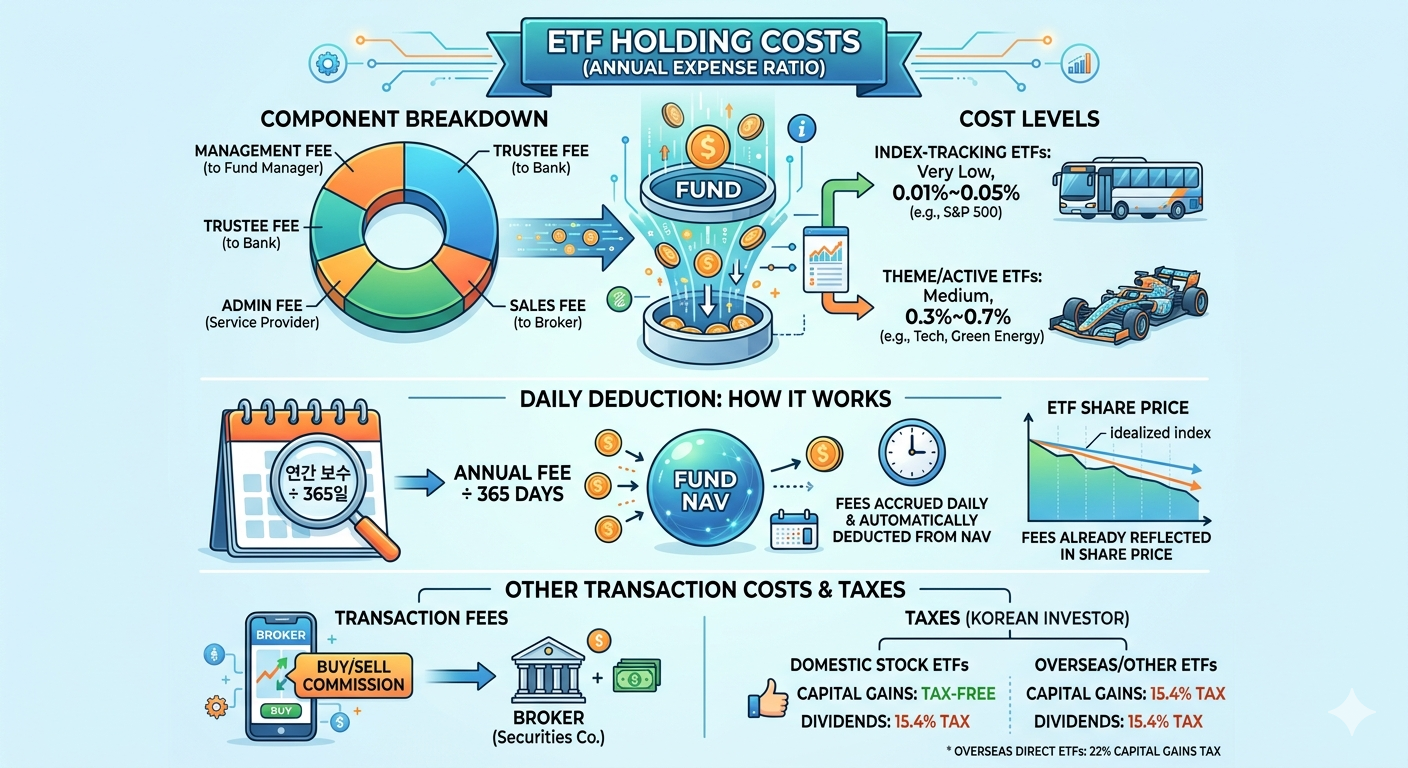
Holding an ETF incurs an Expense Ratio.
- What’s included? Management fees, custodial fees (bank), and administrative costs.
- The Level: Standard index ETFs are extremely cheap (0.01%–0.05%), while specialized themes or Active ETFs are higher (0.3%–0.7%).
- How is it paid? It doesn’t leave your account as a separate bill. Instead, it is deducted daily from the ETF’s NAV. The price you see on your screen already has the management fee “melted” into it.
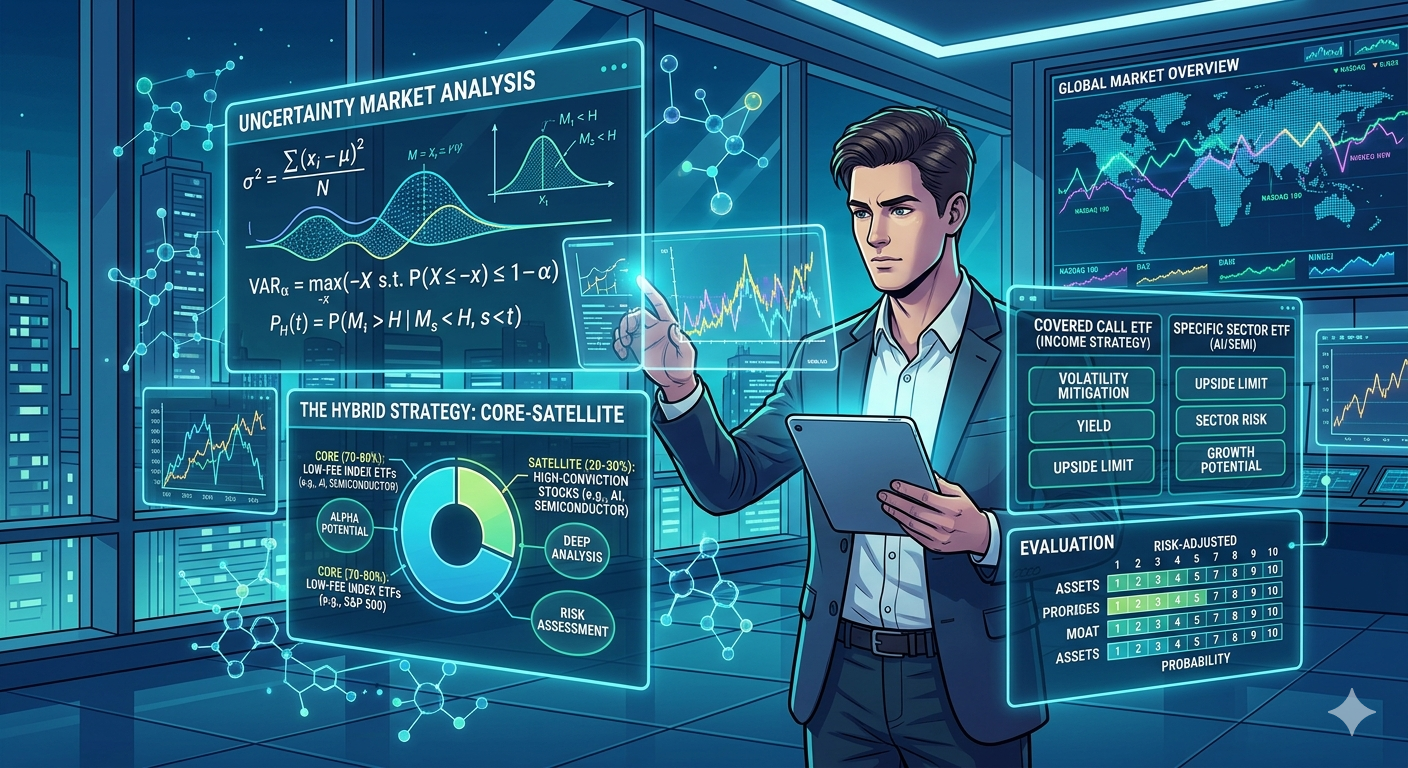
8. Practical Advice: The ‘Core-Satellite’ Strategy
The “correct” answer is rarely choosing only one; it’s about the Combination.
- Core (70-80%): Keep the majority of your assets in broad market ETFs (VOO, QQQ). This is your foundation.
- Satellite (20-30%): Invest the rest in individual growth stocks you believe in. This allows you to hunt for extra “Alpha” without risking your entire future.
- For Retirees (2027 Planning): Focus on Low-Cost Index Funds and Monthly Dividend ETFs. Even a 0.1% difference in fees can result in thousands of dollars in lost gains over a decade.
Conclusion: Key Takeaways
- Individual Stocks are the “Flowers” of a portfolio—vibrant but fragile.
- ETFs are the “Forest”—even if a few trees die, the forest survives.
- Focus on Costs: Fees are the “silent thieves” of your returns. Always check the expense ratio before buying.
- Build a Hybrid: Use the Core-Satellite approach to balance safety with the excitement of growth.
AI Disclosure: Created in collaboration with Google Gemini. All core content was authored, reviewed, and edited by the author.