
In the world of finance, structured products combining derivatives—specifically 2x leveraged and 2x inverse ETFs—often entice investors with the promise of amplified returns. While these tools can be powerful, they hide a sharp edge that can ruthlessly erode your capital if held over the long term. This guide will break down the mechanics, risks, and the strategic purpose behind these complex instruments.
1. Demystifying Financial Terminology
To understand these products, it is helpful to view them through everyday analogies.
- Leverage: Derived from the concept of a “lever,” this involves using borrowed capital or derivatives to amplify potential gains. Think of it like using a massive crowbar to lift a boulder that would otherwise be impossible to move by hand. You are using a small amount of your own capital to control a much larger asset position.
- Multiplier (2x/3x): Imagine driving a car with a “Sports Mode” or “Racing Mode.” In standard mode, pressing the accelerator 1 cm increases speed by 10 mph. In “Sports Mode” (2x), the same pressure increases speed by 20 mph. While this provides an exhilarating sense of speed during acceleration, pressing the pedal in reverse (when the market turns against you) accelerates your losses just as aggressively, potentially leading to a “crash.”
- Inverse: Acting like a mirror or a “reverse gear,” an inverse product is designed to move in the exact opposite direction of the underlying index. When the market rises, you lose money; when the market crashes, you profit. It is a contrarian bet designed to capitalize on market downturns.
2. The Light and Shadow of 2x Leveraged ETFs
The Structural Fatal Flaw: Volatility Drag
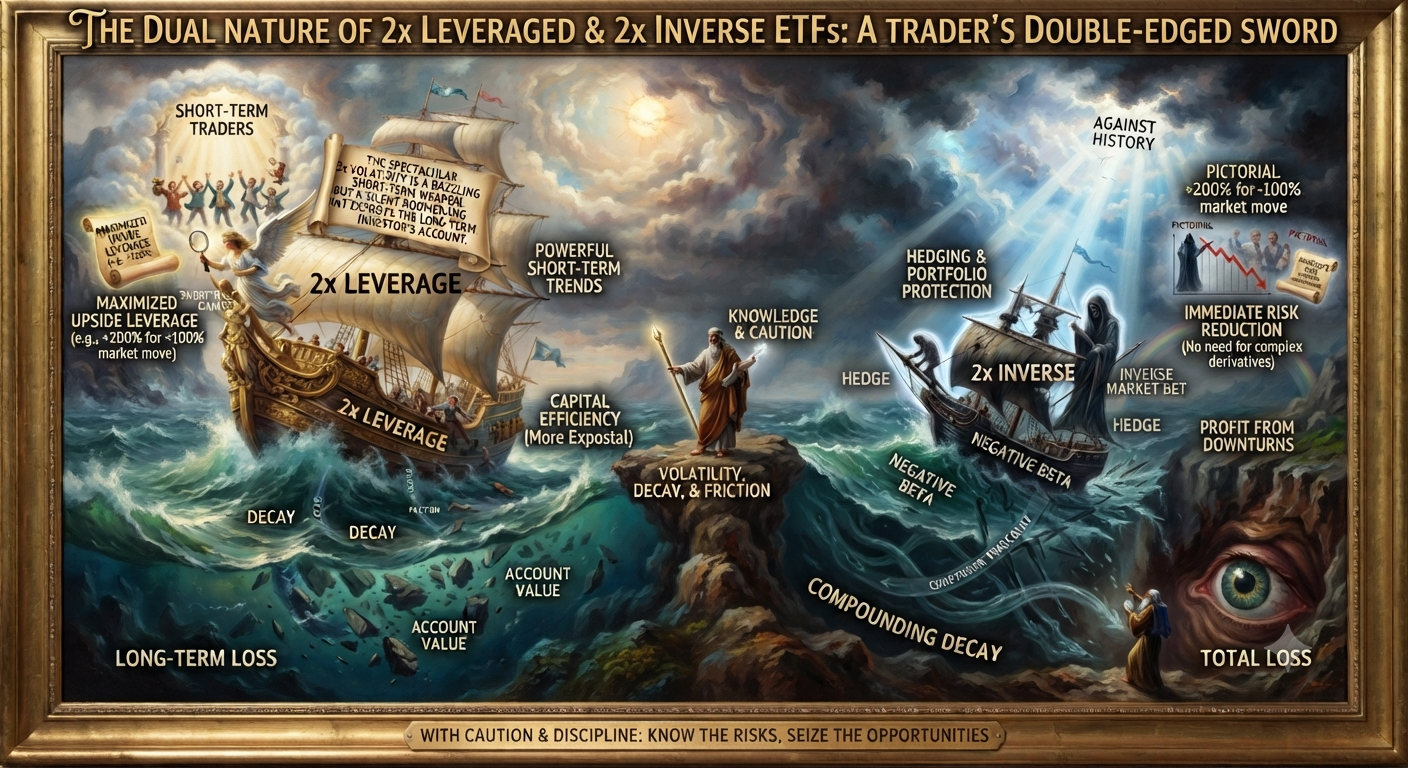
Leveraged ETFs are reset daily. This creates a phenomenon known as Volatility Drag (or “decay”). In a sideways market—where an index moves up and down but ends up back at its starting point—the leverage structure forces the value of the ETF to slowly melt away.
- The Math of Decay: If an index rises 10% and then falls 9.09%, it returns to its original value (100 → 110 → 100). However, a 2x leveraged fund would rise 20% but then fall 18.18%, leaving the investor with a net loss of 1.82% (100 → 120 → 98.18).
Asymmetric Return Profiles
If an index drops by 50%, it requires a 100% gain to break even. If a 2x leveraged fund drops by 80%, it requires a staggering 400% gain to recover. This “asymmetric return” profile makes deep drawdowns nearly impossible to recover from.
The Advantages
Despite the risks, these products are efficient tools for capital efficiency. In a clear, strong short-term trend, the daily reset can actually produce a “compounding roller coaster,” where returns exceed twice the index’s performance. For active traders, they provide immediate exposure without requiring a massive upfront cash outlay.
3. Why Do These Products Exist?
You might wonder why asset management firms continue to supply such “dangerous” products. The answer lies in market logic and financial engineering:
| Perspective | Rationale |
| Revenue Stream | Leveraged and inverse ETFs charge significantly higher management fees than standard passive index funds, serving as reliable “cash cows” for asset managers. |
| Hedging Utility | Institutional investors use them to hedge portfolio risk. Instead of selling off massive amounts of physical stocks, they can use these ETFs to quickly adjust their market exposure. |
| Market Liquidity | They attract diverse investors—from aggressive growth seekers to short-term hedgers—increasing overall trading volume and market liquidity. |
4. The Double Jeopardy: 2x Inverse (Short) ETFs
Commonly referred to as “Short” ETFs, these are designed to move -2x relative to the daily performance of an index.
- Macro Headwinds: Aside from the volatility drag, these products fundamentally bet against the historical tendency of global economies and stock markets to trend upward over time. Holding these long-term is a bet against human progress, making them exponentially more dangerous than their leveraged counterparts.
5. Practical Insights for Investors
Leveraged and inverse ETFs are not “set-it-and-forget-it” investments. They are not suitable for retirement accounts or monthly dollar-cost averaging strategies.
Think of these products as high-precision surgical scalpels. A surgeon uses a scalpel only for the duration of a specific incision and sets it down immediately after. Similarly, these products should only be used by experienced traders during periods of confirmed, high-momentum trends, and only for very short time horizons.
“The shimmering 2x return is a dazzling short-term weapon, but for the long-term investor, it is a boomerang that quietly destroys your account.”
Conclusion: Key Takeaways
- Avoid Long-Term Holding: Due to volatility decay, these products are designed for hours or days, not months or years.
- Understand the Math: Recognize that sideways markets are the enemy of leveraged products, leading to gradual value erosion.
- Use as a Tactical Tool: View these only as short-term tactical instruments for hedging or capitalizing on high-conviction momentum.
- Prioritize Strategy over Speculation: Never hold inverse products based on a vague feeling that “the market will turn eventually”; the structural costs will likely liquidate your position before the market recovers.
* This post was created in collaboration with Google Gemini AI. The author independently created, reviewed, and edited the content to ensure professional quality.