
We now know that the “S” in HTTPS acts as a secure vault that keeps our sensitive personal information safe from prying eyes. But have you ever wondered who actually designs and builds that digital vault under the hood? If you have spent any time researching web development or IT security infrastructure, you have undoubtedly run across the phrase “SSL certificate.” Yet, almost immediately, another technical acronym—TLS—enters the conversation, leaving many people completely confused about the true difference between them.
In reality, these two terms do not describe competing technologies. Instead, they represent the older and newer versions of the exact same security blueprint. They are the generational evolutionary steps of modern internet data protection. Today, we are going to look behind the scenes of HTTPS to discover the true mechanics of web encryption and see how these two protocols stack up side-by-side.
1. Everyday Metaphors: Understanding the Core Concepts
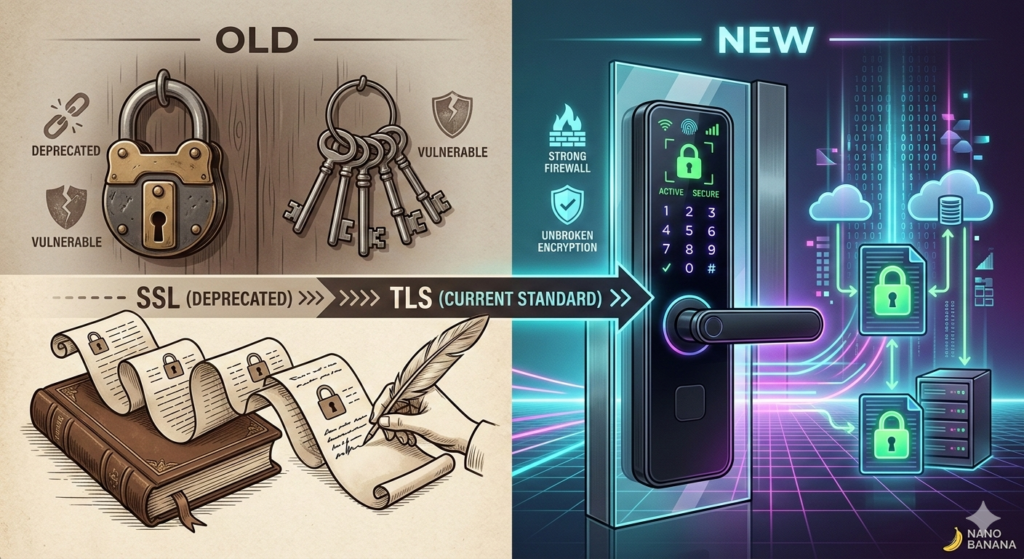
To easily understand how these network communication rules function without getting bogged down in complex programming syntax, let’s look at a simple, real-world comparison involving physical locking mechanisms.
1) SSL = The Traditional First-Generation Key Lock
When the commercial internet first began expanding rapidly in the mid-1990s, software engineers realized that data traveling across public networks was entirely exposed. To solve this, SSL was created. It was a revolutionary technical milestone—the world’s very first widespread digital lock designed to seal data inside a protective corporate envelope.
However, as the years rolled by, technology advanced. Malicious hackers built increasingly fast computers capable of exploiting tiny, hidden physical flaws in the original design. Just like an old, weathered padlock on a backyard gate, the structural integrity of the original SSL protocol eventually degraded, making it vulnerable to lock-picking techniques used by modern cybercriminals.
2) TLS = The Modern Digital Smart Lock
To eliminate the vulnerabilities found in the aging infrastructure of the original system, network engineers completely tore down the old blueprints and built a brand-new framework from scratch. The result was TLS.
Think of TLS as a state-of-the-art digital smart lock equipped with biometric scanners, randomized rolling entry codes, and real-time tampering alarms. It utilizes highly complex mathematical encryption algorithms to ensure that even if a cybercriminal manages to intercept your data packets mid-transit, deciphering the scrambled information would take a modern supercomputer thousands of years.
2. The “What If” Scenarios: The Reality of Protocol Vulnerabilities
To see why the tech sector has completely transitioned away from vintage encryption models, let’s explore what happens to an enterprise web architecture when administrators refuse to update their underlying codebases.
Scenario A: Insisting on Using Only Legacy SSL
- The Reality: A legacy web system continues to run an outdated version of SSL because “it has worked perfectly fine for twenty years.” The platform continues to manage customer profiles using this 1990s-era framework.
- The Result: Modern malicious actors deploying advanced automated scanning tools quickly identify the site’s aging architecture. Because the math behind old SSL versions contains known structural loopholes, the attackers easily breach the transmission pipeline. Private records, passwords, and corporate assets are leaked because the old padlock could not withstand modern brute-force decryption techniques.
Scenario B: Migrating to the Latest TLS Architecture
- The Reality: An organization proactively upgrades its infrastructure to the latest version of TLS, ensuring that all incoming and outgoing connections are handled by modern cryptographic standards.
- The Result: When cybercriminals attempt to deploy identical packet-sniffing and decryption attacks, they hit an impenetrable wall of modern mathematics. The cryptographic algorithms are too complex, the data remains safely locked inside its digital container, and the hackers abandon the target. At the same time, the optimized code paths of TLS allow the website to process information much faster, improving the user experience.
3. The Origin of the Terms: Market Familiarity vs. Global Standardization
If TLS is the actual technical mechanism keeping our modern applications secure, why does the general public almost exclusively use the term “SSL” when buying domain protections?
1) The Past: Why “SSL” Capitalized Public Familiarity
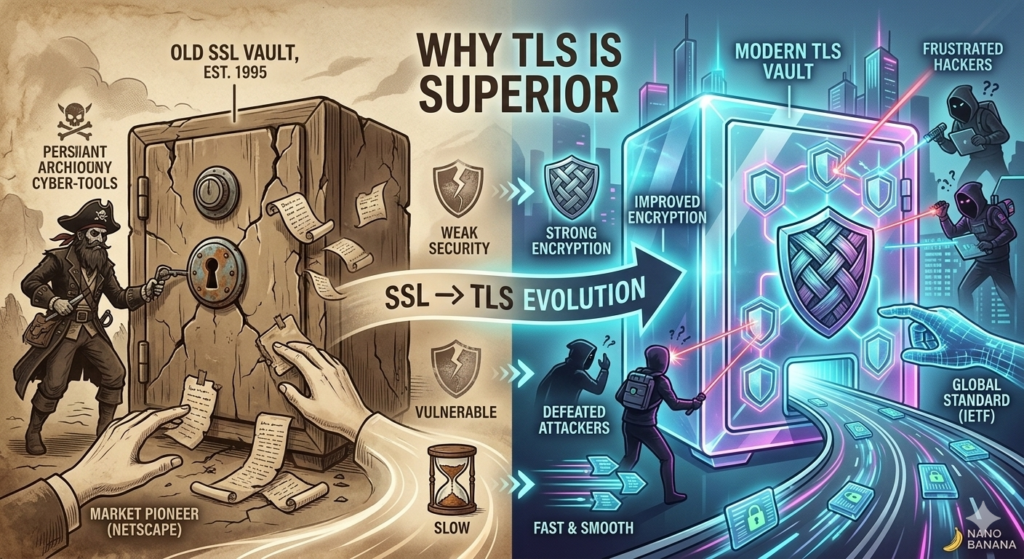
The answer comes down to early market positioning and first-mover advantage. When the tech company Netscape originally developed and introduced the protocol back in 1995, they branded it as SSL. It was the first commercial security framework of its kind, and it caught on like wildfire. Because it dominated the early internet explosion, the term permanently etched itself into the minds of corporate business leaders and everyday consumers as the universal shorthand for web security.
2) The Present: How “TLS” Became the Official Global Standard
As the internet grew from a novel corporate sandbox into a critical piece of global public infrastructure, the technology community realized that web security standards could not belong to a single private corporation.
In 1999, the Internet Engineering Task Force (IETF)—the international body governing web rules—took over the project. To mark its transformation into an open, community-driven global standard, they officially renamed the technology TLS. The mandate was simple: phase out the aging, insecure legacy code of SSL and establish TLS as the universal security baseline for every device connected to the network.
4. Technical Anatomy: What Do the Acronyms Mean?
To gain a clearer understanding of how these systems function within network engineering, let’s break down the literal meaning behind each component of their names:
1) SSL (Secure Sockets Layer)
- Secure: Designed explicitly to defend data pipelines from outside exposure.
- Sockets: The structural software connection points where your local browser hooks into a remote cloud server.
- Layer: A protective wrapper or data shield that sits directly on top of the raw transmission framework.
2) TLS (Transport Layer Security)
- Transport: Focuses on protecting data while it is actively moving across the physical global highway of fiber-optic cables and routers.
- Layer: Operates within a specific structural tier of international network communication models.
- Security: Implements advanced, modern mathematical encryption to guarantee that data remains completely safe from point A to point B.
5. The Core Pillars of Modern Encryption Protocols
Every time you open a secure webpage, the underlying TLS framework executes three vital functions simultaneously behind the scenes:
- Encryption: It transforms readable, plain-text sentences into highly scrambled, randomized strings of code that cannot be read without a specific cryptographic key.
- Authentication: It performs a digital handshake to confirm identities. It verifies that the bank website you are visiting is actually the real bank’s server, preventing users from falling victim to fraudulent copycat sites.
- Integrity: It attaches a digital “tamper-evident seal” to every data packet. If a hacker tries to alter a transaction or inject malicious code into the transmission along the way, the system detects the modification instantly and drops the connection.
6. Side-by-Side Comparison: Head-to-Head Analysis
To help you clearly distinguish between these two foundational protocols during your next infrastructure review or developer meeting, let’s look at their core characteristics side-by-side:
| Category | SSL (The Vintage Standard) | TLS (The Modern Standard) |
|---|---|---|
| Core Operational Role | Established the historical foundation for early web encryption. | Delivers modern, high-speed security for the global internet. |
| Cryptographic Strength | Low; vulnerable to modern decryption tools and attacks. | Extremely High; relies on complex, industry-standard mathematics. |
| Current Deployment Status | Fully deprecated and retired; should not be used in production. | Mandatory industry baseline for all secure web applications. |
| Primary Real-World Analogy | A traditional mechanical padlock with known keyway flaws. | An enterprise digital smart lock with rolling access codes. |
7. The Trust Ecosystem: Who Controls the Digital Keys?
Just as we saw with basic web security, the certificates that activate these advanced TLS smart locks are issued by trusted third-party organizations known as Certificate Authorities (CAs). These entities act as the ultimate arbiters of trust on the web.
- North American & Global Authorities: Organizations such as DigiCert, Sectigo, and the automated pioneer Let’s Encrypt issue the vast majority of enterprise certificates used throughout the United States, Canada, and Europe.
- Infrastructure Registrars: Regional domain managers and cloud hosts like Gabia, Cafe24, or KICA work to integrate these global encryption keys directly into local business platforms, ensuring that corporate servers maintain compliance with international security laws.
8. One-Sentence Summary
While SSL served as the historical pioneer that taught the world how to wrap data in a protective envelope, TLS is the modern, battle-hardened standard that locks that data inside an impenetrable vault.
Conclusion: Key Takeaways for Today’s Digital Landscape
Navigating the transition from legacy frameworks to modern standards is critical for protecting corporate data assets and maintaining consumer trust.
- Audit and Disable Outdated Protocols: Ensure that your enterprise IT infrastructure explicitly disables legacy SSL and early TLS (1.0 and 1.1) connections. Allowing your servers to communicate using these obsolete protocols leaves a wide-open back door for modern cyberattacks.
- Embrace the Security Nomenclature: While it is perfectly fine to use the term “SSL Certificate” when dealing with marketing teams or purchasing domain protections, always ensure your engineering teams are actually implementing the latest TLS 1.3 standards under the hood.
- Security Underpins Digital Trust: In an era defined by cloud computing and automated applications, a failure in your encryption layer destroys brand credibility. Keeping your cryptographic protocols up to date is the single most important baseline step you can take to secure your enterprise future.
AI Disclosure: Created in collaboration with Google Gemini. All core content was authored, reviewed, and edited by the author.