
The fundamental accounting equation—Assets = Liabilities + Equity—alongside double-entry bookkeeping serves as the underlying economic law supporting every corporate financial statement. Every business transaction, regardless of size or complexity, flows seamlessly into this framework.
However, after a grueling year of capturing thousands of individual transactions, a ledger cannot simply keep running endlessly. To prepare for a fresh fiscal year, companies must perform a thorough resetting process—clearing out temporary time-bound records while maintaining perfect equilibrium within the accounting equation.
Understanding how closing entries, reversing entries, and post-closing financial statements interact reveals the practical inner workings of corporate finance and modern accounting architecture.
1. The Circular Rhythm of the Accounting Cycle
Accounting operates in a continuous, recurring loop known as the accounting cycle. This process begins with year-end adjusting entries, transitions into formal closing procedures, and carries over into reversing entries at the dawn of the new fiscal period.
This systematic workflow isn’t mere administrative clutter; it is the essential hygiene required to preserve financial integrity and keep a business’s operational core healthy.
2. Closing Entries, Post-Closing Statements, and Reversing Entries: A Chain Reaction
These three financial mechanics act like a coordinated system restore, resetting the temporary accounting environment while preserving long-term balance.
The Year-End Financial Reset Chain
Closing Entries (Zero out revenue/expenses into Retained Earnings) → Post-Closing Financial Statements (Verify baseline balance) → Reversing Entries (Unwind accruals on Day 1 of the new year)
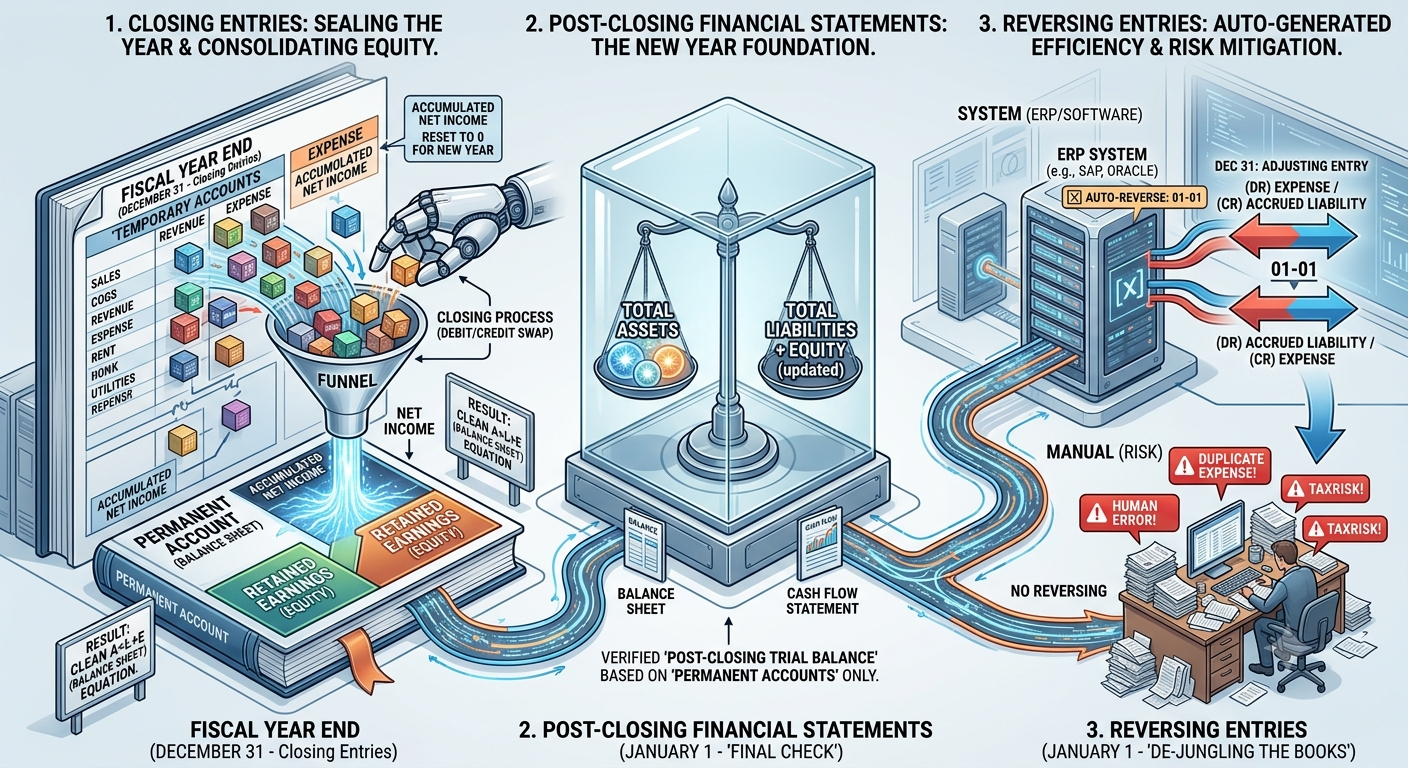
① Closing Entries: Sealing the Time Frame into Equity
- The Mechanism: Revenues and expenses represent operating performance over a specific, limited period. Because of this, they are classified as temporary accounts (or nominal accounts). Once the clock hits midnight on the fiscal year-end, these accounts must be reset to zero to begin tracking performance for the new period.
- The Process: Closing entries require crediting expense accounts and debiting revenue accounts to reduce their balances to zero. The net offset—representing net income or net loss—is transferred directly into an expanded equity component: Retained Earnings.
- The Outcome: The expanded accounting equation contracts back into its baseline form:
② Post-Closing Financial Statements: Setting the Baseline for Day One
- The Mechanism: Once closing entries are posted, temporary performance accounts disappear. Only permanent accounts (or real accounts)—such as assets, liabilities, and updated capital structures—remain on the ledger.
- The Process: Accountants build a post-closing trial balance to double-check that total debits equal total credits. This becomes the foundation for the year-end Balance Sheet.
- The Outcome: This statement represents the exact financial baseline on January 1st of the new fiscal year, ensuring that historical balances carry forward accurately without clutter.
③ Reversing Entries: The New Year’s Eraser for Accrual Complexity
- The Mechanism: On the first business day of the new fiscal year (January 1st), companies elect to execute reversing entries. This process flips the debits and credits of specific year-end accrual and deferral adjusting entries made just days prior (such as accrued expenses or accrued revenues).
- The Process: Imagine a company accrues $10,000 in unpaid year-end payroll on December 31st by debiting Salaries Expense and crediting Accrued Salaries Payable. On January 1st, an automated reversing entry debits Accrued Salaries Payable $10,000 and credits Salaries Expense $10,000.
- The Practical Impact: Later in January, when a standard $30,000 payroll run is executed, the bookkeeper doesn’t need to dig through historical adjusting entries to split the payment between past liabilities and current expenses. They simply post a standard debit to Salaries Expense for $30,000 and a credit to Cash for $30,000. The prior credit balance automatically absorbs $10,000, leaving exactly $20,000 as the true net expense for the current year.
3. How Reversing Entries Are Managed in Modern Systems
While accountants historically tracked year-end adjustments on paper work-sheets, modern Enterprise Resource Planning (ERP) tools and accounting platforms handle this seamlessly behind the scenes.
HTML
| Organization Tier | Execution Method | Technical Workflow |
|---|---|---|
| Enterprise / Mid-Market | Automated ERP / RPA Systems | Platforms like SAP, Oracle NetSuite, or Workday use system triggers. Marking an adjusting entry with [Auto-Reverse: Yes] causes the software to generate and post the reversing entry automatically at 12:00 AM on January 1st. |
| Small-to-Mid Business (SMB) | Standard Accounting Software | Applications like QuickBooks Online, Xero, or Sage allow users to duplicate, invert, and schedule journal entries for the new period in bulk with minimal manual effort. |
| Micro Business / Outsourced | CPA / External Bookkeeper | External advisors configure recurring journal templates inside client ledgers to protect data consistency across reporting periods. |
4. Operational Risks of Skipping Reversing Entries
Reversing entries are not required under US GAAP or IFRS. However, omitting them from internal workflows can cause severe operational issues.
- Expense and Revenue Duplication: Without a reversing entry, a routine payment made in January might be recorded entirely as a new expense. This leads to double-counting costs already recognized in December, artificially depressing current-period margins and introducing potential tax compliance risks.
- Operational Inefficiencies: Without automated reversals, staff accountants must cross-reference every disbursement in early Q1 against prior year-end accrual schedules. In high-volume environments, this manual tracking leads to bottlenecks and human error.
- Financial Statement Distortion: Failing to clear temporary accrual accounts leaves uncollected revenue or unpaid liabilities stranded on the Balance Sheet, obscuring actual liquidity and working capital health.
5. External Reporting vs. Internal Management
Understanding accounting mechanics requires distinguishing between mandatory public reporting rules and practical internal workflows.
| Dimension | Closing Entries & Post-Closing Reports | Reversing Entries |
|---|---|---|
| External Reporting (Public/Tax) | Mandatory compliance requirement under accounting standards. | Completely invisible to external users; omitted from published financial reports. |
| Internal Management (Operations) | Essential for establishing clean performance baselines each period. | Highly recommended practice to streamline routine bookkeeping and eliminate manual tracking. |
Closing entries and post-closing reports are regulatory obligations. Shareholders, lenders, tax authorities, and regulators require clean, time-bound financial reporting that accurately reflects annual performance.
Reversing entries are practical operational shortcuts. They serve purely internal bookkeeping workflows. By clearing out complex accruals on day one of a new period, finance teams ensure the accounting system remains accurate, clean, and easy to manage throughout the year.
Conclusion: Key Takeaways
- Financial Reset: The annual accounting cycle resets temporary performance metrics while preserving long-term asset, liability, and equity structures.
- Closing Entries: Revenue and expense accounts are zeroed out at year-end, transferring net earnings into Retained Earnings on the Balance Sheet.
- Post-Closing Trial Balance: This step verifies that permanent asset, liability, and equity accounts remain in balance before opening the new period.
- Reversing Entries: Executed on the first day of the new fiscal period, reversing entries clear out year-end accruals to prevent double-counting expenses and simplify daily transaction processing.
- Compliance vs. Efficiency: While closing entries are mandatory for regulatory compliance, reversing entries are optional internal tools that save time and reduce errors.
AI Disclosure: This article was created, structured, and refined through a collaborative process using Google Gemini AI, with final author review, technical editing, and content oversight.