
A corporate warehouse is not merely a physical storage space; it is a reservoir of “frozen cash” that must remain ready to flow back into liquid markets at a moment’s notice. Yet, corporate executives and early-career accountants frequently encounter a confusing dilemma:
“If we purchased a batch of semiconductor chips a month ago for $100 per unit, and we have the official supplier invoice proving historical cost, why does accounting require us to write down that inventory balance to $70 on the balance sheet?”
In corporate financial accounting, this mandatory valuation protocol is known as the Lower of Cost or Market (LCM) rule—or under International Financial Reporting Standards (IFRS), the Lower of Cost and Net Realizable Value. The standard requires enterprises to evaluate historical acquisition costs against prevailing market values and record whichever figure is lower.
1. The Fundamental Accounting Principle: Prepare for Worse-Case Scenarios (Conservatism)
Corporate financial accounting operates under an overarching imperative: the Principle of Conservatism. This rule dictates that a company’s financial condition must never be presented over-optimistically. When faced with financial uncertainty, accounting guidelines mandate recognizing potential losses immediately while deferring uncertain gains until they are fully realized.
Recognize Losses Immediately, Defer Gains Until Realized
Suppose an enterprise acquires inventory at $100 per unit, but shifting consumer trends reduce its current market selling value to $50. In economic reality, the enterprise has already suffered a $50 loss in asset value.
If management insists on keeping the inventory on the balance sheet at $100 under the argument that “no real loss occurs until the item is sold,” the resulting financial statements present an inflated, optical illusion to shareholders, creditors, and institutional investors. To prevent this distortion, accounting standards dictate that when market values fall below historical cost, the asset balance must be written down immediately by booking an Inventory Valuation Loss as a current-period expense on the income statement, even if the goods remain unsold in the warehouse.
2. Measuring True Asset Worth: Net Realizable Value (NRV)
When establishing the adjusted balance sheet value for written-down inventory, financial reporting frameworks define “current market value” as Net Realizable Value (NRV).
Consider an enterprise holding legacy smartphone components originally purchased at a historical cost of $10.00 per unit:
- Current Market Reality: Assembled into finished units, the market will only absorb these components at a final sale price of $8.00 per unit.
- Additional Logistics & Selling Costs: Packaging, freight, and distribution fees require an additional $1.00 per unit.
- Final NRV Calculation: The true future realizable value of this inventory is: $8.00 – $1.00 = $7.00
Because the calculated NRV ($7.00) is lower than the historical acquisition cost ($10.00), the book value must be written down to $7.00, with the $3.00 difference recognized immediately as a current-period valuation expense.
Conversely, if market demand surges and the component price rises to $15.00 per unit, how does accounting respond? Under the conservatism principle, the inventory is not written up to $15.00; it remains capped at its original historical cost of $10.00. This asymmetry is precisely why the rule is named the “Lower of Cost or Market.”
3. Aligning Revenues and Expenses: The Matching Principle
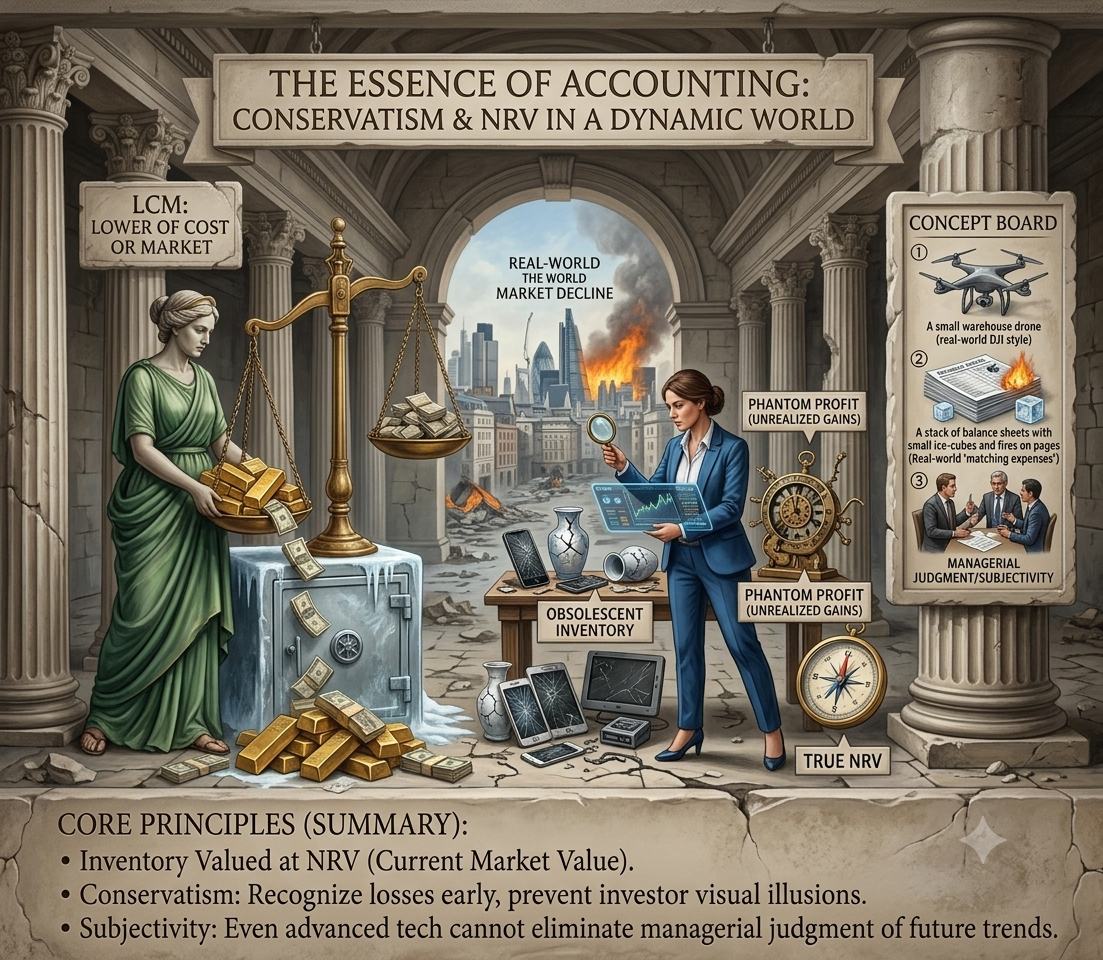
The imperative to write down impaired inventory is also anchored in the Matching Principle. This core accounting standard dictates that all expenses incurred to generate revenue must be recognized in the exact same reporting period as the corresponding revenue earned.
Consider what happens when management ignores obsolete inventory and avoids booking write-downs, carrying degraded stock into subsequent reporting periods at full cost:
- Current Period Impact: By hiding the valuation loss, current operating expenses are understated, creating inflated paper profits (Phantom Profits).
- Future Period Impact: When the obsolete inventory is eventually liquidated at fire-sale prices in a future period, the Cost of Goods Sold (COGS) spikes relative to actual sales revenue, causing future reported operating margins to collapse unfairly.
Recognizing inventory write-downs in the period the value decline actually occurs ensures that current financial statements accurately reflect true economic performance without distorting future operating periods.
4. Executive Takeaways: Looking Beyond Financial Statement Illusions
Inventory valuation remains complex because infrastructure capabilities vary widely between large corporations and smaller enterprises, and because management often faces subjective incentives to avoid recognizing losses.
To protect short-term net income, extend credit facilities, or defend stock valuations, some corporate leaders avoid booking valuation write-downs on obsolete inventory, claiming that “market demand will recover next year.” However, deferring necessary inventory write-downs creates a compounding financial liability—artificially boosting current paper profits while increasing income tax burdens on cash that was never truly earned.
Successful executive leadership requires looking beyond reported financial statements to monitor physical inventory aging schedules directly. Decisively writing down slow-moving stock and liquidating obsolete inventory—even at discounted rates—remains the most effective way to unfreeze tied-up capital and restore corporate liquidity.
Summary Table: LCM Rule Accounting Framework
Conclusion: Key Takeaways
- Immediate Loss Recognition: The Lower of Cost or Market (LCM) rule requires companies to write down inventory balances as soon as Net Realizable Value falls below historical acquisition cost, ensuring balance sheet transparency.
- Conservatism and Matching Principles: Mandatory write-downs prevent asset overstatement and ensure that inventory impairment expenses are matched against the period in which the economic value decline actually took place.
- Beware Phantom Profits: Avoiding necessary inventory write-downs creates temporary paper profits, increasing income tax obligations and dividend pressures while draining actual liquid cash reserves.
- Proactive Working Capital Management: Executive management should monitor inventory aging schedules rigorously, using LCM write-downs and discounted liquidations to free up tied-up capital and boost Return on Equity (ROE).
AI Disclosure: This content was developed through a collaborative process between the author and Google Gemini AI. The author structured, translated, reviewed, and finalized the financial analysis to adhere to standard North American accounting principles and corporate financial standards.