
A corporate warehouse is not a passive storage facility; it is a reservoir of “frozen cash” waiting to liquefy. Yet, many corporate leaders overlook a fundamental reality: while counting physical unit quantities on shelves is relatively straightforward, determining the true financial value of that inventory remains one of the most persistent challenges in accounting history.
Physical inventory flows in an analog, mixed manner, whereas accounting ledgers demand rigid digital rules. When this operational reality collides with management incentives to manage reported earnings, inventory valuation can quickly turn into a financial time bomb. Understanding the inherent complexities of inventory valuation, how execution differs by company size, and the strategic risks hidden beneath standard accounting conventions is critical for sound financial leadership.
1. Four Fundamental Reasons Inventory Valuation Is Inherently Difficult
1) Unit Cost vs. Cost Flow Constraints: You Know the Quantity, But Not Which Specific Item Left
Imagine a warehouse filled with 10,000 identical semiconductor chips or a storage tank holding bulk crude oil. The total physical quantity or volume can be measured precisely. However, these identical goods were purchased over time at varying unit costs—some last month at $100, some early this month at $120, and others yesterday at $150—all mixed together in a single storage location.
When an item is shipped to a customer, individually tracking every single unit to determine its exact acquisition price—known as the Specific Identification Method—is practically impossible for mass logistics. Consequently, accounting frameworks must introduce artificial assumptions such as First-In, First-Out (FIFO) or Weighted Average Cost. These standard mathematical formulas create an inevitable disconnect between actual physical logistics and balance sheet accounting values.
2) Valuation Uncertainty: Knowing Historical Cost vs. Predicting Future Liquidation Value
Accounting standards enforce the Lower of Cost or Net Realizable Value (LCNRV) rule, requiring a company to write down inventory values when current market selling prices drop below original acquisition costs. However, forecasting the future realizable value of outdated or fashion-sensitive inventory is notoriously difficult. Unlike publicly traded stocks with real-time price quotes, obsolete spare parts sitting in a warehouse lack active secondary markets, forcing finance teams to rely on subjective management estimates and uncertain predictions.
3) Discrepancies Between Systems and Physical Stock: Invisible Inventory Losses (Shrinkage)
Even with modern barcodes and automated Warehouse Management Systems (WMS), physical stock counts rarely match digital records. Inventory shrinkage resulting from theft, physical damage, natural evaporation, or human data-entry errors remains an invisible blind spot until a comprehensive physical inventory audit is conducted.
4) Strategic Management Incentives: The Temptation of Profit Smoothing
Inventory is one of the most accessible operational levers for legal earnings management. Overvaluing ending inventory on the balance sheet directly lowers the Cost of Goods Sold (COGS) on the income statement, artificially boosting current-period net income. Conversely, undervaluing ending inventory reduces reported earnings and minimizes current tax liabilities. When a firm holds slow-moving or obsolete inventory, management faces a strong incentive to avoid booking valuation write-downs by insisting that demand will return next year—a subjective bias that financial systems cannot easily restrict.
2. Large Enterprises vs. Small Businesses: Operational Discrepancies in Valuation
Regulatory environments and corporate scale create stark differences in how companies measure and manage inventory.
Large Corporations (IFRS Compliance & Mandatory External Audits)
Large enterprises primarily adopt the Moving Average Method or FIFO to derive objective average unit costs while minimizing distortion during inflationary cycles. Under International Financial Reporting Standards (IFRS), the Last-In, First-Out (LIFO) method is strictly prohibited. Large corporations run Perpetual Inventory Systems, utilizing barcodes, RFID tags, and automated scanning infrastructure to track real-time inventory movements. Annual physical stock audits are then conducted to reconcile digital records with real physical counts.
Small-to-Medium Enterprises (SMEs) and Startups
Smaller businesses often favor the Weighted Average Method using a periodic inventory framework. This involves dividing total goods available for sale by total unit quantities at period-end to determine average cost. Lacking the capital to deploy enterprise-grade Enterprise Resource Planning (ERP) infrastructure, these firms rely on Periodic Inventory Systems, counting physical stock on hand at year-end rather than tracking real-time transactions continuously. A major drawback of this approach is that inventory shrinkage, theft, or physical damage cannot be isolated separately—it is absorbed entirely into reported Cost of Goods Sold.
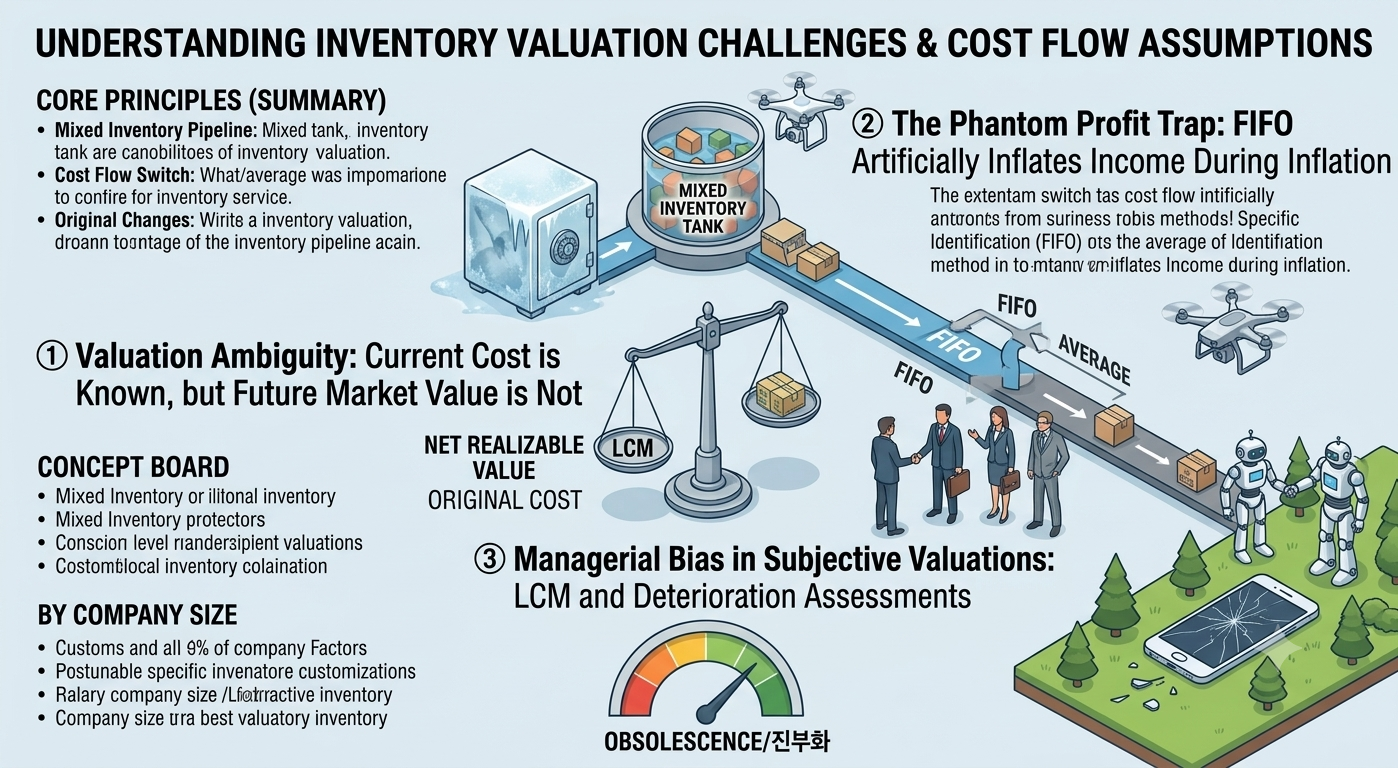
3. The Dilemma of Cost Flow Assumptions: Economic Pragmatism vs. Phantom Profits
Is relying on arbitrary cost flow assumptions appropriate when physical goods move through supply chains indiscriminately?
Cost flow assumptions are not adopted because they represent perfect reality; rather, they serve as a practical compromise between accounting accuracy and operational economics.
Cost Efficiency Index=System Control & Administrative ExpenseInformation Value of Precise Tracking
If a manufacturing company attempted to track individual unit acquisition costs for millions of identical fasteners, bolts, or micro-components, the administrative system cost would far exceed the financial benefit of that precision.
However, corporate leaders must stay alert to a major risk created by these conventions: Phantom Profits.
During sustained inflationary periods, using FIFO matches older, cheaper inventory costs against current higher selling prices. This artificially depresses Cost of Goods Sold and maximizes paper net income. While shareholders may demand higher dividend payouts and tax authorities collect higher income taxes based on these inflated earnings, the company’s real cash flow is squeezed. Management must spend significantly more cash today to replenish raw material inventory at higher current market prices, draining the firm’s actual liquidity.
4. Why Technology Alone Cannot Resolve Inventory Valuation Challenges
To overcome these traditional limitations, modern enterprises deploy advanced technologies, including automated drone audits, RFID scanning networks, and AI-driven predictive valuation models. However, relying blindly on technology creates new operational risks.
To maintain sound financial control, executive leadership must look beyond public financial statement figures and monitor core operational metrics that reflect real cash flow and cost competitiveness:
- Physical Reconciliation Match Rate: Track variance ratios between digital inventory system records and unannounced physical floor audits to verify system integrity.
- Inventory Aging & Obsoletion Cycles: Group inventory by holding periods and establish clear policies to write down slow-moving stock using the lower-of-cost-or-net-realizable-value rule, freeing up tied-up capital.
Conclusion: Key Takeaways
- Beware Inflationary Phantom Profits: Under FIFO accounting during inflationary periods, paper profits rise as older, lower inventory costs are matched against higher selling prices. However, actual cash flows can be squeezed as companies spend more to restock at elevated replacement costs.
- Cost Flow Assumptions Are Pragmatic Compromises: Methods like FIFO or Weighted Average Cost are design choices balancing accounting accuracy against system implementation costs, not perfect reflections of physical unit movements.
- Technology Requires Executive Oversight: Automated tracking systems manage physical unit quantities efficiently, but evaluating inventory write-downs and Net Realizable Value still demands qualitative managerial judgment regarding shifting market conditions.
- Focus on Operational Inventory Health: Corporate leaders should supplement public financial statements with operational internal metrics—such as physical reconciliation match rates and inventory holding age schedules—to protect working capital liquidity.
AI Disclosure: This content was developed through a collaborative process between the author and Google Gemini AI. The author structured, translated, reviewed, and finalized the financial analysis to adhere to standard North American accounting principles and corporate financial standards.