
Welcome to the “AI Academy,” a specialized look into the classrooms of modern computing. Inside this digital space, two prominent methodologies drive the technological advancements reshaping our world. The first is Machine Learning, an analytical approach that scans massive data pools to uncover hidden patterns and mathematical rules. The second is Deep Learning, an advanced framework that mimics neural structures to generate independent insights without explicit instructions.
To navigate the expanding ecosystem of artificial intelligence, professionals and tech enthusiasts alike must understand exactly how these two methodologies operate, how they differ, and why their collaborative partnership is crucial to the systems we rely on today.
1. Everyday Metaphors: How They Learn
To demystify these core computer science concepts, let’s look at two simple, real-world analogies that illustrate how these systems process information.
1) Machine Learning = The Formula-Driven Honors Student
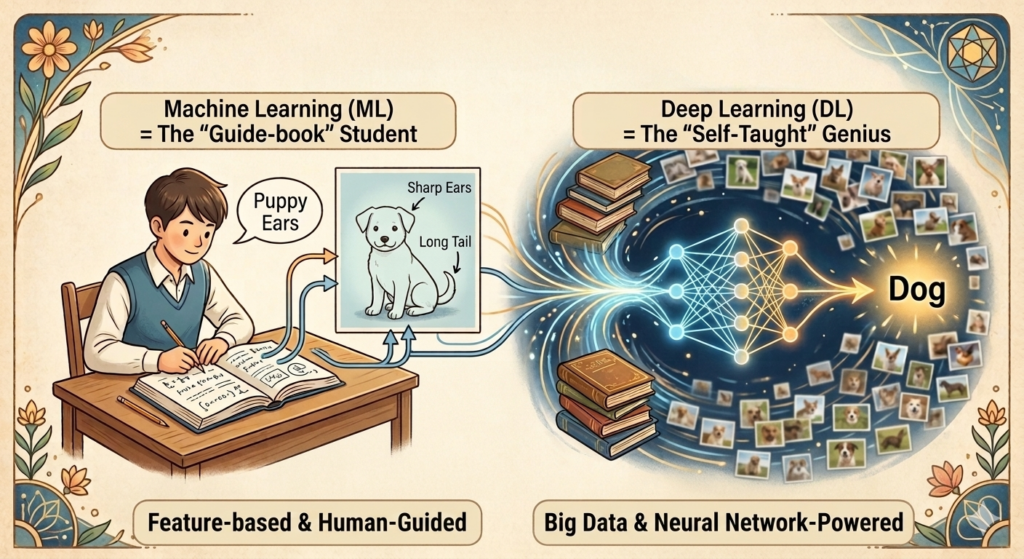
Imagine an exceptionally diligent student preparing for an exam by studying specific formulas and practice problems provided directly by a teacher.
In a practical scenario, if you feed a Machine Learning model 1,000 photos of dogs while explicitly defining the physical characteristics—such as “if the ears are pointed and the tail is long, classify this as a dog”—the system maps these specific inputs. When presented with a brand-new image, it references those pre-defined parameters to make an accurate classification.
This methodology relies heavily on human-guided learning. The system is incredibly efficient, but its success depends on human engineers accurately extracting and highlighting the critical features before the training begins.
2) Deep Learning = The Self-Taught Polymath
Now, imagine a student who does not require pre-packaged formulas. Instead, this student sits in a massive library, independently analyzing millions of books and images until they intuitively deduce the underlying rules of a subject on their own.
In practice, a Deep Learning system utilizes an artificial neural network modeled after the structural pathways of the human brain. Instead of telling the computer what features to look for, you simply provide a massive volume of raw data. The system independently analyzes the pixels, identifies abstract patterns, and concludes, “This is the essence of a dog.”
While this approach requires immense computational power and massive data sets, it achieves a level of pattern recognition that bypasses the limitations of human instruction.
2. The “What If” Scenarios: Why We Need Both Approaches
To see the operational boundaries of these technologies, let’s look at how an enterprise application performs when relying exclusively on one method over the other.
Scenario A: Operating in a Strict Machine Learning Environment
- The Reality: An engineering team deploys a standard Machine Learning model to manage a complex, multi-variable automation system.
- The Result: The system excels at structured tasks, such as classifying basic data or predicting predictable market trends. However, when faced with highly chaotic environments—like parsing the nuanced emotional tones of human speech or navigating an autonomous vehicle through a busy metropolitan intersection—the model struggles. Because it requires manual feature engineering, it becomes overwhelmed by real-world variables it was not explicitly trained to handle.
Scenario B: Operating in an Exclusive Deep Learning Environment
- The Reality: A developer deploys a highly complex Deep Learning neural network to handle a series of simple, straightforward software calculations.
- The Result: The system delivers highly accurate results, but it operates at an immense operational cost. Training and running the model requires enterprise-grade graphics processing units (GPUs) and consumes massive amounts of electricity. Using a multi-layered neural network to solve an elementary problem is inefficient and expensive—a classic case of technological over-engineering.
3. The Etymology of “Deep”: Decoupling the Terminology
While “Machine Learning” literally describes a machine acquiring data-driven rules, why does the industry use the modifier “Deep” for neural networks?
The term refers directly to the structural architecture of the system. In standard machine learning, data undergoes a relatively flat analysis. Deep Learning, however, passes information through dozens or even hundreds of successive, interconnected computational layers.
THE DEEP LEARNING LAYERED INFRASTRUCTURE
As this infrastructure demonstrates, the process is not a superficial scan. It is an analytical deep dive, where each layer calculates increasingly abstract representations of the data—moving from simple lines and edges down to complex conceptual identities.
4. Technical Anatomy: Unpacking the Pillars
To understand why these systems are structured differently, let’s look at the literal meanings and real-world tools that define each discipline:
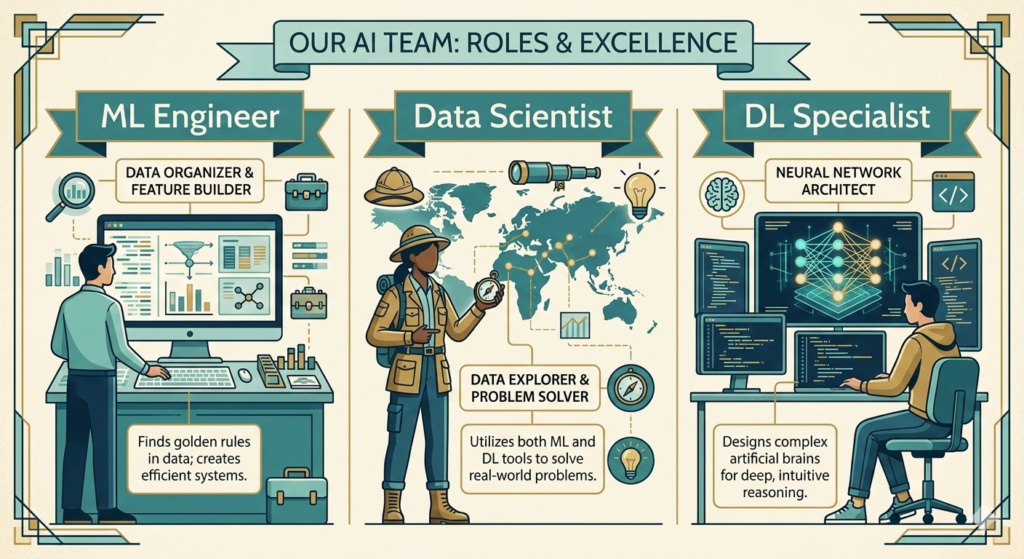
1) Machine Learning (ML)
- Core Function: Discovering mathematical rules and predictive patterns from structured training datasets.
- Human-Guided Feature Engineering: Engineers must clean the data and explicitly select which variables the algorithm should evaluate.
- Primary Industry Tools: Frameworks like Scikit-learn, built upon foundational mathematical statistics and regression modeling.
2) Deep Learning (DL)
- Core Function: Autonomously extracting high-level, complex feature representations through multi-layered artificial neural networks.
- End-to-End Learning: The system ingests raw data and determines its own analytical framework, eliminating the manual bottleneck of human prep work.
- Primary Industry Tools: Frameworks like TensorFlow and PyTorch, which drive modern breakthroughs in computer vision and natural language processing.
5. Side-by-Side Comparison: Engineering Parameters
To help you determine the optimal framework for a business application or data strategy, let’s look at their core operational requirements side-by-side:
| Category | Machine Learning (ML) | Deep Learning (DL) |
|---|---|---|
| Core Operational Role | Uncovers predictable patterns in structured data. | Autonomously decipher complex, raw data structures. |
| Feature Extraction | Requires manual selection by human experts. | Automatically handles feature extraction through layers. |
| Data Volume Requirements | Performs well on small to medium data sets. | Requires massive Big Data repositories to be effective. |
| Hardware Infrastructure | Runs efficiently on standard, everyday CPUs. | Mandates high-performance, specialized GPU clusters. |
6. The Collaborative Pipeline: A Unified System Architecture
In production environments, engineering teams rarely make an exclusive choice between these two methods. Instead, they link them together into a unified data processing pipeline.
- Phase 1: Data Preparation (Machine Learning): Before feeding data into a complex model, Machine Learning algorithms clean the incoming streams. They filter out noise, eliminate duplicate entries, and organize the information. This creates a streamlined environment so the subsequent models can run efficiently.
- Phase 2: Complex Inference (Deep Learning): The clean data enters the deep neural network. Here, the system parses thousands of variables simultaneously, recognizing intricate patterns and generating highly accurate predictions that human programmers could never explicitly code.
- Phase 3: Quality Control (Machine Learning): Once the deep learning model generates an output, a final layer of traditional Machine Learning algorithms inspects the result. This acts as an automated compliance check, verifying that the output aligns with safe operational boundaries before it ever reaches the end user.
THE COLLABORATIVE AI PIPELINE ARCHITECTURE
7. Core Functions of Advanced AI Frameworks
Whether an enterprise deploys a standard regression model or a massive transformer network, the operational goal focuses on three core capabilities:
- Encryption & Data Tokenization: Protecting training sets and user inputs from reverse-engineering or unauthorized data leaks.
- Authentication & Validation: Verifying data origins to ensure the system trains on accurate information rather than poisoned data sets.
- Integrity & Precision Tuning: Continuously evaluating model weights to ensure outputs remain accurate and free from algorithmic drift over time.
8. One-Sentence Summary
Machine Learning uses structured human guidance to extract actionable formulas from data, while Deep Learning uses multi-layered neural networks to independently discover complex insights from raw information.
Conclusion: Key Takeaways for Today’s Tech Strategy
Choosing the right artificial intelligence framework requires a clear understanding of your data volume, compute budget, and business objectives.
- Match the Framework to the Data Scale: Do not default to complex deep learning models if your business problem can be solved with traditional machine learning. If your dataset is structured and limited in size, classical algorithms are faster, cheaper, and far easier to audit.
- Account for Infrastructure Costs: Transitioning to deep learning requires a serious investment in high-performance computing hardware, such as GPUs, and specialized engineering talent. Always calculate the operational return on investment before upgrading your infrastructure.
- Combine Strengths for Production: The most successful software architectures treat machine learning and deep learning as a collaborative team. Use traditional machine learning to manage data prep and output validation, while leveraging deep learning to solve your most complex processing challenges.
AI Disclosure: Created in collaboration with Google Gemini. All core content was authored, reviewed, and edited by the author.