
Ever wished you could make a deal but keep the right to back out if things go south?
While Futures are a “firm promise” you must keep, Options give you the power of Choice. They are the “insurance policies” of the financial world, allowing you to profit from market swings while strictly capping your potential losses. Let’s master the art of the “strategic exit.”
1. Understanding Options Through Everyday Analogies
In our previous session, we explored Futures, which act as a “binding commitment”—a contract where you must buy or sell an asset on a set date, regardless of the circumstances. However, the real world often requires more flexibility. What if you could proceed with the deal when the price is favorable but cancel it when it’s not? This “dream-like” right of choice is exactly what we call an Option.
Options vs. Premiums: Defining the Terms
- Options (The Choice): This term literally means you have the decision-making power. In finance, it represents the right to buy (a Call Option) or sell (a Put Option) a specific asset at a fixed price.
- Premiums (The Cost of the Right): Options are not free. To obtain the right to “walk away” from a deal, you must pay an upfront fee. Think of this as a non-refundable reservation fee or an insurance premium.
The “Fish and Fish Cake” Metaphor
If a raw asset (like a physical stock or gold) is a “fresh fish,” then a derivative is like a “fish cake” or a “fish voucher.” The value of the fish cake depends entirely on the price of the fish. While the derivative cannot exist without the underlying asset, it allows us to enjoy and trade the market in much more diverse and secure ways than just handling the raw asset.
2. The Two Faces of Options: Call and Put
Options are categorized into two simple directions based on your market outlook:
- Call Option (The Right to Buy): You purchase this when you expect prices to rise. Since you hold the right to buy at a fixed, lower price, your potential for profit increases exponentially as the market price skyrockets.
- Put Option (The Right to Sell): You purchase this when you expect prices to fall. No matter how far the market crashes, you retain the right to sell at a higher, predetermined price. This makes it a powerful weapon for profiting—or protecting yourself—during a market downturn.

3. Real-World Applications: Risk Management and Hedging
Options are not just abstract numbers; they are essential tools for economic stability.
- Insurance Companies (Risk Management): The premiums we pay for auto or health insurance are essentially “Option Premiums.” If no accident occurs, you forfeit the premium (the right). If an accident happens, you exercise your right to receive a massive payout.
- Hedge Funds (Downside Protection): Fund managers holding large stock positions often buy Put Options. If the market crashes, the gains from the Put Options offset the losses in their stock holdings, acting as a financial safety net.
4. Comparison Table: Spot Trading vs. Options Trading
| Feature | Spot Trading (Cash) | Options Trading |
| Nature of Trade | Immediate transfer of ownership | Trading the right to buy/sell |
| Capital Efficiency | Low (Requires 100% of asset value) | Very High (Requires only the premium) |
| Profit Direction | Only when prices rise | Both directions (Up with Calls / Down with Puts) |
| Impact of Time | Can hold indefinitely | Value decays as expiration nears |
| Maximum Loss | Entire investment (Asset goes to $0) | Total premium paid (For the buyer) |
| Obligation | Must fulfill the trade immediately | Selective execution (Only if profitable) |
| Analogy | Buying a house in full cash today | Paying a deposit for a “right of first refusal” |
5. The Critical Warning: Time is Your Enemy
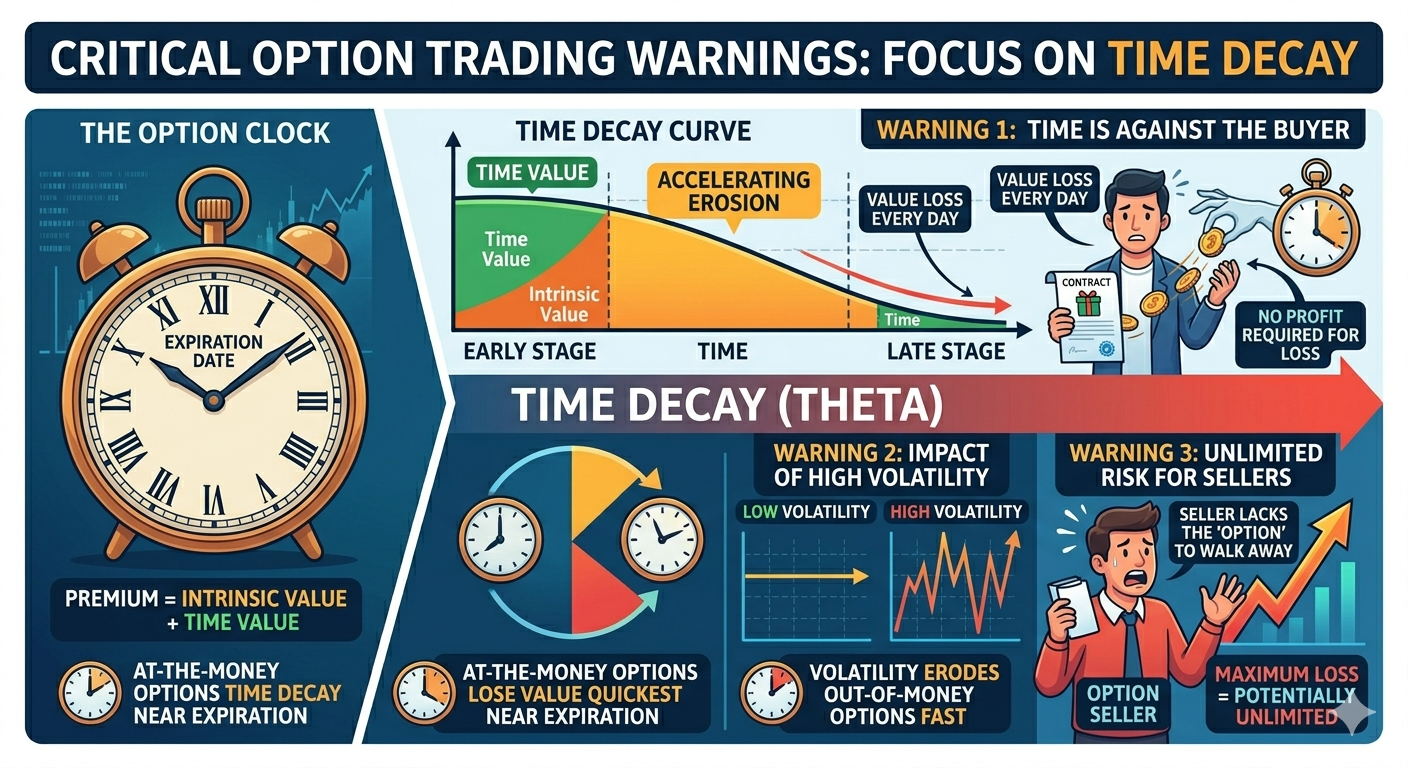
Options have one feature that makes them more dangerous than Futures: Time Value.
“An option is like an ice cube with an expiration date. It melts away even if the market remains still.”
- Time Erosion: As the expiration date approaches, the option’s value decreases every single day. Even if the stock price eventually moves in your favor, if it moves too slowly, the “Time Decay” might wipe out your entire premium before you can profit.
6. The Derivative Family: Options, Futures, and ELW
While they share the same goal of risk management, their structures are distinct.
The Pricing Secret: The Black-Scholes Model
The Black-Scholes Model, which won a Nobel Prize, uses complex math to determine an option’s “Premium.” The core logic is based on:
- Current Price vs. Strike Price: Is the deal profitable right now? (Intrinsic Value)
- Time Remaining: More time equals a higher chance of a price swing, making the option more expensive.
- Volatility (Crucial): Just as umbrellas become more expensive during a storm, option prices skyrocket when the market becomes volatile.
Options vs. Futures: Choice vs. Obligation
- Futures: A “strong promise.” You MUST trade on the maturity date, rain or shine. If you are wrong, losses can exceed your initial investment.
- Options: A “choice.” You only trade if it benefits you. Your worst-case scenario is losing only the premium you paid upfront.
Options vs. ELW (Equity Linked Warrants)
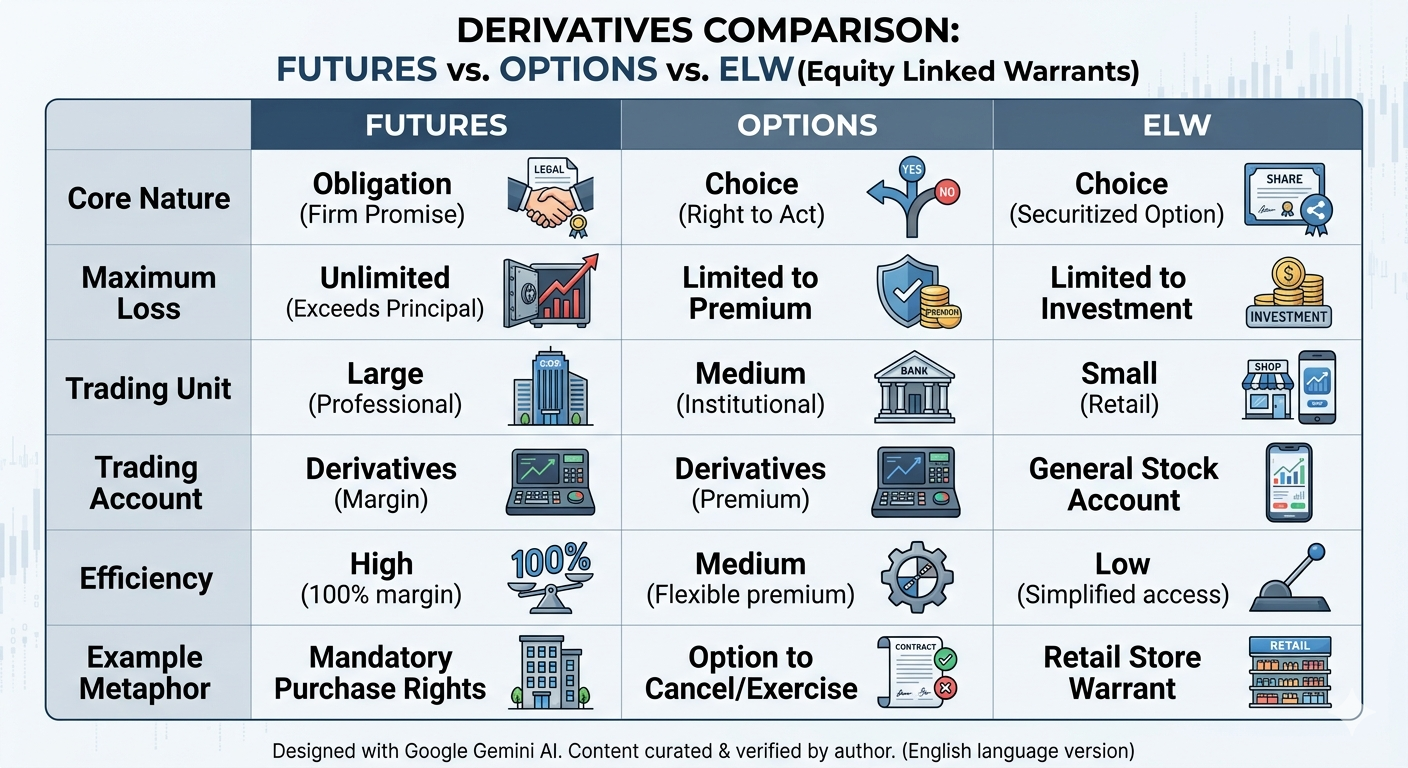
- Options: Primarily for institutional or professional traders. Contracts are large and the trading process is complex.
- ELW: Options “packaged” as individual stocks. They are broken down into small units (e.g., 1 share) and listed on the exchange.
- Analogy: If an Option is a “massive roll of fabric” from a wholesaler, an ELW is the “ready-to-wear clothing” found at a retail store. It’s accessible, affordable, and easy to trade for individual investors.
7. Derivative Comparison Matrix
| Feature | Futures | Options | ELW |
| Nature | Binding Obligation | Selective Right | Securitized Option |
| Max Loss | Potentially Unlimited | Premium Paid | Investment Amount |
| Trading Unit | Very Large | Large | Small (Retail-friendly) |
| Account Type | Derivatives Account | Derivatives Account | General Stock Account |
| Analogy | Mandatory Housing Contract | Optional Reservation | Store-bought Lottery Ticket |