
In modern business, accounting is far more than a dusty ledger recording past transactions. It is the “Digital Neural Network” of a living, breathing corporate entity. This network, however, speaks to us in three distinct languages, each serving a unique strategic purpose.
First, there is Financial Accounting, which diagnoses the company’s health from an external perspective. This is the official “Report Card” shared with shareholders and investors, capturing past performance within a standardized framework.
When we turn our gaze inward, the tone changes completely. Cost Accounting acts as a “Precision Diagnostic Tool,” tracking the exact cost of every unit produced to uncover the true source of profit.
Finally, stepping even further, Managerial Accounting serves as the “Strategic Navigation Compass,” using collected data to predict the future and make the high-stakes decisions that determine business success or failure. Let’s explore these three pillars one by one.
1. Evolution: The Flow of Accounting in the AI Era
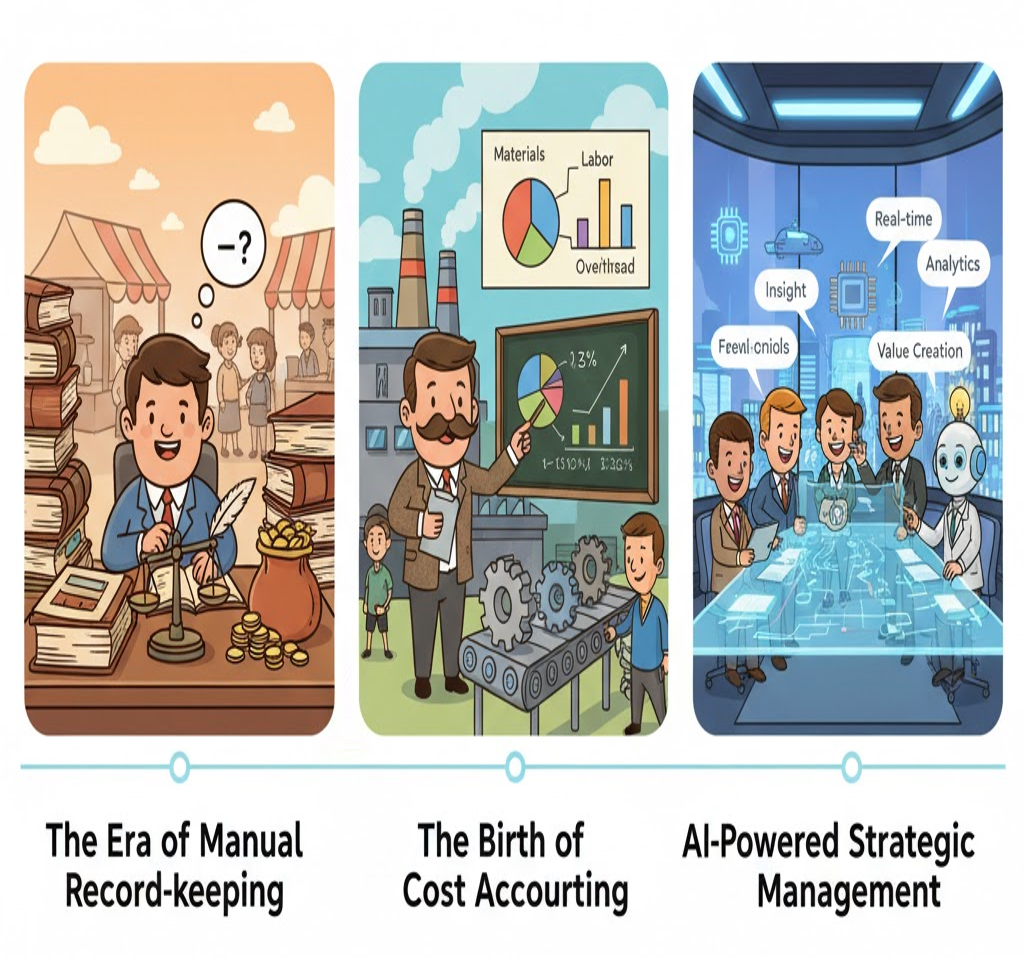
Before the Industrial Revolution, when small-scale commerce was the norm, bookkeeping was a passive tool—merely recording the “Inflow and Outflow of Cash.” It was essentially “Wallet Management.” However, as industry scaled, companies demanded “Analysis” rather than mere “Recording.”
1) Industrialization and the Birth of Cost Accounting (Early 20th Century)
- The Backdrop: As massive factories emerged and mass production systems were built (think Ford’s Model T), simple cash tracking reached its limit.
- The Core Question: “Exactly how much raw material and labor did we sacrifice to build these 100 units?”
- The Result: Cost Accounting was born. By allocating internal factory costs to individual product units, a foundation was laid to calculate exactly what and how much to produce to generate a profit.
2) The Managerial Revolution and Decision-Making (Mid-20th Century)
- The Backdrop: As corporations grew into bloated conglomerates and markets became volatile, “Post-Mortem Reporting” (simply summarizing the past) was no longer enough for survival.
- The Core Question: “Based on these past figures, which new product line should we invest in next month to maximize our ROI?”
- The Result: Managerial Accounting emerged. Accounting moved beyond the “After-the-Fact Report” to become a strategic tool for budgeting, capital allocation, and future forecasting—the “Compass of Management.”
3) The Era of Strategic Cost Management (21st Century & AI)
- The Backdrop: In hyper-competitive markets like AI Semiconductors (e.g., Intel vs. NVIDIA), simply cutting costs isn’t enough. Value creation itself determines survival.
- The Core Question: “How do we engineer costs starting from the design phase, and how do we redesign our profit structure for a shifting market?”
- The Result: Evolution into Strategic Cost Management (SCM). Accounting information is now used as “Real-Time Resource Intelligence,” serving as the most powerful weapon for executives to win amidst global uncertainty.
2. Understanding Through Everyday Analogies
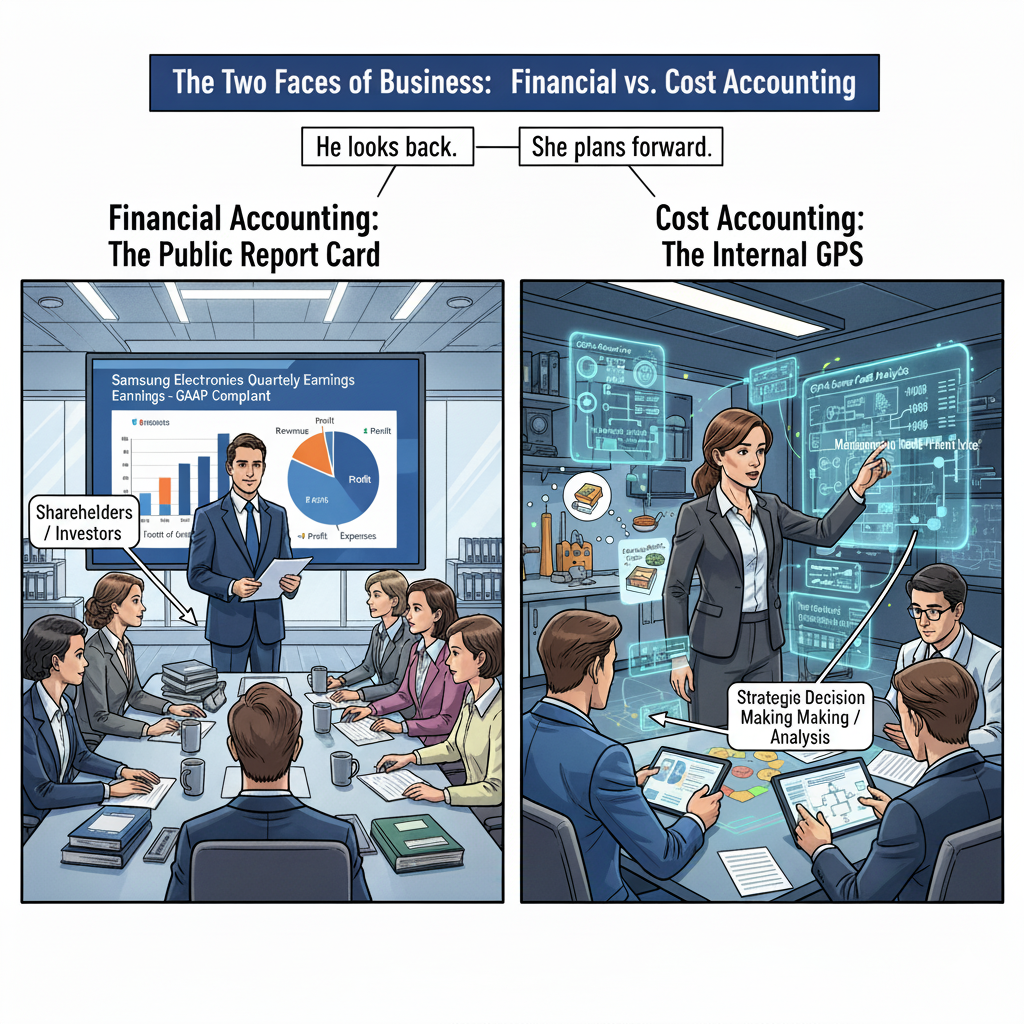
1) Financial Accounting = “The Official Corporate Report Card”
- The Analogy: A summary of a household’s annual spending and earning.
- The Characteristic: It must be prepared transparently according to strict rules (GAAP/IFRS) for external investors and banks.
- Real-World Scenario: The “Operating Income” reported by Apple in its quarterly 10-Q filing is the ultimate product of Financial Accounting.
2) Cost Accounting = “The Precision Diagnostic Device”
- The Analogy: A “Recipe Analysis” that calculates the exact cost of ingredients and labor required to serve one specific dish.
- The Characteristic: It doesn’t need to be shared with the public, but it is essential for a manager to set the right price and identify waste.
- Real-World Scenario: When OpenAI calculates the server cost incurred per single ChatGPT prompt to determine its subscription pricing, that is Cost Accounting in action.
3. Academic Objectives: Internal vs. External
1) The Objective of Financial Accounting
- External Orientation: Provides information to external stakeholders such as shareholders, banks, and the IRS.
- Regulatory Compliance: Must strictly follow accounting standards like U.S. GAAP or IFRS.
- Past-Oriented: Focuses on finalizing and reporting the management performance of the previous period.
2) The Objective of Cost Accounting
- Internal Orientation: Provides data so management can set prices, establish budgets, and improve efficiency.
- Autonomy: Can be operated flexibly to fit the company’s specific internal needs.
- Future-Oriented: Uses collected data to design and control future profitability.
4. The Critical Difference: Who, Why, and When?
- The Beneficiary: Financial Accounting is for the “Outsider,” while Cost Accounting is for the “Internal Manager.”
- The Time Horizon: Financial Accounting emphasizes “Historical Reporting,” whereas Cost Accounting emphasizes “Proactive Planning and Control.”
An Illustrative Analogy:
If a restaurant owner creates a “Monthly Sales Summary” for tax filing, that is Financial Accounting. If the head chef breaks down the cost of raw ingredients and utilities to set the price on the menu, that is Cost Accounting.
The Missing Link:
The “Product Cost” calculated in Cost Accounting is recorded as an “Asset” (Inventory) on the Balance Sheet in Financial Accounting. The moment the product is sold, this asset transforms into an “Expense” (COGS) on the Income Statement. In essence, Cost Accounting records the “Flow of Value” that forms the very foundation of Financial Accounting.
5. Cost Accounting vs. Managerial Accounting
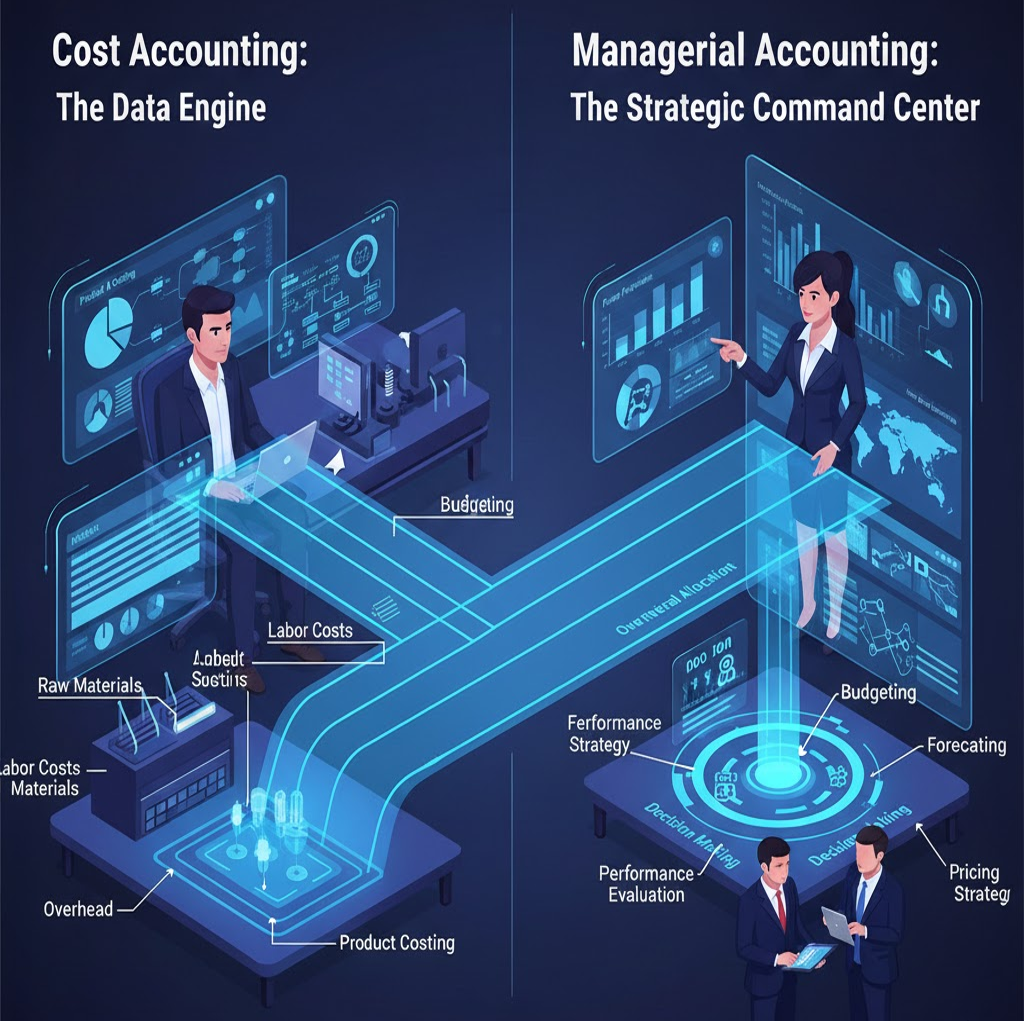
Modern accounting has evolved into the era of Resource Intelligence. Cost Accounting is the engine, and Managerial Accounting is the steering wheel.
1) Cost Accounting: The Diagnostic Engine
- Role: Precisely tracks and aggregates every cost (Materials, Labor, Overhead) involved in making a single product.
- Core Question: “How efficient is our manufacturing? Are there any wasted resources?”
- Value: Maximizes internal operational efficiency to secure price competitiveness.
2) Managerial Accounting: The Strategic Compass
- Role: Develops future business strategies based on the detailed data provided by Cost Accounting.
- Core Question: “How much should we produce? What is the optimal price to maximize profit when the market shifts?”
- Value: Provides predictive models and performance metrics to help leaders make better decisions in an uncertain future.
3) The Strategic Synergy
Cost Accounting is the “Analysis” of what happened and why, while Managerial Accounting is the “Strategy” of where to go next. Without Cost Accounting, the Compass has no data; without Managerial Accounting, the Engine has no direction.
6. At a Glance: The Triple Comparison Table
| Feature | Financial Accounting | Cost Accounting | Managerial Accounting |
| Primary Goal | External Reporting | Production Analysis/Efficiency | Strategic Decision Making |
| Time Horizon | Past (Result-Oriented) | Past/Present (Aggregation) | Future (Prediction/Planning) |
| Primary Users | Investors, Creditors, Regulators | Factory Managers, Ops Teams | C-Suite, Strategy Teams |
| Rules | Strict (IFRS/GAAP) | Internal (Flexible) | Internal (Customized) |
| Scope | Total Entity | Products, Services, Processes | Departments, Projects, Future Lines |
| Nature | Disclosure | Analysis | Strategy |
Conclusion: Key Takeaways
- Accounting is Multilingual: To lead a company, you must speak Financial for your investors, Cost for your operations, and Managerial for your future.
- Data-Driven Leadership: Success in the AI era depends on Resource Intelligence—knowing exactly where your value comes from and where it should go.
- The Ultimate Weapon: The perfect harmony of these three accounting branches is the most powerful strategic weapon for any modern enterprise.
AI Disclosure: Created in collaboration with Google Gemini. All core content was authored, reviewed, and edited by the author.