
Have you ever noticed how everyday English words suddenly take on a completely different, almost cryptic meaning the moment they enter the world of Artificial Intelligence? If you have ever felt confused by this phenomenon, you are definitely not alone.
One of the most frequently used—and misunderstood—terms in this new era is the word “Token.” Why does this word change its shape and definition when we talk about Large Language Models (LLMs) like GPT or Claude? Today, we are going to dive deep into the world of AI architecture to uncover exactly what a token is, where the term comes from, and why it matters to you.
1. In Everyday Life: A Symbol of Trust and Value
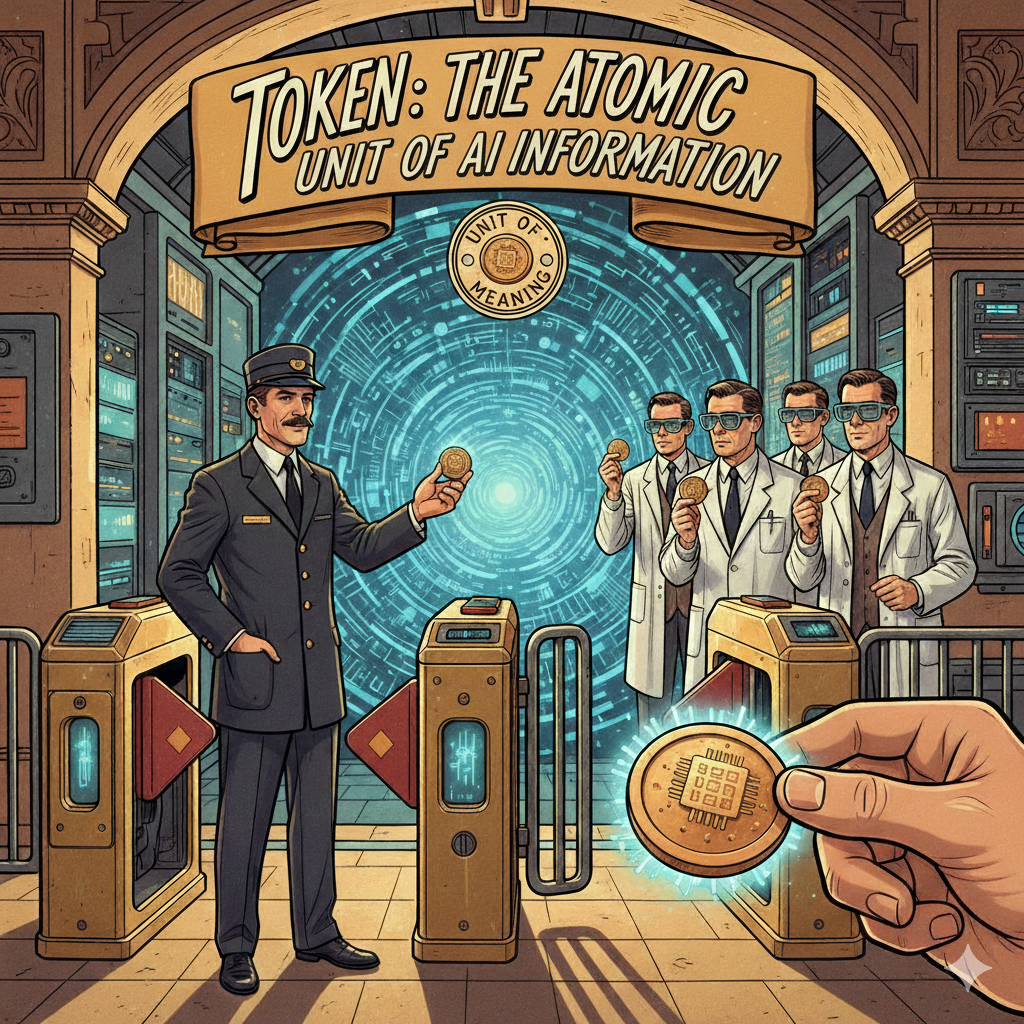
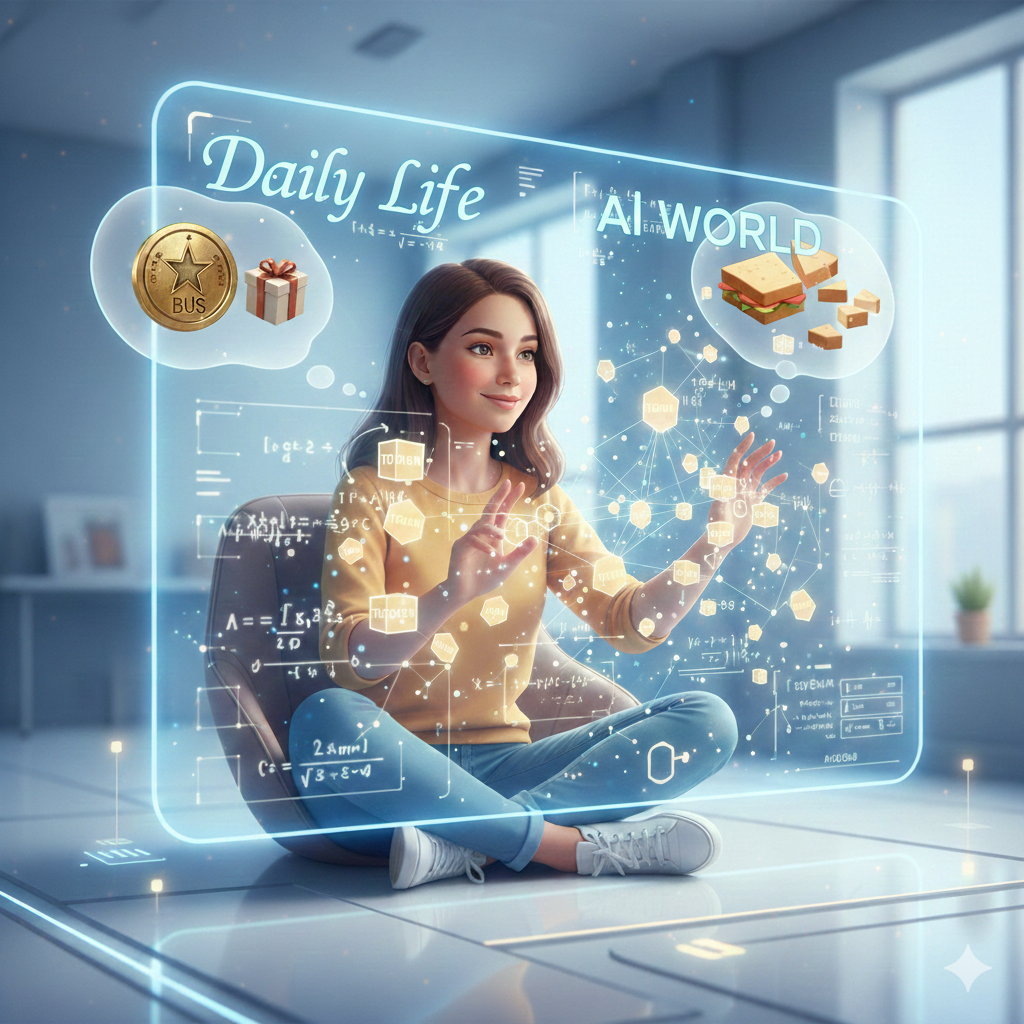
Before it became tech jargon, a token was something you could hold in your hand. For many of us, the word triggers a bit of nostalgia. You might think of the brass transit tokens with a hole in the middle that you used to ride the subway or bus, or the metallic coins you dropped into arcade machines to start a game. In these contexts, a token was always a physical placeholder—a “representation of value” or a “promise” that guaranteed you access to a service or a destination.
Even in literature and daily conversation, the core meaning remains the same. “Token” originally stems from an Old English word meaning a sign, symbol, or evidence of something. When you give someone a small gift and say, “Please accept this as a token of my appreciation,” you are using the object to symbolize a deeper, unseen sentiment: your gratitude.
2. In the AI and IT World: The “Bite-Sized” Pieces of Language
When we transition into the digital landscape of Machine Learning, the physical coin disappears, but the concept of a fundamental unit remains.
To put it simply: A token is the absolute smallest unit of data processing that an AI uses to understand and generate human language.
Computers do not process human language the way we do. An AI model cannot swallow a whole sentence or a massive paragraph in one single gulp. To make sense of our world, the system must break text down into digestible, bite-sized pieces—much like cutting food into small chunks before eating.
For example, when you type the phrase “I am happy today,” the AI’s processing system doesn’t see it as a single thought. It slices the sentence into segments: “I / am / happy / today.” Each of these individual segments is a token. It is the core currency of computation, the foundational seed from which the AI extracts meaning and builds its responses.
3. The Origin Story: Why “Token”?
How did computer scientists land on this specific term? The origin lies in early computer science and compilation theory.
Decades ago, when engineers were trying to teach machines how to read programming languages and human text, they faced a massive wall: natural language is messy, full of nuances, and highly unpredictable. To force a rigid, mathematical machine to calculate human expressions, they needed a system to break text into strictly defined, verifiable elements with distinct structural values.
The logic went something like this: “We need the computer to analyze text systematically. Let’s chop human sentences into small, verifiable units that have a clear, fixed value for the system—just like token coins used at a turnstile.”
Thus, the word “Token” was adopted. Today, it represents the bridge between human thought and machine calculation. When you look at it this way, tech terminology feels less cold and mechanical. Tokens are simply the building blocks the AI uses to carefully curate, organize, and comprehend our ideas.
- Token: The fundamental unit of information that an AI uses to process, calculate, and understand human language. It is the “atomic unit” of AI data.
- Tokenization (Tokenizing): The crucial preprocessing step where a system takes raw text and slices it into individual tokens, clearing the path for the AI to compute the data.
4. Cleared Up: Token vs. Word vs. Chunk
It is incredibly easy to confuse tokens with other linguistic units. Let’s break down the technical differences so you can talk about AI architecture like a pro:
| Category | Technical Definition | Practical Example |
| Token | The actual mathematical unit recognized by the AI’s neural network. | Can be a whole word, a part of a word (sub-word), or even a single punctuation mark. |
| Word | The grammatical unit of language used by humans in daily speech. | A standard vocabulary word (e.g., “Incomprehensible”). |
| Chunk | A collection of multiple tokens grouped together to maintain semantic context. | A phrase, a sentence, or a paragraph retrieved during data processing. |
In English, a good rule of thumb is that one token equals roughly 4 characters or 0.75 words. Therefore, a text block containing 1,000 tokens translates to approximately 750 English words.
5. Common AI Concepts Involving Tokens
As you navigate the business and tech landscape, you will encounter the word token attached to several critical concepts:
- Token Limit (Context Window): This refers to the maximum number of tokens an AI model can read, process, or remember in a single interaction. Think of it like a theater’s maximum capacity; once the seats (token slots) are full, you cannot bring in any more information without pushing older data out.
- Tokenizer: The specialized algorithmic tool that automates tokenization. It acts as the high-speed industrial slicer that prepares raw paragraphs into uniform data segments for the model.
- Security Token: Moving slightly outside of LLMs, this is a digital key used in cybersecurity to authenticate identity. It allows systems to verify who you are securely without requiring you to re-type passwords constantly.
- NFT (Non-Fungible Token): In the blockchain space, this is a unique digital certificate stored on a ledger that proves ownership of a specific asset, guaranteeing authenticity in a digital world.
6. Who Controls the Token Economy?
Tokens are not just a technical metric; they are the primary business model for major tech corporations and digital ecosystems:
- OpenAI (GPT-4o): As the creators of the world’s most widely adopted AI models, OpenAI structures its commercial API pricing entirely around token consumption. Businesses are billed based on the exact number of input tokens sent in a prompt and output tokens generated in the response.
- Anthropic (Claude): Renowned for engineering industry-leading “Context Windows.” Anthropic’s models excel at ingestion, allowing users to drop entire novels, financial audits, or massive codebases (amounting to hundreds of thousands of tokens) into a single prompt.
- Ethereum (ERC-20): Shifting to Web3, this protocol established the universal standard for creating fungible digital assets, allowing developers worldwide to launch their own cryptographic tokens on the blockchain.
- Auth0 by Okta: A pillar in enterprise identity management, this service safely issues security identity tokens to manage user authentication and access control across thousands of corporate applications.
Conclusion: Key Takeaways for Today’s Tech-Driven World
Understanding the mechanics of a token gives you a clearer view of how the digital future is being built.
- It’s All About Efficiency: AI doesn’t think like a human; it calculates text. Tokens are the vital bridge that transforms organic human conversation into structured, computational data.
- Watch Your Footprint: In the enterprise AI landscape, tokens equal cost. Optimizing your prompts to use fewer tokens directly improves operational efficiency and lowers your API bills.
- The Seed of Intelligence: Just as transit tokens once carried us to physical destinations, digital tokens are the semantic seeds carrying our thoughts into the realm of artificial intelligence, delivering us to the answers we seek.
AI Disclosure: Created in collaboration with Google Gemini. All core content was authored, reviewed, and edited by the author.